Showing posts with label Houdini 3. Show all posts
Showing posts with label Houdini 3. Show all posts
Tuesday, August 20, 2013
Enlightened by Houdini
It's always educational to analyze one's games, even "stupid" games like online blitz games, with a strong engine like Houdini. In the following game, for example, I made a major tactical hiccup on move 10, which should have dropped a piece - to which I, and apparently also my opponent, were oblivious. Then I did something right, exploiting his inaccuracy on move 15, and got "an easily won game." I blundered on move 23 with a "loose" move, which he exploited with a tactic that should have left me scrambling for a draw. But just two moves later he fell into a back-rank trap that left me in an ending an exchange up. Thanks to the wonders of premove, I was able to convert it into a win despite the dearth of time on my clock.


Tuesday, July 2, 2013
A trap in the King's Indian?
The best-scoring line against the King's Indian Defense is the flexible 5.h3! 0-0 6.Bg5! In Mega Database 2013, White scores a gaudy 64.6% in 2938 games! That is better than he does against garbage like the Englund Gambit, where he only scores 57.7% in 1280 games in the main line (1.d4 e5? 2.dxe5 Nc6 3.Nf3 Qe7) - although White does get 66.8% with 4.Qd5!, almost forcing Black to make his pawn sac permanent with 4...f6, when White's best-scoring line is 5.exf6 Nxf6 6.Qb3 d5 7.Bg5! (82.7%, but with a tiny sample size - only 27 games). But I digress.
The 5.h3 0-0 6.Bg5 line also sets a little trap: Black's most natural and thematic move, 6...e5, is here a blunder, dropping a pawn to 7.dxe5 dxe5 8.Qxd8 Rxd8 9.Nd5! GM Yury Shulman in his lecture at the North Shore Chess Center last year discussed a 1996 game in which he fell into this trap. Though disgusted with himself, he played on as though nothing had happened. He went on to roll his 2460-rated opponent like a joint, as NM Marvin Dandridge would say:
Where did White go wrong? According to Houdini 3, the natural 11.Nxc7 was already a small inaccuracy, and 12.Nd5 a more serious one. After 12...h6! White had to surrender his dark-squared bishop for Black's knight. This is a big positional concession, as Black's unopposed dark-squared bishop will be a holy terror once it sets up camp on c5. Black already had sufficient compensation for his accidentally sacrificed pawn, and White's game went downhill from there. (Note that all numerical assessments in this and the following game are by Houdini 3.)
How should White play? As I say, Houdini says that 11.Nxc7 is already a little inaccurate. But 11.0-0-0, White's most successful move (3-0 in Mega 2013), is actually a blunder. As I indicate in my notes to the above game, Houdini then analyzes 10...Rf8 11. Nxc7 Nxe4! as leading to equality. White's best move is instead 11.Rd1!, threatening to win a piece with 12.Nxf6+. Note that unlike the similar 11.0-0-0 it does not leave f2 vulnerable to a knight fork. After 11.Rd1!, Black must lose a tempo with 11...Rf8, and now 12.Nxc7 Rb8 13.f3! leaves White with an advantage that Houdini assesses as +1.32.
This line is seen in the following game. Incidentally, the note to Black's 9th move is very interesting. Houdini considers 9...Nbd7, dropping the c-pawn and leading to a position where White has a +1.32 advantage, inferior to surrendering the exchange with either 9...Nxd5 10.Bxd8 Nf6 (+0.94) or 9...Rxd5 10.cxd5 Ne4 (+1.09).
Friday, April 5, 2013
Queen sac-a-palooza
This is a fun game, concluding with two pseudo-queen sacrifices, but Houdini as usual points out improvements for me. Obvious ones. D'oh! This game upped my record on GameKnot.com to 29-0.
Monday, March 25, 2013
Beauty and the (Silicon) Beast
I was very pleased with the following blitz game, which ends with a queen sac and a beautiful mate administered by Harrwitz bishops. But Black could have avoided mate with 8...Kd8!, though he's still quite lost. When I analyzed the game later with Houdini 3, it pointed out an even clearer win for me on move 8! Do you see it?
Saturday, February 9, 2013
Never say die! redux
Last Christmas I published Latino-Dumas, a game in which White on move 3 hung an entire piece to a queen check. Rather than resigning (as some others had done in the same position), Latino played on and went on to win the game! Here's a similar example: White blunders a piece on move 5, also to ...Qa5+, yet goes on to win. White's 6.Nc3 is an improvement on GM Ivan Farago's "Resigns," as in Farago-Bliumberg, 1994. To be precise, 6.Nc3! had been seen before, in Kunte (2536!)-Varga (2494!), 2008. That game ended in a draw!
How strong was the loser of our subject game, who won a whole piece on move 5, but went on to lose? She is Anna Ushenina, who at the time of this game was rated 2458. Later in the year, she went on to win the Women's World Championship, thereby automatically becoming a grandmaster.
It's fascinating to analyze this game with an engine. How could a strong player go from being a clear piece up to losing the game? She didn't play a terrible blunder, but rather a number of second-best moves: 11...b5 (11...Qb4! 12.Qe2 Bxd4-+), the weakening 14...gxf5?! (14...O-O), 20...Bb7?! (20...Qb5), the decentralizing 21...Nh5?!, 23...a5? (23...Nhf6!), and 24...Bg7? (24...Nhf6!). Her final mistake was 25...Ndf6? According to Houdini 3, she would still have kept a large advantage with 25...a4!, driving the bishop off the a2-g8 diagonal, e.g. 26.Bd1 Ndf6 27.Be2 (27.e5 c5! 28.exf6 Nxf6!) Kf8 28.Nd6 exd6! 29.Bxb5 cxb5 30.d5 Re8. Of course, all of this is much easier to see with Houdini, rather than a ticking clock, next to you.
The moral(s) of the story? Don't expect a "won game" to win itself. Stay alert and try to play the most accurate and incisive moves. Don't be afraid to give back some material to simplify the position into one that you can win more easily and/or gives the opponent fewer counterchances.
On the other side of the board: if you have a losing position, don't mentally give up the game. Keep the position complicated, and keep setting problems for your opponent. Be alert to tactical chances. Don't resign unless you have no realistic chance of winning or drawing the game. (This will vary depending not only on the position, but also on your strength, your opponent's strength, and the clock situation. Ushenina would probably have won this game if at had been played at a standard time control rather than rapid.)
Friday, February 8, 2013
A positional draw
It is theoretically possible for a lone bishop, in certain very rare situations, to draw against two rooks. The bishop must be pinning one of the rooks against the enemy king, the bishop must have at least one additional square available to it on the pinning diagonal, the defender's king must also be attacking the rook, and the attacker's other rook and king must be tied up defending the rook. The "free" rook must be placed in such a way that it cannot check the defending king or pin the defending bishop. See diagram below.
Problemists have long known of this type of drawing position. It is also mentioned in some practical books, for example Ludek Pachman's Attack and Defence in Modern Chess Tactics. In actual practice, it is an extremely rare bird. Mega Database 2013 has about 5.5 million games. The position after Black's 75th move is the only example of this positional draw.
I remember being amazed when I first encountered this idea almost 40 years ago, in a comment by Manfred Zitzman in Robertson Sillars' "Reader's Showcase" column in Chess Life & Review (the magazine known today as simply Chess Life). (As I recall, Zitzman and his opponent might have reached such a position in their game, but didn't actually do so. Zitzman proposed calling this type of situation "the Zitzman theme," until readers pointed out that problemists had conceived this idea long before.)
Despite White's huge material advantage, he cannot make progress. If he waits with Rb5/c5/d5/e5, Black does the same by shuffling his bishop from h7 to g6 and back again. White's only winning try is to give up his rook and try to win the resultant rook versus bishop ending (a book draw). Adams realized this and immediately gave up his rook, but it was still a draw.
Incidentally, this sort of positional draw is one of the few instances where we humans can feel superior to chess engines. If one shows this position to Houdini 3 (for example), it is utterly unimpressed. It gives White a +6.17 advantage - a trivial win! Asked how it proposes to win, it produces 76.Rc5 Bg6 77.Rd5 Bh7 78.Re5 Bg6 79.Rc5, and keeps going that way until it's on the brink of a three-time repetition. Then it finally gives up the rook and changes its evaluation to +0.32 (small advantage to White).
Friday, November 23, 2012
The perfect Christmas present for the chess player on your list
... is Houdini 3, the latest version of the world's strongest chess engine.
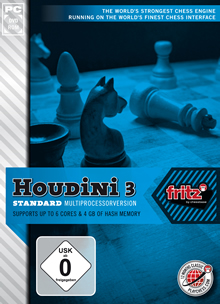
USCF Sales is running a Black Friday sale through Sunday: you can buy the Standard Edition of Houdini 3 for something like $85 dollars all in (Media Mail shipping) if you use the coupon code BLACKFRIDAY. (I am not a big fan of USCF Sales, but this is ten clams cheaper than what I paid last week.)
Or if you have Amazon Prime, you can buy Houdini 3 for $84.95 (price updated 11/25/12) and have it two days later.
My guess is that 95% of users won't have any need for Houdini 3 Pro. This souped-up version supports 32 cores and 256 GB of hash memory, as opposed to the standard version's "measly" 6 cores and 4 GB of hash. I suspect that the difference in analysis strength is not noticeable in most cases, and that most grandmasters would find the standard version more than adequate for their needs. (And Houdini can suck up all system resources if you let it: on a quad-core machine, I only use three cores for analysis.) But if you can afford the extra $20, the lucky giftee might find the pro version marginally more useful: hobbyists interested in computer vs. computer play and correspondence players might be most likely to benefit.
I really like the DeepFritz 13 user interface, and even find the contextual Microsoft Office 2010 interface somewhat less annoying that I did when using Rybka 3 Aquarium. While there's a handy "Goto Chessbase" feature for ChessBase users, I havn't been able to install the Houdini 3 engine directly in ChessBase. But that's my only complaint so far: this is truly great software! I hope to have a fuller review before Santa loads the sleigh.
For those of you on a budget: earlier versions of Houdini are available to download free of charge. See this earlier blog post for details.
USCF Sales is running a Black Friday sale through Sunday: you can buy the Standard Edition of Houdini 3 for something like $85 dollars all in (Media Mail shipping) if you use the coupon code BLACKFRIDAY. (I am not a big fan of USCF Sales, but this is ten clams cheaper than what I paid last week.)
Or if you have Amazon Prime, you can buy Houdini 3 for $84.95 (price updated 11/25/12) and have it two days later.
My guess is that 95% of users won't have any need for Houdini 3 Pro. This souped-up version supports 32 cores and 256 GB of hash memory, as opposed to the standard version's "measly" 6 cores and 4 GB of hash. I suspect that the difference in analysis strength is not noticeable in most cases, and that most grandmasters would find the standard version more than adequate for their needs. (And Houdini can suck up all system resources if you let it: on a quad-core machine, I only use three cores for analysis.) But if you can afford the extra $20, the lucky giftee might find the pro version marginally more useful: hobbyists interested in computer vs. computer play and correspondence players might be most likely to benefit.
I really like the DeepFritz 13 user interface, and even find the contextual Microsoft Office 2010 interface somewhat less annoying that I did when using Rybka 3 Aquarium. While there's a handy "Goto Chessbase" feature for ChessBase users, I havn't been able to install the Houdini 3 engine directly in ChessBase. But that's my only complaint so far: this is truly great software! I hope to have a fuller review before Santa loads the sleigh.
For those of you on a budget: earlier versions of Houdini are available to download free of charge. See this earlier blog post for details.
Subscribe to:
Posts (Atom)