For Halloween, I present one of the most horrifying games ever - and played in the Halloween Open, no less. I refer, of course, to the dreaded Tomb Game: Harper-Zuk, Halloween Open 1971. If White's position doesn't give you nightmares, nothing will.
Showing posts with label zugzwang. Show all posts
Showing posts with label zugzwang. Show all posts
Tuesday, October 30, 2012


Tuesday, September 18, 2012
King and Pawn vs. King (Chess Homeschool, Day 6)
If we can't play positions with three pieces reasonably well, what hope is there for us with thirty-two pieces on the board?
I'm not providing solutions to any of the positions below yet: get Mom or Grandpa to play the other side and see whether the two of you can figure this out together.
Usually, you want it to be your turn to move. Here, neither player wants to be on move! (Nerd alert: the technical term is reciprocal zugzwang.) When both kings can make it to the pawn's queening square, each player is trying to trick the other into a position like the one above.
In one-on-one basketball, what does the player with the ball do when the defender is in perfect position? Maybe a head fake: the attacker wants the defender to move in one direction so she can drive the lane in the other direction. The pawn's queening square (d8 in Position 4) is like the basket, and the Black king on d7 is a perfectly-placed defender: that's why Black doesn't want to move first! 1...Kc7 2.Ke6 or 1...Ke7 2.Kc6.
To understand Black's drawing technique with White to move, see Vince Hart's blog post, Straight Back Draws. Compare Position 4 to Position 2: Position 2 is always lost because the Black King has no room to go straight back! Of course, it's important to go straight back at the right time: 1.Kc5 Kd8?? loses because White can get to Position 2, but 1.Kc5 Kc7 2.d5 Kd7 and then....
The rook pawn is a special case. Either king can be stalemated on the rook pawn's queening square:
I'm not providing solutions to any of the positions below yet: get Mom or Grandpa to play the other side and see whether the two of you can figure this out together.
 |
| 1) White to play draws, Black to play loses |
*******
 |
| 2) White wins, no matter whose move it is |
 |
| 3) White to play wins, but watch out for stalemate! |
 |
| 4) White to play draws, Black to play loses |
In one-on-one basketball, what does the player with the ball do when the defender is in perfect position? Maybe a head fake: the attacker wants the defender to move in one direction so she can drive the lane in the other direction. The pawn's queening square (d8 in Position 4) is like the basket, and the Black king on d7 is a perfectly-placed defender: that's why Black doesn't want to move first! 1...Kc7 2.Ke6 or 1...Ke7 2.Kc6.
To understand Black's drawing technique with White to move, see Vince Hart's blog post, Straight Back Draws. Compare Position 4 to Position 2: Position 2 is always lost because the Black King has no room to go straight back! Of course, it's important to go straight back at the right time: 1.Kc5 Kd8?? loses because White can get to Position 2, but 1.Kc5 Kc7 2.d5 Kd7 and then....
 |
| 5) White wins, either player to move |
 |
| 6) Rook pawns are weird: draw with either player to move |
 |
| 7) Rook pawns are very weird: Black to play draws |
 |
| 8) White to play wins, Black to play draws |
 |
| 9) A tricky square to draw! |
 | |
| 10) White to play wins (in chess, the shortest distance between two squares is not necessarily a straight line!) |
 | |
| 11) Black to play draws (Gligoric-Fischer, Candidates 1959) |
 |
| 12) White to play: what happens? Black to play: ditto? |
There's much more to know: the Wikipedia article on king and pawn vs. king is a good place to continue. (Check out the 1908 study by Jan Drtina in the "Any key square by any route" section.) If you enjoy these endings, I can't recommend Müller & Lamprecht's Secrets of Pawn Endings strongly enough: it's amazing that these seemingly simple positions are so complicated and so beautiful.
Experienced players will note that I avoided the "O word"! I like to teach that by starting with a position from checkers:
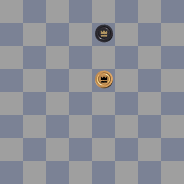 |
| Black to play loses; White to play draws |
Monday, May 14, 2012
Use your fingers and toes
Nik Goncharoff of the Motorola Kings has played 612 (!!) games in the Industrial League. So it's not surprising that he knows how to count reserve tempi. Create zugzwang in a pawn ending, and the player who has more pawn moves in reserve will usually win:
Thursday, July 7, 2011
"Zing 'em With Zugzwang"
A classic column from my favorite Nixon Administration speechwriter explains zugzwang to non-chessplayers by quoting GM Arthur Bisguier: ''When standing in a traffic island, with cars going in both directions, one is most assuredly in Zugzwang.''
Hat tip to former USCF Executive Director / Facebook friend Al Lawrence.
Also: Zugzwang does not rhyme with "bug thang." But in standard English usage (contra Safire), use the lower case.
Hat tip to former USCF Executive Director / Facebook friend Al Lawrence.
Also: Zugzwang does not rhyme with "bug thang." But in standard English usage (contra Safire), use the lower case.
Monday, June 7, 2010
What is zugzwang?
For the answer to this question, see the Kavalek column.
We take turns in chess: first White moves, then Black, then White.... Usually, "having the move" is a big advantage: if both sides are threatening mate, you would like it to be your move!

Whoever moves first, wins
I hope it's my turn!
This is particularly true in the opening: when we speak of tempo (plural "tempi"), we're often talking about getting your pieces into battle more quickly than your opponent does. Having the move can only help! If you look at the three Marshall Defense traps that Frederick posted earlier this week, you'll see that White gained one or more tempi by forcing Black to recapture the d5 pawn, then retreat the recapturing piece. If you move four pieces out with your first moves and I've only moved one piece out, then you've gained three tempi on me! It's a little more complicated than that, but this gives you an idea....
But sometimes (more frequently than most chessplayers realize), having the moving is a burden, not a privilege.

White to play
A complicated position!
I remember trying to explain the king and rook versus king mate to elementary students. They found this position difficult, so I asked their parents to help. The parents were confused, too!
First, let's pretend it's Black's move:
- How many legal moves does Black have?
- In each case (heh!), can you find White's best reply?
- What is the fastest way for White to win?
- With White to play, what is the fastest way for White to win this position?

White to play
Another complicated position!
(Remember that the White pawns generally travel "up" the page (or in this case, the screen) and Black pawns travel "down": the queening square for the d6 pawn is d8.)
No answers for the time being: try to figure this out yourselves!
Not your typical checkmate in three moves
A recent Huffington Post column by GM Lubomir Kavalek used one of my favorite chess problems to illustrate the concept of zugzwang. (I like it so much that I've posted it on the blog once before!) The author of this problem is the nineteenth-century French playwright Alfred de Musset.


de Musset
White to play and checkmate in three moves
Tuesday, December 22, 2009
I suppose I should have given the answer for the trébuchet problem...
As usual, you can find the answer in Wikipedia. (Slightly different position, but the idea is exactly the same.)
And to make sure we all understand, here's yet another a slightly different position that you won't find at the Wikipedia link. What is White's best move?

And to make sure we all understand, here's yet another a slightly different position that you won't find at the Wikipedia link. What is White's best move?
White to play and win
Friday, December 18, 2009
The French have a word for it

Le Trébuchet
What is White's best move in the above position? (It is not often that a move is so bad that double question marks magically appear on the chessboard.)
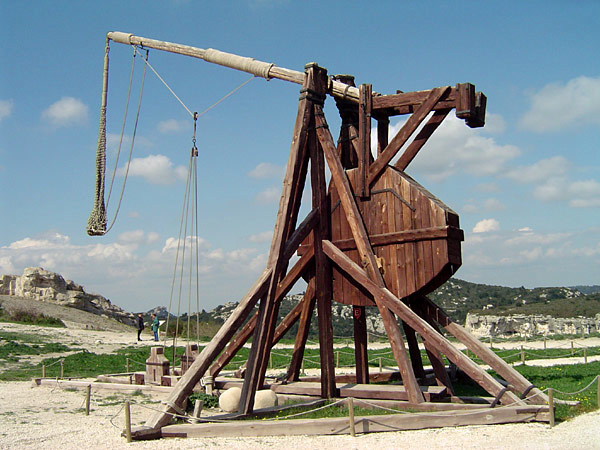
The other kind of trébuchet: useful when besieging enemy fortresses
(but I don't see the resemblance)
Subscribe to:
Posts (Atom)