Saturday, December 1, 2012
National K-12 Championships this weekend in Orlando
Keep your eyes on the 4th grade and 6th grade sections....


Anna Ushenina takes Women's World Championship

Enormous win for Nakamura
A win with Black against the #2 player in the world is a great way to start the London Chess Classic!
Tuesday, November 27, 2012
Giving Tuesday: Chicago Chess Center
There's a welcome new tradition this year: following the conspicuous consumption of Black Friday and Cyber Monday, charities are calling for us to help others on Giving Tuesday.
It's exciting to be in on the ground floor of something good. Since I entered the Chicago chess scene in 1977, I recall many fun days at Jules Stein's Chicago Chess Center, Richard Verber's various incarnations of the Chicago Chess Club, Les Bale's Lincolnwood Chess and Games (later transplanted to Lincoln Avenue in the city), Papa Dee's Chicago Chess Club, and (half a block from our apartment!) the Wild Onion.
Founders pass away and business models change: all these places are gone.
Keith Ammann came to me with a dream last year: why not found a permanent chess center in Chicago for Chicagoans? I told Keith that I was interested if we could do it in a way that would insure that the center remained after its founders were gone.

Our board (Keith Ammann, FM Albert Chow, Chris Christmas, Alyse Hammonds, Hector Hernandez, and myself; with the invaluable assistance of Les Bale) has made excellent progress. We've obtained nonprofit status for Chicago Chess Center NFP, Inc., we've received some generous donations, we're scouting for sites, planning fundraising events....and there's still so much to do before we open our doors.
Chess is not just a pleasant pastime, it transforms lives for the better. I know: I grew up in an Appalachian anthracite mining town. We lived in public housing, and my mother worked as a third-shift nurse's aide in a nursing home. Had it not been for chess, I never would have been admitted to MIT. For chess teaches critical thinking skills that helped me in math and science (and later in business), skills that are essential for success in our information economy.
We'd like to use the center to give Chicago's young people the same opportunities. And hey, adults are never too old to learn, never too old to share their wisdom with the young, and have a little fun in the process.
It's important to our mission that the site be accessible to those who need it the most. While our tendencies may be utopian socialist, we're also pragmatic enough to be committed to finding a site with off-street parking.
We also learn through competition. The Center will have regular events open to all at affordable prices.
How can you help us open our doors in 2013?
Thank you for your support!
Bill Brock
It's exciting to be in on the ground floor of something good. Since I entered the Chicago chess scene in 1977, I recall many fun days at Jules Stein's Chicago Chess Center, Richard Verber's various incarnations of the Chicago Chess Club, Les Bale's Lincolnwood Chess and Games (later transplanted to Lincoln Avenue in the city), Papa Dee's Chicago Chess Club, and (half a block from our apartment!) the Wild Onion.
Founders pass away and business models change: all these places are gone.
Keith Ammann came to me with a dream last year: why not found a permanent chess center in Chicago for Chicagoans? I told Keith that I was interested if we could do it in a way that would insure that the center remained after its founders were gone.

Our board (Keith Ammann, FM Albert Chow, Chris Christmas, Alyse Hammonds, Hector Hernandez, and myself; with the invaluable assistance of Les Bale) has made excellent progress. We've obtained nonprofit status for Chicago Chess Center NFP, Inc., we've received some generous donations, we're scouting for sites, planning fundraising events....and there's still so much to do before we open our doors.
Chess is not just a pleasant pastime, it transforms lives for the better. I know: I grew up in an Appalachian anthracite mining town. We lived in public housing, and my mother worked as a third-shift nurse's aide in a nursing home. Had it not been for chess, I never would have been admitted to MIT. For chess teaches critical thinking skills that helped me in math and science (and later in business), skills that are essential for success in our information economy.
We'd like to use the center to give Chicago's young people the same opportunities. And hey, adults are never too old to learn, never too old to share their wisdom with the young, and have a little fun in the process.
It's important to our mission that the site be accessible to those who need it the most. While our tendencies may be utopian socialist, we're also pragmatic enough to be committed to finding a site with off-street parking.
We also learn through competition. The Center will have regular events open to all at affordable prices.
How can you help us open our doors in 2013?
- Please become a Founding Member of the Chicago Chess Center today.
- If you'd prefer to use snail mail, please send your contribution to Chicago Chess Center NFP, Inc., 230 W. Monroe, Suite 330, Chicago IL 60606.
- Or give what you can afford: no donation is too small, and we truly appreciate your help.
- If you'd like to make a capital donation to insure the future of the Chicago Chess Center, kindly drop me a line.
- Most of all, we need your input. We need new board members, new committee members, legal counsel, and friends who offer good will.
Thank you for your support!
Bill Brock
CICL: a lucky escape
My Rogue Squadron teammate David Franklin doesn't get positionally rolled very often, but Mike Failor of Enova Financial inflicts some serious positional hurt. Then things get complicated, and both players miss some shots....
Sunday, November 25, 2012
Chicago Class vanity
I got outplayed by both of my opponents last Sunday. Psychologically, draws are not the most satisfying result, but drawing two games beats losing two games. And in both games, both players were trying to win...
Try to predict White's move in the position below!
At the ICA Banquet the previous day, I had the honor of presenting the 2012 Broughton Award to Jim Brotsos. While Jim and I were bantering about his lifetime of service to Illinois chess, I had my iPhone in my hand, as I was about to read some email testimonials that Jim's friends had sent. Somehow, I managed to start playing a Peter Drucker audiobook in the middle of Jim's remarks.
Not having sufficiently learned my lesson, I forgot to turn my iPhone off before round 4. In the middlegame, I somehow triggered the iPhone in my pocket, and "Five Years" (the opening track of The Rise and Fall of Ziggy Stardust and the Spiders from Mars) began playing for the "benefit" of the players. For "Five Years," I was penalized ten minutes (which seems more than fair: I could have been forfeited). My apologies to all!
Don't be an inconsiderate dope like me: turn off your cell phone before play begins. (I realize that family and work concerns make it mandatory for some players to be in touch at all times: put your phone on vibrate, and let the TD know what you're doing.)
Try to predict White's move in the position below!
At the ICA Banquet the previous day, I had the honor of presenting the 2012 Broughton Award to Jim Brotsos. While Jim and I were bantering about his lifetime of service to Illinois chess, I had my iPhone in my hand, as I was about to read some email testimonials that Jim's friends had sent. Somehow, I managed to start playing a Peter Drucker audiobook in the middle of Jim's remarks.
Not having sufficiently learned my lesson, I forgot to turn my iPhone off before round 4. In the middlegame, I somehow triggered the iPhone in my pocket, and "Five Years" (the opening track of The Rise and Fall of Ziggy Stardust and the Spiders from Mars) began playing for the "benefit" of the players. For "Five Years," I was penalized ten minutes (which seems more than fair: I could have been forfeited). My apologies to all!
Don't be an inconsiderate dope like me: turn off your cell phone before play begins. (I realize that family and work concerns make it mandatory for some players to be in touch at all times: put your phone on vibrate, and let the TD know what you're doing.)
Adair-Uedemann, 1879
Here's another delightful post on local chess history from A Chess Reader. Louis Uedemann and J.D. Adair were very well-matched when they played for Chicago bragging rights, and their play looks energetic and reasonably sound 133 years later.
The Chinese room as seen from the dentist's chair
On Black Friday, I had
two impacted wisdom teeth pulled. Our dentist is an artist—he puts his patients at ease, he's conscientious, he's fast, and like every good professional, he knows his limitations. The extractions were as close to painless as one could hope for.
Still, it was not completely painless. Squeamish person that I am, I didn't want to think about what was going on inside my mouth.
Instead, I began thinking about (what else) chess. One difference between human chess players and computer chess players: pull a card out of the computer's motherboard, and the computer generally doesn't say "Ouch!". One computer chess player was famously afraid, but that was in the movies, so I don't think that counts (yet).
Half an hour earlier, on the walk to the dentist's office, I'd been listening to one of John Searle's 2011 lectures on consciousness. (The whole series can be downloaded at https://itunes.apple.com/itunes-u/philosophy-132-001-spring/id438307693?mt=10.) In the seventh lecture, Searle argued that Deep Blue's victory over Kasparov proved nothing about Deep Blue's understanding of chess. Theoretically, a human with no knowledge of the rules of the chess could be thrown in a locked room, given Deep Blue's algorithm for finding the best move, some scratch paper and sharp pencils, and (after the arbiter slips Kasparov's move through the mail slot) replicate Deep Blue's decisions. (Granted, the human might need a couple millennia to make certain moves, but hey, it's a thought experiment.) Would we award this hypothetical human the title of the world's strongest chess player?
Still, it was not completely painless. Squeamish person that I am, I didn't want to think about what was going on inside my mouth.
Instead, I began thinking about (what else) chess. One difference between human chess players and computer chess players: pull a card out of the computer's motherboard, and the computer generally doesn't say "Ouch!". One computer chess player was famously afraid, but that was in the movies, so I don't think that counts (yet).
Half an hour earlier, on the walk to the dentist's office, I'd been listening to one of John Searle's 2011 lectures on consciousness. (The whole series can be downloaded at https://itunes.apple.com/itunes-u/philosophy-132-001-spring/id438307693?mt=10.) In the seventh lecture, Searle argued that Deep Blue's victory over Kasparov proved nothing about Deep Blue's understanding of chess. Theoretically, a human with no knowledge of the rules of the chess could be thrown in a locked room, given Deep Blue's algorithm for finding the best move, some scratch paper and sharp pencils, and (after the arbiter slips Kasparov's move through the mail slot) replicate Deep Blue's decisions. (Granted, the human might need a couple millennia to make certain moves, but hey, it's a thought experiment.) Would we award this hypothetical human the title of the world's strongest chess player?
Searle argues that this hypothetical human has no
understanding of chess whatsoever. As Deep Blue and Houdini 3 are doing nothing more than executing an algorithm, they too don't know what they're doing. This is a version of
Searle's famous "Chinese room" argument: as summarized by Wikipedia, "a program cannot give a
computer a 'mind', 'understanding' or 'consciousness', regardless of how
intelligently it may make it behave." Passing the Turing Test alone doesn't make a computer self-aware, wise, able to enjoy victory subjectively and suffer defeat stoically, or have the intuition of a Capablanca.
Human experts are not like computer experts. A master dentist can approach problems from both
intuitive and analytically rigorous perspectives. Suppose the patient after me also had impacted wisdom teeth: my dentist may have been able to tell from a glance at the X-rays that this patient's molars were going to be much more difficult to extract, so he referred that patient to an oral surgeon. Being a professional is not just executing an algorithm, it's also an art. (On the other hand, the most conscientious artist can make an error: Daniel Kahneman discusses the limitations of snap judgments in Thinking: Fast and Slow.)
Chess masters make snap judgments all the time: how else could grandmasters play forty players at once successfully? In some
positions, a master "knows" at a glance what the right move must be. Of course, not every snap judgment is correct—grandmasters do lose games in simultaneous exhibitions—but the quality of the grandmaster's snap judgment is much higher than the quality of our considered judgments.
(I remember consoling one well-known local master after a critical loss to Aleksander Stamnov: "The problem with playing Stamnov is that he makes good moves very quickly." He replied, "Yes, and he also makes bad moves very quickly.")
(I remember consoling one well-known local master after a critical loss to Aleksander Stamnov: "The problem with playing Stamnov is that he makes good moves very quickly." He replied, "Yes, and he also makes bad moves very quickly.")
Some recent chess books tell us to look at positions with "computer eyes," calculating all the forcing moves; others advise us to move first and think later. What's a patzer to do? Some positions demand brute-force calculation (we can never compete on an even level with chess engines in this sphere), others ask us to use our "feel" for the game. And most positions ask us to use some of each way of thinking.
These two ways of thinking—Kahneman calls the intuitive way "System 1" and the analytical way "System 2"—actually occur in different parts of the brain. Thinking in System 2 is hard work! As we're surfing through the complications of each chess game, we have to toggle back and forth between the two modes of thinking.
I'll close this rambling (hey, it's a blog) with two observations:
Narrowly: you may never be able to beat Houdini, but you already understand much more about chess than Houdini ever will. I remember a Scientific American article circa 1979 about programmers who hoped to make chess programs think in a more human fashion. That turned out to be an absolute dead end, and "brute force" alpha-beta searches won. It's true that useless branches of the analytical tree are pruned by the top engines, and it's true that evaluation functions have been improved, but still...chess engines are "merely" executing an algorithm, and executing an algorithm requires no understanding whatsoever.
Broadly: similar musings about the failure to date of the "strong AI" project and about how humans become expert at what they do are very much in the air right now.
These two ways of thinking—Kahneman calls the intuitive way "System 1" and the analytical way "System 2"—actually occur in different parts of the brain. Thinking in System 2 is hard work! As we're surfing through the complications of each chess game, we have to toggle back and forth between the two modes of thinking.
I'll close this rambling (hey, it's a blog) with two observations:
Narrowly: you may never be able to beat Houdini, but you already understand much more about chess than Houdini ever will. I remember a Scientific American article circa 1979 about programmers who hoped to make chess programs think in a more human fashion. That turned out to be an absolute dead end, and "brute force" alpha-beta searches won. It's true that useless branches of the analytical tree are pruned by the top engines, and it's true that evaluation functions have been improved, but still...chess engines are "merely" executing an algorithm, and executing an algorithm requires no understanding whatsoever.
Broadly: similar musings about the failure to date of the "strong AI" project and about how humans become expert at what they do are very much in the air right now.
Saturday, November 24, 2012
Chicago Latino Chess Championship XX: How Many Can We Fit in Here?
The 20th annual Chicago Latino Chess Championship is complete, with a record-smashing 93 participants. This year's upper section alone was larger than last year's entire tournament!
Jimi Akintonde of Whitney Young High School swept Section I (age 15 and up), followed by Justin Rajsky with 4.5/5 and Felipe Quiroz, Edward Zhang, Ricardo Román, Phillip Parker-Turner and Mark Jungo with 4.0/5. Parker-Turner and Jungo were so thoroughly tied, by every standard tiebreak measure, that their trophy order had to be decided by a blitz game (which all parties preferred to a coin flip). Parker-Turner prevailed.
In Section II (age 14 and under), Ricky Román of Nightingale School finished first with a perfect 4.0/4, followed by Teja Munagala of Center Grove School in Greenwood, Ind., and Abdel Raoul of the University of Chicago Lab School with 3.5/4. Seven young players followed with final scores of 3.0/4 to win the remaining trophies: Iggy Bielobradek (Komarek, North Riverside), Kaleb Tucker (Beasley), Joseph Buklis (Decatur Classical), Daniel Román (Nightingale), Susan Huang (U. of C. Lab), Daniel Zhang (South Loop) and Elias O'Malley (Decatur Classical).
Ten place trophies were awarded in each section. The tournament is held at the Rudy Lozano Branch Library in Pilsen, home of the Knight Moves Chess Club.
Jimi Akintonde of Whitney Young High School swept Section I (age 15 and up), followed by Justin Rajsky with 4.5/5 and Felipe Quiroz, Edward Zhang, Ricardo Román, Phillip Parker-Turner and Mark Jungo with 4.0/5. Parker-Turner and Jungo were so thoroughly tied, by every standard tiebreak measure, that their trophy order had to be decided by a blitz game (which all parties preferred to a coin flip). Parker-Turner prevailed.
In Section II (age 14 and under), Ricky Román of Nightingale School finished first with a perfect 4.0/4, followed by Teja Munagala of Center Grove School in Greenwood, Ind., and Abdel Raoul of the University of Chicago Lab School with 3.5/4. Seven young players followed with final scores of 3.0/4 to win the remaining trophies: Iggy Bielobradek (Komarek, North Riverside), Kaleb Tucker (Beasley), Joseph Buklis (Decatur Classical), Daniel Román (Nightingale), Susan Huang (U. of C. Lab), Daniel Zhang (South Loop) and Elias O'Malley (Decatur Classical).
Ten place trophies were awarded in each section. The tournament is held at the Rudy Lozano Branch Library in Pilsen, home of the Knight Moves Chess Club.
Friday, November 23, 2012
The perfect Christmas present for the chess player on your list
... is Houdini 3, the latest version of the world's strongest chess engine.
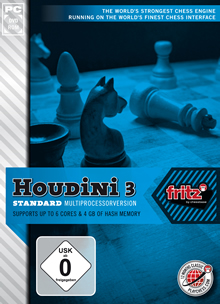
USCF Sales is running a Black Friday sale through Sunday: you can buy the Standard Edition of Houdini 3 for something like $85 dollars all in (Media Mail shipping) if you use the coupon code BLACKFRIDAY. (I am not a big fan of USCF Sales, but this is ten clams cheaper than what I paid last week.)
Or if you have Amazon Prime, you can buy Houdini 3 for $84.95 (price updated 11/25/12) and have it two days later.
My guess is that 95% of users won't have any need for Houdini 3 Pro. This souped-up version supports 32 cores and 256 GB of hash memory, as opposed to the standard version's "measly" 6 cores and 4 GB of hash. I suspect that the difference in analysis strength is not noticeable in most cases, and that most grandmasters would find the standard version more than adequate for their needs. (And Houdini can suck up all system resources if you let it: on a quad-core machine, I only use three cores for analysis.) But if you can afford the extra $20, the lucky giftee might find the pro version marginally more useful: hobbyists interested in computer vs. computer play and correspondence players might be most likely to benefit.
I really like the DeepFritz 13 user interface, and even find the contextual Microsoft Office 2010 interface somewhat less annoying that I did when using Rybka 3 Aquarium. While there's a handy "Goto Chessbase" feature for ChessBase users, I havn't been able to install the Houdini 3 engine directly in ChessBase. But that's my only complaint so far: this is truly great software! I hope to have a fuller review before Santa loads the sleigh.
For those of you on a budget: earlier versions of Houdini are available to download free of charge. See this earlier blog post for details.
USCF Sales is running a Black Friday sale through Sunday: you can buy the Standard Edition of Houdini 3 for something like $85 dollars all in (Media Mail shipping) if you use the coupon code BLACKFRIDAY. (I am not a big fan of USCF Sales, but this is ten clams cheaper than what I paid last week.)
Or if you have Amazon Prime, you can buy Houdini 3 for $84.95 (price updated 11/25/12) and have it two days later.
My guess is that 95% of users won't have any need for Houdini 3 Pro. This souped-up version supports 32 cores and 256 GB of hash memory, as opposed to the standard version's "measly" 6 cores and 4 GB of hash. I suspect that the difference in analysis strength is not noticeable in most cases, and that most grandmasters would find the standard version more than adequate for their needs. (And Houdini can suck up all system resources if you let it: on a quad-core machine, I only use three cores for analysis.) But if you can afford the extra $20, the lucky giftee might find the pro version marginally more useful: hobbyists interested in computer vs. computer play and correspondence players might be most likely to benefit.
I really like the DeepFritz 13 user interface, and even find the contextual Microsoft Office 2010 interface somewhat less annoying that I did when using Rybka 3 Aquarium. While there's a handy "Goto Chessbase" feature for ChessBase users, I havn't been able to install the Houdini 3 engine directly in ChessBase. But that's my only complaint so far: this is truly great software! I hope to have a fuller review before Santa loads the sleigh.
For those of you on a budget: earlier versions of Houdini are available to download free of charge. See this earlier blog post for details.
Wednesday, November 21, 2012
In Pilsen: Chicago Latino Chess Championship XX!
Twentieth edition: wow!
The site is the Chicago Public Library Lozano Branch on 1805 S. Loomis (Loomis is 1400 West: folks coming from the Loop may find the CTA's #60 bus - Blue Island/26th - handy). No entry fee: lots of trophies! Registration is from 9 to 9:30 a.m., Saturday, Nov. 24; play begins at 10 a.m. You'll be home in time for dinner.
See the ICA Tournament Calendar for details!
The site is the Chicago Public Library Lozano Branch on 1805 S. Loomis (Loomis is 1400 West: folks coming from the Loop may find the CTA's #60 bus - Blue Island/26th - handy). No entry fee: lots of trophies! Registration is from 9 to 9:30 a.m., Saturday, Nov. 24; play begins at 10 a.m. You'll be home in time for dinner.
See the ICA Tournament Calendar for details!
Turkey Day 2K this weekend in Skokie
Brought to you by the miracle of cut and paste. Original here.
Friday thru Sunday Nov 23 - 25, 2012. Turkey Day 2k - $2,000 prize fund guaranteed. 6R-SS Game-90 + 30/sec increment.
Location: North Shore Chess Center - 5500 W Touhy Ave Suite A, Skokie, IL 60077
Round Times: 12pm and 5pm daily
Entry Fee: $50 for everyone
Prize Fund Distribution:
This event will be USCF and FIDE rated.
Maximum capacity registration will be 64 players. The organizer reserves the right to limit lower the limit.
Friday thru Sunday Nov 23 - 25, 2012. Turkey Day 2k - $2,000 prize fund guaranteed. 6R-SS Game-90 + 30/sec increment.
Location: North Shore Chess Center - 5500 W Touhy Ave Suite A, Skokie, IL 60077
Round Times: 12pm and 5pm daily
Entry Fee: $50 for everyone
Prize Fund Distribution:
- Overall: $500-350-200 (+$50 perfect score prize)
- U2200: $150-100-50
- U1900: $150-100-50
- U1700: $150-100-50
This event will be USCF and FIDE rated.
Maximum capacity registration will be 64 players. The organizer reserves the right to limit lower the limit.
Tuesday, November 20, 2012
A beautiful queenside attack
I asked David Peng's teacher, Grandmaster Dmitry Gurevich, to take a quick look at my light notes to this game, played a week ago Saturday at Kings Island. Dmitry wrote back, "Those 9 years olds like David and Awonder [Liang] are going to beat IMs and GMs soon... that's impressive.. scary :)) "
White: David Peng (2076)
Black: NM Charles Diebert (2234)
Kings Island Open, Mason, Ohio
November 10, 2012
Philidor Defense
I had the pleasure of witnessing most of this game from the adjoining board. David Peng is 9½ years old!
1. e4 d6 2.d4 Nf6 3.Nc3 Nbd7 4.Bc4 e5 5.d5 Be7 6.Nge2 a5 7.O-O O-O 8.Ng3 Nc5 9.f3 Ne8 10.Be3 g6
Black isn’t satisfied with a draw against his young opponent, and is willing to take some risks to win. From that respect, the opening has been reasonably successful for Black. The knight on c5 is particularly well posted, and the pawn on a5 restrains White from playing b2-b4, evicting the knight. On the kingside, Black hopes to play ...f7-f5 at an appropriate time: perhaps Black could bring pressure to bear on White’s e4 square, then play ...f5xe4 in a way that White has to reply f3xe4, and the pressure will begin to get serious. Black has the clear idea of exchanging his bad bishop on e7 with ...Be7-g5. It’s not clear what the future holds for White’s bishop on c4: the d5 pawn secures a space advantage for White, but also blocks the a2-g8 diagonal.
11. a3 a4 12. b4 axb3 13. cxb3 Bd7
14. a4!?
Prophylaxis is the art of figuring out your opponent’s plans, then making a move (sometimes mysterious-looking!) that does something to frustrate your opponent’s schemes while advancing your own.
White wants to roll up Black’s queenside! But here’s the problem: if White plays an immediate b3-b4, the horsie hops to a4. With the support of the bishop on d7 and the rook on a8, it’s an excellent blockading piece. But if White plays a4 first, then the a4 square is denied to Black’s knight.
Objectively, Black has more than one adequate response to White’s plan, but I think 14.a4!? is an incredibly sophisticated move for such a young player to make. And for all I know, there may be three or four moves that are objectively better.
The immediate 14.b4 can be answered by the intermezzo 14…Bg5!? (the immediate 14...Na4 works, too) 15.Bxg5 Qxg5 16.Qc1 (but not 16.bxc5?! Qe3+ and Black is better) 16... xc1 17. Rfxc1 Na4 18.Bb5 Bxb5 19.Nxb5 Rc8 20.Rc4 f5 and Black has sufficient counterplay.
14... Bg5 15. Bf2 b6!?
15... Na6!? would be a creative response, as White has weakened the b4 square.
16. b4 Nb7?
And now White can continue with his plan virtually unimpeded. At the same time, it’s hard to fault Mr. Diebert for making what seems to be a very pragmatic decision: suffer for a few moves, then counterattack on the kingside. Instead, 16... Nxa4! allows Black to retain equality because of the fork trick on b5.
17. Qb3 Ng7 18. Bb5! h5
Or 18... Bxb5 19. Nxb5 with enduring pressure. (Allowing doubled pawns with 19. axb5!? also looks strong. )
19. Bc6 Rb8 20. Nb5 Qe7 21. a5 Bxc6
21... bxa5 22. bxa5 Nc5 23. Bxc5 Bxc6 24. dxc6 dxc5 is a better try for Black, which suggests that White may have played a4-a5 a bit prematurely.
22. dxc6 +-
White’s technique in the remainder of the game is excellent: no need to hurry in a position like this!
22…Nd8 23.axb6 Nxc6 24.Qc4 Qd7 25.bxc7 Rxb5 26.Qxb5 Qxc7
Diebert offers stiff resistance in a lost position: beating a master is hard work!
27.Qc4 Qd7 28.b5 Nd4 29.b6 Nge6 30.Rfb1 Rb8 31.Ne2 Nxe2+ 32.Qxe2 Nd4 33.Qc4 Nc6 34.Qa6 Rb7 35.Qa8+ Kg7 36. Rd1 Rb8 37.Qa4 Rb7 38.Ra2 Bd8 39.Rc2 Nd4 40.Qxd7 Rxd7 41.Bxd4 exd4 42.Rb2 Rb7 43.Rdb1 Kf6 44.Kf2 Ke6 45.Ke2 d5 46.Kd3 dxe4+ 47.Kxe4 Kd6 48.Rb3 Bf6 49.Ra1!
White has accurately evaluated that a couple checks and a pawn push is nothing to fear. 49…Re7+ 50.Kd3 Kc6 50... Re3+ 51. Kc2 d3+ 52. Kd2 and the rook on a1 is immune, even after Re2+ 53. Kxd3
51.Ra7 Re3+ 52.Kc4 Rc3+ 53.Rxc3 dxc3 54.Kd3 Kxb6 55.Rxf7 Be5 56.h3 Kc5 57.Rf8 Kb4 58.Kc2 g5 59.Rf5 Bf4 60.h4! 1-0
White: David Peng (2076)
Black: NM Charles Diebert (2234)
Kings Island Open, Mason, Ohio
November 10, 2012
Philidor Defense
I had the pleasure of witnessing most of this game from the adjoining board. David Peng is 9½ years old!
1. e4 d6 2.d4 Nf6 3.Nc3 Nbd7 4.Bc4 e5 5.d5 Be7 6.Nge2 a5 7.O-O O-O 8.Ng3 Nc5 9.f3 Ne8 10.Be3 g6
Black isn’t satisfied with a draw against his young opponent, and is willing to take some risks to win. From that respect, the opening has been reasonably successful for Black. The knight on c5 is particularly well posted, and the pawn on a5 restrains White from playing b2-b4, evicting the knight. On the kingside, Black hopes to play ...f7-f5 at an appropriate time: perhaps Black could bring pressure to bear on White’s e4 square, then play ...f5xe4 in a way that White has to reply f3xe4, and the pressure will begin to get serious. Black has the clear idea of exchanging his bad bishop on e7 with ...Be7-g5. It’s not clear what the future holds for White’s bishop on c4: the d5 pawn secures a space advantage for White, but also blocks the a2-g8 diagonal.
11. a3 a4 12. b4 axb3 13. cxb3 Bd7
 | ||
| White to play |
14. a4!?
Prophylaxis is the art of figuring out your opponent’s plans, then making a move (sometimes mysterious-looking!) that does something to frustrate your opponent’s schemes while advancing your own.
White wants to roll up Black’s queenside! But here’s the problem: if White plays an immediate b3-b4, the horsie hops to a4. With the support of the bishop on d7 and the rook on a8, it’s an excellent blockading piece. But if White plays a4 first, then the a4 square is denied to Black’s knight.
Objectively, Black has more than one adequate response to White’s plan, but I think 14.a4!? is an incredibly sophisticated move for such a young player to make. And for all I know, there may be three or four moves that are objectively better.
The immediate 14.b4 can be answered by the intermezzo 14…Bg5!? (the immediate 14...Na4 works, too) 15.Bxg5 Qxg5 16.Qc1 (but not 16.bxc5?! Qe3+ and Black is better) 16... xc1 17. Rfxc1 Na4 18.Bb5 Bxb5 19.Nxb5 Rc8 20.Rc4 f5 and Black has sufficient counterplay.
14... Bg5 15. Bf2 b6!?
15... Na6!? would be a creative response, as White has weakened the b4 square.
16. b4 Nb7?
And now White can continue with his plan virtually unimpeded. At the same time, it’s hard to fault Mr. Diebert for making what seems to be a very pragmatic decision: suffer for a few moves, then counterattack on the kingside. Instead, 16... Nxa4! allows Black to retain equality because of the fork trick on b5.
17. Qb3 Ng7 18. Bb5! h5
Or 18... Bxb5 19. Nxb5 with enduring pressure. (Allowing doubled pawns with 19. axb5!? also looks strong. )
19. Bc6 Rb8 20. Nb5 Qe7 21. a5 Bxc6
21... bxa5 22. bxa5 Nc5 23. Bxc5 Bxc6 24. dxc6 dxc5 is a better try for Black, which suggests that White may have played a4-a5 a bit prematurely.
22. dxc6 +-
White’s technique in the remainder of the game is excellent: no need to hurry in a position like this!
22…Nd8 23.axb6 Nxc6 24.Qc4 Qd7 25.bxc7 Rxb5 26.Qxb5 Qxc7
Diebert offers stiff resistance in a lost position: beating a master is hard work!
27.Qc4 Qd7 28.b5 Nd4 29.b6 Nge6 30.Rfb1 Rb8 31.Ne2 Nxe2+ 32.Qxe2 Nd4 33.Qc4 Nc6 34.Qa6 Rb7 35.Qa8+ Kg7 36. Rd1 Rb8 37.Qa4 Rb7 38.Ra2 Bd8 39.Rc2 Nd4 40.Qxd7 Rxd7 41.Bxd4 exd4 42.Rb2 Rb7 43.Rdb1 Kf6 44.Kf2 Ke6 45.Ke2 d5 46.Kd3 dxe4+ 47.Kxe4 Kd6 48.Rb3 Bf6 49.Ra1!
White has accurately evaluated that a couple checks and a pawn push is nothing to fear. 49…Re7+ 50.Kd3 Kc6 50... Re3+ 51. Kc2 d3+ 52. Kd2 and the rook on a1 is immune, even after Re2+ 53. Kxd3
51.Ra7 Re3+ 52.Kc4 Rc3+ 53.Rxc3 dxc3 54.Kd3 Kxb6 55.Rxf7 Be5 56.h3 Kc5 57.Rf8 Kb4 58.Kc2 g5 59.Rf5 Bf4 60.h4! 1-0
White to play: what's the best plan?
| ||
| White to play |
Ask your computer, and you will get a list of candidate moves with more-or-less meaningless evaluations. (There are no immediate tactics in this position, and White is somewhat better, but nothing serious.)
I am by no means certain that the player of the White pieces (to be identified later today) came up with the best plan, but it was a very impressive plan!
I am by no means certain that the player of the White pieces (to be identified later today) came up with the best plan, but it was a very impressive plan!
Illinois Class results!
Final results and prizewinners are here on the Illinois Class website, and the event was rated almost immediately.
Permit me be lazy and link to Keith Ammann's tournament report, which should be going up on the ICA website in the next day or so.
Thanks to Keith Ammann, Wayne Clark, Maret Thorpe, Gary Jannsen, and the staff at Concordia University for a very smooth event at a very nice location!
Friday, November 16, 2012
"Check ... this out: Richards boasts first all-girls chess team lineup"
| Members of Richards High School's girls chess club are from left, Kristina Huggins, Jessica Zavala, Juliet Lucente, Mady Doan, Caitlin O'Sullivan, Anne Sortino, Marial Rancel and Aminah Garcia; who are practicing at the school in Oak Lawn, IL on Wednesday November 14, 2012. | Matt Marton~Sun-Times Media |
Thursday, November 15, 2012
Tuesday, November 13, 2012
Rolling the Rossolimo
David Peng's parents, Jenny and Bill, were kind enough to send along David's first-round game from Kings Island. I find it difficult to believe that a nine-year-old could play such a game.
NM Kristopher Meekins of Ohio tries to outplay David strategically in the trendy Rossolimo Sicilian, but David more than holds his own. 19.g4?! is a critical decision by White: if Black doesn't capture en passant, White locks up the kingside and plays on the rest of the board (King's Indian players know this theme well). So David keeps the game open: kingside attacks are stronger because that's where His Majesty lives.
White is still coping adequately until the moment after David poses the beautiful question 25...c4! Houdini suggests that White may still be slightly better after 26.Kh2, but even a master can easily go wrong in such a position.
NM Kristopher Meekins of Ohio tries to outplay David strategically in the trendy Rossolimo Sicilian, but David more than holds his own. 19.g4?! is a critical decision by White: if Black doesn't capture en passant, White locks up the kingside and plays on the rest of the board (King's Indian players know this theme well). So David keeps the game open: kingside attacks are stronger because that's where His Majesty lives.
White is still coping adequately until the moment after David poses the beautiful question 25...c4! Houdini suggests that White may still be slightly better after 26.Kh2, but even a master can easily go wrong in such a position.
Monday, November 12, 2012
Vanity: Kings Island Road Trip
GM Nikola Mitkov headed a contingent of Chicago players at this year's Kings Island Open. The site is a creaky but charming resort adjoining the amusement park in metro Cincinnati.
This year's field was not as strong as last year's (most GMs chose to play in Detroit the week before), but still pretty darn strong. Once again, Kentucky GM Gregory Kaidanov took honors, splitting first with IM Goran Vojinovic of Ohio. Crosstables here!
In Saturday's round three, I was playing next to nine-year-old David Peng, and I looked at his game almost as much as mine. As David was rolling up his second master of the event, I found myself thinking, "Is this kid already stronger than I am?" Wonder no longer: David's post-event rating is 2108, and mine is 2106. Even before his recent ratings jump, David was second only to Awonder Liang on the nation's top nine-year-old list. (As I noted a few days ago, both David and Awonder at age nine are substantially stronger than the twelve-year old Bobby Fischer. But this is a misleading comparison on many levels. Parents, chess is more than having a large number after one's name: you want your children to enjoy playing and enjoy learning. These young players simply love to play!)
***
Here are my games, not because they're particularly good, but because it's a blog. :-) Constructive criticism is most welcome: that's how we get better!
Claire and I drove in Friday night: traffic was heavy, so I wound up taking a first-round bye (thanks to USCF Executive Director Bill Hall for conveying the message to Wayne Clark).
In round two, I was paired with fellow Chicagoan Tam Nguyen, who is on the cusp of a long-overdue National Master title. I sacked a pawn for no particularly good reason and was fortunate to escape with a draw:
In round three, I was paired against the reigning Kentucky state champion, NM Davis Whaley. Black made a Slav triangle and grabbed the Catalan gambit pawn. At one point, I thought I had excellent wining chances, but the game fizzled out into a dead draw quickly. Between Evanston and Kings Island, I had now drawn five consecutive games in eight days. (This after making a vow to myself not to offer or accept draws in unclear positions: sometimes there's nothing the players can do...)
Sunday morning, I won against NM Pappu Murthy of Ohio. 15...Nc7? is a cute idea, but the attempt to trap the bishop fails. The alert reader will probably notice several dozen faster wins that I missed (29.Qc4 with the idea of 30.a3 is one, Black's counterplay after 32.Nxd6 appears not be that fearsome, after all), but hey, I won. And yes, Black could have resigned a few moves earlier, but note that Black almost set up a kamikaze stalemate trap. (Queens and rooks are great for kamikaze missions, but monochromatic bishops are generally ineffective.)
This year's field was not as strong as last year's (most GMs chose to play in Detroit the week before), but still pretty darn strong. Once again, Kentucky GM Gregory Kaidanov took honors, splitting first with IM Goran Vojinovic of Ohio. Crosstables here!
In Saturday's round three, I was playing next to nine-year-old David Peng, and I looked at his game almost as much as mine. As David was rolling up his second master of the event, I found myself thinking, "Is this kid already stronger than I am?" Wonder no longer: David's post-event rating is 2108, and mine is 2106. Even before his recent ratings jump, David was second only to Awonder Liang on the nation's top nine-year-old list. (As I noted a few days ago, both David and Awonder at age nine are substantially stronger than the twelve-year old Bobby Fischer. But this is a misleading comparison on many levels. Parents, chess is more than having a large number after one's name: you want your children to enjoy playing and enjoy learning. These young players simply love to play!)
***
Here are my games, not because they're particularly good, but because it's a blog. :-) Constructive criticism is most welcome: that's how we get better!
Claire and I drove in Friday night: traffic was heavy, so I wound up taking a first-round bye (thanks to USCF Executive Director Bill Hall for conveying the message to Wayne Clark).
In round two, I was paired with fellow Chicagoan Tam Nguyen, who is on the cusp of a long-overdue National Master title. I sacked a pawn for no particularly good reason and was fortunate to escape with a draw:
In round three, I was paired against the reigning Kentucky state champion, NM Davis Whaley. Black made a Slav triangle and grabbed the Catalan gambit pawn. At one point, I thought I had excellent wining chances, but the game fizzled out into a dead draw quickly. Between Evanston and Kings Island, I had now drawn five consecutive games in eight days. (This after making a vow to myself not to offer or accept draws in unclear positions: sometimes there's nothing the players can do...)
Sunday morning, I won against NM Pappu Murthy of Ohio. 15...Nc7? is a cute idea, but the attempt to trap the bishop fails. The alert reader will probably notice several dozen faster wins that I missed (29.Qc4 with the idea of 30.a3 is one, Black's counterplay after 32.Nxd6 appears not be that fearsome, after all), but hey, I won. And yes, Black could have resigned a few moves earlier, but note that Black almost set up a kamikaze stalemate trap. (Queens and rooks are great for kamikaze missions, but monochromatic bishops are generally ineffective.)
Thanks to my style of boring opponents to death, I had a chance to Swiss-Gambit my way into the Under 2300 prize in the final round. NM James Mills of Indiana had other ideas. 15.Ne5!? is interesting: I think I was right to take on d4, but 16...Nf8 is too passive: better 16...Rac8. 18...Bg5!? is my attempt to deal with the coming incursion on c6. I saw White's beautiful 23rd move coming, but didn't appreciate its force until it was too late: 23...f5? is just psychological collapse. A nice win by Mr. Mills!
Now that you've seen all the weaknesses in my play, come exploit them this weekend at the Illinois Class in River Forest!
Thursday, November 8, 2012
Shulman & Amanov win Michigan Chess Festival
The field at last weekend's Michigan Chess Festival in Troy was ridiculously powerful: Grandmasters Sam Shankland, Alexander Shabalov, Yury Shulman, Victor Mikhalevski, Sergey Kudrin, Ben Finegold, and Mesgen Amanov.
The two Illinois grandmasters, Shulman and Amanov, were the only players to win their first four games. They drew each other in the final round, and nobody caught them. And our Carl Boor didn't win any cash, but he was the top finisher under 2400, losing only to GM Shabalov. Excellent road trip, gentlemen!
International Master Irina Krush used day one of the event as the warmup for the Women's World Championship, giving her the dubious distinction of having been in Detroit and Siberia in the same week. Tomorrow, Krush faces Alexandra Kosteniuk in round one.
Crosstables here!
The two Illinois grandmasters, Shulman and Amanov, were the only players to win their first four games. They drew each other in the final round, and nobody caught them. And our Carl Boor didn't win any cash, but he was the top finisher under 2400, losing only to GM Shabalov. Excellent road trip, gentlemen!
International Master Irina Krush used day one of the event as the warmup for the Women's World Championship, giving her the dubious distinction of having been in Detroit and Siberia in the same week. Tomorrow, Krush faces Alexandra Kosteniuk in round one.
Crosstables here!
Subscribe to:
Posts (Atom)