What would you play in the diagrammed position?
If you said 10...Nde5! or 10...Nce5!, take full credit. White's position is already resignable after either knight move. White loses two pawns and is forced to move his king. Mega Database 2013 finds 18 games that reached the above position. In 15 of them, Black moved one of the knights to e5. He scored 14.5 points in those 15 games.
If you said anything other than 10...N(either)-e5!, please enroll in Remedial Chess Tactics 101 forthwith. But don't feel too bad: you're in good company. Garry Kasparov, arguably the greatest player of all time, also missed it. He played the lemon 10...Nb4?, which would have allowed White to survive after 11.Bd2! when White is only a little worse (-0.47 according to Komodo 9.02). Instead, White played 11.Bb1? and was steamrollered.
How long has the shot 10...Ne5! been known, you ask? For almost 90 years. It was first seen in Norman-Vidmar, Hastings 1925/26, which Black won in short order:
This trap was given in Irving Chernev's book Winning Chess Traps, first published in 1946. The entire game appears, for example, in Chernev and Reinfeld's The Fireside Book of Chess (1949), as well as in more recent works such as the Encyclopedia of Chess Miniatures (2014) and Müller and Knaak's 222 Opening Traps After 1.d4 (2008). It is scarcely believable that Kasparov did not know of this old chestnut. Even if he somehow did not, it is mind-blowing that so great a tactical genius could miss so obvious a shot.
Tuesday, August 4, 2015


Wednesday, February 25, 2015
Nothing new under the sun II
After playing Rhine-Boerkoel (see previous post), I found the following game, which has strikingly similar tactics. The most salient difference is that in the final position 18...Kxf7 isn't an option because of 19.Nxd8+. Had the game continued, Black would have had to take the queen, allowing White's rook to give perpetual check on g7 and h7.
Tuesday, February 24, 2015
A spectacular game
This is one of my three favorite games that I have played. The others are K.Thompson-Rhine, 1992 and Rhine-Sprenkle, 1981. This is the only one of the three that isn't published in Chess Informant I should've submitted this one too, but I got lazy. It's a beautiful game, primarily because of my opponent's efforts - he sacrificed, or offered to sacrifice, a pawn, knight, bishop, rook, and queen - literally every kind of piece except his king. The cold, dispassionate engine (Houdini 3) tells me that had I played slightly differently (23.Qc2!), I would have had a large advantage. But as "Kinghunt" once observed on chessgames.com, "This is a King's Indian Defence - Black is always objectively lost until suddenly Black wins." Or draws, in this case.
Up through 15.c5, the game was all book. My opponent's 15...c6!? was a novelty. I was quite happy after 23.Qb3, thinking that I was a pawn up for little compensation. I could meet 23...f3 with 24.g3 Qh3 25.Bf1. Boerkoel's 23...Ne3!! came as a huge shock. The main points are that Black threatens to win with both 24....Nxg2 25.Kxg2 f3+ and 24...f3 25.g3 Qh3 26.Bf1 Nxf1, and if White plays 24.fxe3, 24...fxe3 threatens 25...Qxh2#, 25...Qxe4, and 25...f2+. The subtle 23.Qc2! would have avoided this shot; since it would have guarded my knight, I could have met 23...Ne3?? with simply 24.fxe3 fxe3 25.g3 and wins. I still thought I was winning after 26.Kxf2. After 26...Bxg3+!, the light finally dawned: I had to allow perpetual check.
Sunday, February 22, 2015
Nothing new under the sun
The same tactical themes are seen again and again. Compare the finishes of these two games. They reached identical positions except for the side on which White castled. In both, 15.Nxc6! is the killer, with the point that 15...bxc6 is met by 16.Qa6#, while 15...Qxe2 is met by the unusual checkmate 16.Nxa7#. The first game is No. 314 in Chernev's classic The 1000 Best Short Games of Chess.
Over sixty years later, I played this blitz game, without knowing of its predecessor:
The astute observer will notice that in my game, 14.Nxc6! was already possible. In fairness to Albert, who was my teammate on the Lane Tech High School chess team, this result was highly atypical of our games at the time. He was much stronger. Later we both became masters. Many years later, he co-founded the chessgames.com website.
Tuesday, February 17, 2015
A typical sacrifice
In the game below, White was already in big trouble when he attempted to exploit the pin on my knight with 8.Ne4?? 8...Nxe4! was a typical sham sacrifice. After 9.Bxd8 Bb4+, Black will regain the sacrificed material with interest. In the final position, the threat of 15...Nd2 double check and mate was enough to induce my opponent to resign.
Tuesday, February 3, 2015
Still another Englund Gambit trap
I have previously written several posts about traps in the Englund Gambit (1.d4 e5? or, to be charitable, 1.d4 e5?!). There are two "official" refutations of the main line of the gambit: after 2.dxe5 Nc6 3.Nf3 Qe7, one begins with 4.Bf4 (or 4.Bg5) Qb4+ 5.Bd2 Qxc3 6.Nc3!, the other with 4.Qd5. As I've previously noted, indiscriminately combining the two can lead to disaster. Below is another instance of this. After 5.Bg5?? (5.Nc3!) Qb4+!, White is losing after either 6.Bd2 Qxb2 7.Bc3 Bb4, as in the game, or 6.Qd2 Qxb2 7.Qc3 Bb4. The final position is very reminiscent of that arising after the classic Englund trap, 4.Bf4 Qb4+ 5.Bd2 Qxb2 6.Bc3?? Bb4! 7.Qd2 Bxc3 8.Qxc3 Qc1#.
Thursday, January 22, 2015
Three Times a Lady
In the B Group at the Tata Steel (Wijk aan Zee) tournament, the world's current youngest grandmaster, 14-year-old Samuel Sevian, performed a feat that has surely occurred very rarely in chess history. He sacrificed three queens on three consecutive moves! He thereby achieved an easily winning rook versus pawns ending, which his opponent promptly resigned. Very cool.
Saturday, January 3, 2015
A trap in Larsen's Opening
The following game illustrates what happens if White tries to grab a pawn in Larsen's Opening with 6.fxe5 fxe5 7.Bxc6+? bxc6 8.Bxe5?? Black wins by force. Instead, White should play 6.Qh5+ g6 7.Qh4 exf4 8.exf4 Bd7 9.Nf3 Nb4 10.Bxd7+ Qxd7 11.Na3 O-O-O or 6.fxe5 fxe5 7.Nf3 Bg4 8.h3 Bxf3 9.Qxf3 Nf6 10.Nc3 a6, in either case with approximate equality. Note that in the game continuation, 14...Bf5!, staying in the middlegame, was even better than allowing White to go into a lost endgame.
Note also that 10...Qxh1!, as played, was much better the tempting 10...Bg4?! I think that I once had the White side of this many years ago against James Fagan in a blitz tournament at the Elbo Room. White survives after 11.Nc3!, and now (a) 11...Qg6 12.Bxh8! Bxd1 13.Nxd1!, when White is only a little worse, or (b) 11...Qxh1 12.Qxg4 Qxg1+ 13.Ke2 Qxa1 14.Nxd5 Qh1 15.Qe6+ Be7 [15...Kd8 16.Nf6 (16.Bf6+ also draws) 16...Qg2+ 17.Kd3 Qf1+ 18.Ke4 Qh1+ 19.Kd3 with a draw by perpetual check] 16.Nxc7+ Kd8 17.Nxa8.
ADDENDUM: White can also grab the pawn immediately on move 7 without first playing Bxc6+. It turns out that this is a better try, although still weak. After 7.Bxe5 Qh4+ 8.g3 Qe4 9.Bxg7 Qxh1 10.Qh5+ Ke7 11.Qh4+ Kf7 12.Bxh8 Qxg1+ 13.Bf1 Bf5 14.Nc3 Nge7 15.Ne2 Qh1 16.Bc3 Ne5 17.O-O-O Qe4 18.Qxe4 dxe4 Black is up a piece for two pawns. The alternative 11.Kf1 is clearly winning for Black after 11...Be6 12.Be2 Be5 13.Bxh8 [or 13.Bxe5 Nxe5 14.Qxe5 Rf8+ 15.Bf3 Rxf3+ 16.Ke2 Qxg1 17.Qxc7+ (17.Nc3 Qg2+ 18.Kd3 Nf6) 17... Kf6] 13...Rf8+ 14.Bf3 Bxh8.
Note also that 10...Qxh1!, as played, was much better the tempting 10...Bg4?! I think that I once had the White side of this many years ago against James Fagan in a blitz tournament at the Elbo Room. White survives after 11.Nc3!, and now (a) 11...Qg6 12.Bxh8! Bxd1 13.Nxd1!, when White is only a little worse, or (b) 11...Qxh1 12.Qxg4 Qxg1+ 13.Ke2 Qxa1 14.Nxd5 Qh1 15.Qe6+ Be7 [15...Kd8 16.Nf6 (16.Bf6+ also draws) 16...Qg2+ 17.Kd3 Qf1+ 18.Ke4 Qh1+ 19.Kd3 with a draw by perpetual check] 16.Nxc7+ Kd8 17.Nxa8.
ADDENDUM: White can also grab the pawn immediately on move 7 without first playing Bxc6+. It turns out that this is a better try, although still weak. After 7.Bxe5 Qh4+ 8.g3 Qe4 9.Bxg7 Qxh1 10.Qh5+ Ke7 11.Qh4+ Kf7 12.Bxh8 Qxg1+ 13.Bf1 Bf5 14.Nc3 Nge7 15.Ne2 Qh1 16.Bc3 Ne5 17.O-O-O Qe4 18.Qxe4 dxe4 Black is up a piece for two pawns. The alternative 11.Kf1 is clearly winning for Black after 11...Be6 12.Be2 Be5 13.Bxh8 [or 13.Bxe5 Nxe5 14.Qxe5 Rf8+ 15.Bf3 Rxf3+ 16.Ke2 Qxg1 17.Qxc7+ (17.Nc3 Qg2+ 18.Kd3 Nf6) 17... Kf6] 13...Rf8+ 14.Bf3 Bxh8.
Wednesday, December 17, 2014
Mate by castling
Over four years ago, I published a game where I administered checkmate by capturing en passant. Here I deliver another very rare form of checkmate: mate by castling. This appears to be comparable in rarity to mate by en passant. The only other examples of it that I've been able to find are P. Morphy-A. Morphy, New Orleans 1850,
and Kvicala-NN, Prague 1875. The famous game Ed. Lasker-Thomas, London 1912 is not an instance of this, since Edward Lasker in that game chose to play 18.Kd2# rather than 18.0-0-0#. Nor, it appears, is Prins-Day, Lugano (ol) 1968, despite the score of that game given at chessgames.com, which shows the game ending with 31...0-0-0#. According to Day, the winner of the game, who should know, the game actually ended after 28...Qe4+. He writes, "And my opponent resigned, unwilling to investigate 29.K-B6 Q-B4+ 30.K-N7 Q-N3+ 31.K-R8 and Black has a choice of absurd mates." Raymond D. Keene (ed.), Learn from the Grandmasters, p. 108. Mate by castling is thus sufficiently rare that I have been unable to find an example of it occurring in the entire 20th century!
Saturday, September 6, 2014
A trap in the Caro-Kann Defense, Exchange Variation
I found this trap in Amatzia Avni's excellent book Danger in Chess: How to Avoid Making Blunders. The identical trap can arise by transposition from other openings, such as the London System (1.d4 d5 2.Bf4). The winning idea is sufficiently unusual that most White players missed it - ChessBase shows that in the position after Black's 12th move, only 5 out of 31 players found the winning move! All six masters and experts that reached the position played 13.Nxe5??, scoring only 3-3.
Friday, August 29, 2014
A trap in the Quaade Gambit
What on earth is the Quaade Gambit, you ask? It's a line of the King's Gambit that begins 1.e4 e5 2.f4 exf4 3.Nf3 g5 4.Nc3!?, deviating from the usual Kieseritzky prescription of 4.h4 g4 5.Ne5. The line is named for a 19th-century Dutch sea captain (not to be confused with Captain Evans, a Welshman). The natural response is 4...g4 5.Ne5 Qh4+, when White responds with the surprising 6.g3! fxg3 7.Qxg4! Now Black can and should trade queens, when Black will be a pawn up but White's lead in development and better pawn structure give him sufficient compensation.
But who can resist the temptation to win a rook with 7...g2+ 8.Qxh4 gxh1=Q? Not many, according to the databases. But resist Black should, for after 9.Qh5! he is in big trouble. According to John Shaw in his magnum opus on the King's Gambit, Black's best chance is 9...Nh6! 10.d4 d6 11.Bxh6 dxe5 12.Qxe5+ Be6 13.Qxh8 Nd7 14.Bxf8 0-0-0 15.Qxh7 Nxf8 16.Qh6 Ng6 17.0-0-0 Rh8 18.Qd2 Qxh2 19.Qxh2 Rxh2 20.Bd3, when White is a pawn up in the endgame with good winning chances. In the game below, Black instead went down in flames, as he usually does in this line. White won a once-in-a-lifetime beauty of a game:
But who can resist the temptation to win a rook with 7...g2+ 8.Qxh4 gxh1=Q? Not many, according to the databases. But resist Black should, for after 9.Qh5! he is in big trouble. According to John Shaw in his magnum opus on the King's Gambit, Black's best chance is 9...Nh6! 10.d4 d6 11.Bxh6 dxe5 12.Qxe5+ Be6 13.Qxh8 Nd7 14.Bxf8 0-0-0 15.Qxh7 Nxf8 16.Qh6 Ng6 17.0-0-0 Rh8 18.Qd2 Qxh2 19.Qxh2 Rxh2 20.Bd3, when White is a pawn up in the endgame with good winning chances. In the game below, Black instead went down in flames, as he usually does in this line. White won a once-in-a-lifetime beauty of a game:
Tuesday, August 19, 2014
Another trap in the Caro-Kann, Two Knights Variation
Bobby Fischer wrote in My 60 Memorable Games that the purpose of the Two Knights Variation against the Caro-Kann Defense (1.e4 c6 2.Nc3 d5 3.Nf3) "is to exclude the possibility of" ...Bf5. As I've showed previously, Black indeed gets in big trouble if he proceeds in stereotyped fashion with 3...dxe4 4.Nxe4 Bf5?! 5.Ng3 Bg6?! But the Two Knights Variation is no one-trick pony. The following game shows another, much less-known trap in the 3...Bg4 line, which is considered Black's best. As the game and notes show, after 4.d4!?, Black gets in hot water if he tries to win a pawn with the natural 4...dxe4 5.Nxe4 Bxf3 6.Qxf3 Qxd4. Better is the solid 4...e6!, which gives Black a plus score in the databases.
Scott Thomson ("keypusher" on ChessGames.com) sets the stage for the game:
I don't have the score, but as our Secretary of State might say it is seared -- seared! in my memory. . . . It was when I lived in England in the early 90s, and for some reason -- perhaps a cholera epidemic -- I was playing first board for Wood Green in a team match. There was a pub next door, to which my opponent repaired after each move (which he took about five seconds on).Deceived by his opponent's alcohol consumption and seemingly reckless play, Scott proceeded to lose a miniature in humiliating fashion. We've all been there.
Tuesday, July 15, 2014
Hello world 2.0 - July 2014
*Wakes up from 6½-month hibernation*
Kindly check out the Chicago Chess Center Blog: I'll be hanging out there for the foreseeable future. As with all new web spaces, it may take us a little time to get up to speed....
Jim Froelich's Chicago Area Chess usergroup on Facebook is a great place to chat and gossip, and the Illinois Chess Association's tournament calendar, maintained by the indefatigable Maret Thorpe, keeps you up-to-date on where to play. It's because of these two great resources that I didn't feel guilty about a sabbatical.
I'll certainly keep this blog up, and I may occasionally post things over here that are incompatible with the CCC's nonprofit mission. And of course, my very nice co-editors are always welcome to continute to use this space for anything of interest to the Chicago chess community or to woodpushers in general. Thanks to Keith Ammann, Vince Hart, Matt Pullin, Tom Panelas, and especially NM Frederick Rhine for their contributions.
And thanks to you folks for visiting this site and giving us useful feedback! Your thoughts are always welcome: my personal email is billbrock1958@gmail.com and my Chicago Chess Center email is billbrock@chichess.org.
Sunday, June 15, 2014
Another trap in From's Gambit
DO NOT play 1.f4 unless you have an answer ready for From's Gambit, 1...e5!? King's Gambiteers can happily play 2.e4. The line White played in the game was fine up to a point. IM Tim Taylor in his book Bird's Opening recommends 7.d4 Ng6 8.Nxg6 hxg6 9.Qd3! Nc6 10.c3! Bf5 11.e4 Qe7 12.Bg2 0-0-0 13.Be3 Bd7 14.Bf2!, when Black doesn't have enough compensation for the gambit pawn. Another line is 5.d4 g4 6.Ne5!, heading into a slightly better ending for White after 6...Bxe5 7.dxe5 Qxd1+ 8.Kxd1. Instead of playing these reasonable lines, most of my blitz opponents have played ridiculously and gotten crushed. A case in point:
Monday, December 30, 2013
Chess for Chicago's youth
I've read a string of wonderful stories in the last week about young Chicago-area players making their mark on their chessboard:
I've played tournament games against six of these seven young people, and have analyzed with the seventh. I feel honored to know them!- The Pan-American Intercollegiate Team Chess Championship is winding up today in Lubbock, Texas. Most of the young masters on the University of Illinois team are from the Chicago area. Today, the "walk-ons" play a much stronger team from Texas Tech (international players on chess scholarships!) to try to return to the Final Four of chess for a second consecutive year. Please join me in wishing Eric Rosen, Michael Auger, Xin Luo, and Akshay Indusekar the best of luck today! By the time you read this, you may be able to see whether the Illini qualified.
- David Peng of Wilmette (whose coach is Grandmaster Dmitry Gurevich of Chicago) just won a silver medal in the World Under-10 Championship in Al-‘Ain, United Arab Emirates. Who won the gold medal in the same section? Awonder Liang of Wisconsin, who often studies with Chicago grandmasters.
- And just a couple of weeks ago, Sam Schmakel of Chicago's Whitney Young High School won his fifth national scholastic title. For this accomplishment, Sam was featured in yesterday's New York Times.
So chess in Chicago must be doing wonderfully, no? Not according to Dylan Loeb McClain, the author of the Schmakel feature:
Schmakel's school, Whitney Young High, is a magnet school that is part of the Chicago public school system and is where Michelle Obama graduated. It was the only representative at the K–12 Championships from the city, which is not known as a chess stronghold. More students are enrolled in scholastic chess programs and are sent to tournaments across the country from schools in New York, which sends more teams to competitions than any other city; Miami; Seattle; Portland, Ore.; and even Brownsville, Tex.
It is unusual for a city as large as Chicago, with 2.7 million people, to have only one school enter a tournament as prestigious as the K–12 Championships. By comparison, Los Alamos, N.M., population 18,000, also sent one school.It helps to go to a great magnet school. It helps to have parents who are willing to make financial sacrifices in order to give their children the opportunity to succeed. But most of the talented young people in our city won't be admitted to Whitney Young. And many of their parents would love to give their children greater opportunities but are barely making ends meet.
In my last fundraising pitch, I also asked for financial assistance to send teams from two Chicago West Side schools to the same Florida event at which Sam Schmakel won his fifth title. In the end, the schools could not accept the money that several kind people (including a CPS administrator) pledged. The airfares jumped in price as the deadline approached, and the trip was called off.
Could these kids have succeeded at Nationals? Of course they could have: the team from Faraday Elementary, which draws its students from some of the most dangerous neighborhoods on the West Side, just finished third in a December 14 Youth Chess Foundation of Chicago event.
The Chicago Chess Center does not want to turn children away because their parents can't afford to pay us. Please help us open our doors: please help us help them.

Children don't get to choose how much money their parents have, and they don't get to choose the neighborhood they are raised in. We want to be there for all of these children, but we can't do it without your support.
We are fortunate to have GMs Dmitry Gurevich, Yury Shulman, Nikola Mitkov and Mesgen Amanov on our advisory board, which also includes leaders from Chicago's nonprofit and business community.
My friend and fellow board member Dave Ducat made a compelling pitch on Facebook the other day. I can't improve on it, so I'll steal Dave's words:
Of course you're thinking that this is Chicago and that there has to be such a place already . . . an actual "Chicago Chess Center" somewhere . . . right?
Nope.
There is no physical "Chicago Chess Center" location in the city, and there hasn't been one within the city limits for over 20 years. Cities like St. Louis and Dallas have developed premier chess clubs, have set the new standard and have seen their international exposure and tourism increased over the last three to five years. I want that for Chicago. I want Chicago to become the center for chess in the United States, and I want it to set the example for other cities to follow.
I need your help to make the Chicago Chess Center a reality. I need your financial contributions to create a physical location, centralized and within easy access of public transportation, so that chess-playing people of all ages, all walks of life, and all neighborhoods in and around the city can have a place to call their own. I need your help to shape the future of chess in Chicago and shape it with our youth in mind.
When the CCC was founded, the board put together a campaign to raise $30,000 within a year to fund the acquisition, furnishing and rent of a suitable space to call the Chicago Chess Center. To date, through tireless solicitation by the board of directors as well as through key personal and corporate investments [...], we've been able to raise over half that amount [we're now over $18,000—BB]. It's my hope that you can find a few dollars to contribute to this worthy cause and help the CCC reach its goal of opening the doors of a new location in early 2014. We need your support to make this happen.
Please take a moment to review our website and click the "Donate Now" button. Please consider a donation of $50; however, any amount will be gratefully accepted. For the price of one latte a day for one week, you can make a lasting contribution to a worthwhile cause and help us achieve our mission.Bill again. Without your financial support, we may not be able to fulfill our mission. And we are so close to opening our doors .
Please make your tax-deductible year-end donation now. Thank you for caring.
Bill Brock
Treasurer
Chicago Chess Center NFP Inc.
P.S. If you'd like to make your donation by check, here's our mailing address:
Chicago Chess Center NFP Inc.
P.O. Box 180095
Chicago, IL 60618
Thursday, December 26, 2013
David Peng at World Youth Championships
David has 7 points in 9 rounds!
UPDATE: He won again! Now 8-2! Tomorrow he faces Abdrashev Arlen of Kazakhstan, who just lost to Awonder Liang.
http://www.worldyouth2013.com/playerbio/120
Cheesehead and honorary Chicagoan Awonder Liang leads the world with 9-0!
UPDATE: Make that 10-0! Tomorrow he faces Kaifeng Yu of China, who trails him by a full two points! That is the last round, so it looks like Awonder has already clinched the World Under-10 Championship outright, while David is fighting for second! We wish the best of luck (and skill) to both Awonder and David tomorrow.
http://www.worldyouth2013.com/playerbio/118
FINAL UPDATE: Yes, David won the World Under-10 silver medal and Awonder won his second gold medal! Story here.
UPDATE: He won again! Now 8-2! Tomorrow he faces Abdrashev Arlen of Kazakhstan, who just lost to Awonder Liang.
http://www.worldyouth2013.com/playerbio/120
Cheesehead and honorary Chicagoan Awonder Liang leads the world with 9-0!
UPDATE: Make that 10-0! Tomorrow he faces Kaifeng Yu of China, who trails him by a full two points! That is the last round, so it looks like Awonder has already clinched the World Under-10 Championship outright, while David is fighting for second! We wish the best of luck (and skill) to both Awonder and David tomorrow.
http://www.worldyouth2013.com/playerbio/118
FINAL UPDATE: Yes, David won the World Under-10 silver medal and Awonder won his second gold medal! Story here.
Friday, November 29, 2013
CICL: Big upset for Tornado Snakes

The East Division of the Chicago Industrial Chess League is going to be interesting this year!
Mark Coleman scores a convincing upset against yours truly. (I have a backlog of recent losses to publish: it's therapeutic.)
Wednesday, November 27, 2013
"Freshman ranks #2 among US chessplayers"
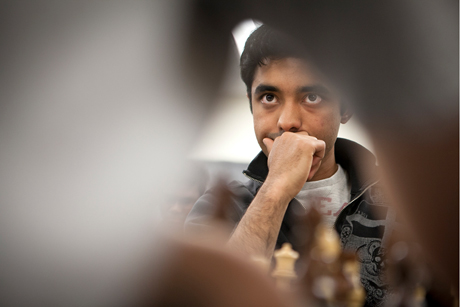
I would have said "18-year-old US chessplayers," but what the heck.
Story here.
Thursday, November 21, 2013
Road trip: Kings Island Rd 1
Hey, it's a blog.
I had a casual dinner with Andrew Karklins at the Melrose a week ago Monday, and wound up playing him in Ohio on Friday. A perpetual cheapo salvages my iffy position.
Wednesday, November 13, 2013
The Belfast Immortal
My former graduate school / barroom colleague Paul Catterson plays the game of his life. I have vowed revenge.
Subscribe to:
Posts (Atom)