Sunday, August 22, 2010

Chess Fundamentals: Rook and King against King

CHESS FUNDAMENTALS
JOSÉ R. CAPABLANCA

PART I

CHAPTER I

First Principles: Endings, Middle-Game, and Openings

The first thing a student should do, is to familiarize himself with the power of the pieces. This can best be done by learning how to accomplish quickly some of the simple mates.

1. SOME SIMPLE MATES

Example 1. — The ending Rook and King against King.

The principle is to drive the opposing King to the last line on any side of the board.


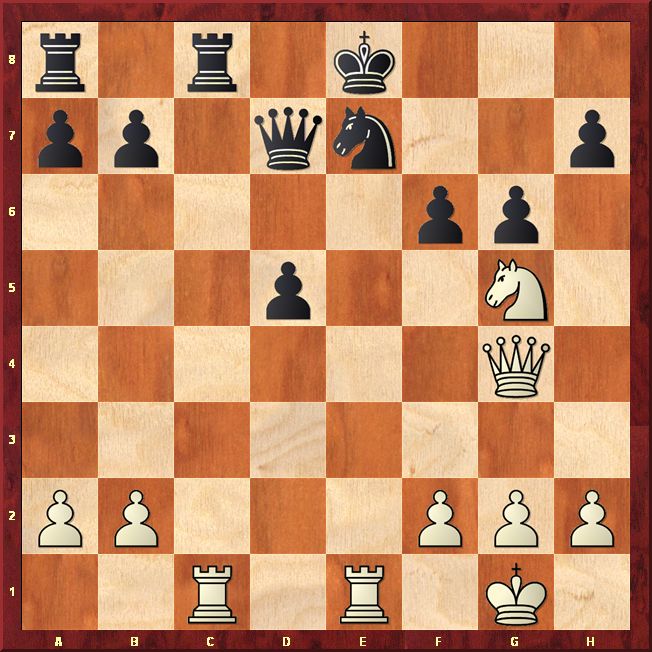
 Example 1: White to play

In this position the power of the Rook is demonstrated by the first move, Rh7, which immediately confines the Black King to the last rank, and the mate is quickly accomplished by 1.Ra7 Kg8 2.Kg2 

The combined action of King and Rook is needed to arrive at a position at which mate can be forced. The general principle for a beginner to follow is to

keep his King as much as possible on the same rank, or, as in this case, file, as the opposing King. 

When, in this case, the King has been brought to the sixth rank, it is better to place it, not on the same file, but on the one next to it towards the center.  

2...Kf8 3.Kf3 Ke8 4.Ke4 Kd8 5.Kd5 Kc8 6.Kd6

Not 6.Kc6 , because then the Black King will get back to d8 and it will take much longer to mate.

6...Kb8

If now 6...Kd8 7.Ra8 mates at once. 

7.Rc7 Ka8 8.Kc6 Kb8 9.Kb6 Ka8 10.Rc8 mate.

On move 5, Black could have played 5...Ke8 , and, according to principle, White would have continued 6.Kd6 Kf8 the Black King will ultimately be forced to move in front of the White King and be mated by Ra8. 7.Ke6 Kg8 8.Kf6 Kh8 9.Kg6 Kg8 10.Ra8 mate.


Example 2: White to play


Since the Black King is in the center of the board, the best way to proceed is to advance your own King thus: 1.Ke2 Kd5 2.Ke3 As the Rook has not yet come into play, it is better to advance the King straight into the center of the board, not in front, but to one side of the other King. Should now the Black King move 2...Ke5, the Rook drives it back by 3.Rh5+. On the other hand, if 2...Kc4 then also 3.Rh5 If now 3...Kb4, there follows 4. Kd2, but if instead 3...Kc3 4.Rh4 , keeping the King confined to as few squares as possible.

Now the ending may continue 4...Kc2 5.Rc4+ Kb3 6.Kd3 Kb2 7.Rb4+ Ka3 8.Kc3 Ka2 It should be noticed how often the White King has moved next to the Rook, not only to defend it, but also to reduce the mobility of the opposing King. Now White mates in three moves thus: 9.Ra4+ Kb1 10.Ra8 Or Rook to any square on the a-file, forcing the Black King in front of the White. 10...Kc1 11.Ra1 mate.  It has taken eleven moves to mate, and, under any conditions, I believe it should be done in under twenty. While it may be monotonous, it is worthwhile for the beginner to practice such things, as it will teach him the proper handling of his pieces.

Saturday, August 21, 2010

Interview with Alexander Khalifman

The former FIDE World Champion chats at Chess in Translation.

NM Steve Tennant wins South Suburban CC Game/15

National Master Steve Tennant had a perfect 3-0 score in last night USCF quick-rated event.  

You can follow the South Suburban Chess Club on Facebook.  They meet every Friday night from 7-10:30PM at the Oak View Community Center at 110th & Kilpatrick in Oak Lawn. Everyone is welcome!

Friday, August 20, 2010

Canal - Capablanca, Budapest 1929

There was one other game that made a deep impression on me in Chernev's Logical Chess: Move By Move.  In Canal-Capablanca, Budapest 1929, it sure looked like Capa was in trouble.  (And indeed FireBird suggests a moment or two where White may have missed an opportunity for advantage.)

Chernev is silent on White's big mistake:


Canal-Capablanca, Budapest 1929
After 31...Ra1
White to move

Black's next couple moves are fairly easy to predict: ...a3, ...a2, ...Rook moves somewhere (with check or attack), and ...a1=Q.  

How can White interfere with this plan? 

Friday catblogging

 
Here are some positions that my cats (of blessed memory) could have solved.  Well, Chloé could have solved them; Muffin was perhaps a bit too dense.

Today's theme is the "Perils of Pauline": the White king on b1 is tied to the railroad tracks, and ...Qb2 checkmate seems inevitable.  Your job: ride to the rescue!

Seriously, many of you may be stumped by some or even all of these.  Just keep in mind that every move must be a forcing move, and you'll eventually be able to figure them out!  (If you have problems, just leave a note in the comments.)

White to play and win

White to play and win

White to play and win

White to play and win


 White to play and win

 White to play and win

  White to play and win
  White to play and win


Learm these mating patterns!  In a real game, strong players don't have to calculate these mates from scratch.   They recognize the pattern and simply check to make sure that it works in the given position.

How to Beat Your Dad at Chess is one of several good books for learning these basic mates.

Thursday, August 19, 2010

Learning from our losses

Matt Pullin messes up a promising position against Zach Kasiurak and uses his loss as the occasion for some constructive self-criticism.  Botvinnik would approve!

Cute miniature, cute story

Reigning Chicago Open champion Loek Van Wely got crushed by Hikaru Nakamura today at the NH Youth versus Experience tournament.  Before you read Ian Rogers's hilarious report on Chess Life Online, see if you can solve this quiz:

 White to play and win
(there are at least two solutions; which line is most forcing?)

Nakamura and Anish Giri are now tied for the youth lead, but Hikaru still has to play both Svidler and Gelfand....

Scholastic Section Sept. 4 at this year's Illinois Open!

We get email.  Jerry Neugarten writes:
As most of you know, one of the major events on the annual chess calendar is the Illinois Open, being held this year from September 4th to 6th in Oak Brook. This might be a good  warm-up for the coming scholastic season, including the Illinois All Grade championship on November 13th in Chicago.  Most young players won't be ready to play in the open sections (the lowest of which is for players under 1800), but there's a scholastic tournament on the first day (Saturday, September 4th). 

Although the scholastic event will be in a separate room, kids playing in that section, on their breaks, will be allowed to observe (and perhaps rub shoulders with) many top players, including Grandmasters Yury Shulman, Dmitry Gurevich and Nikola Mitkov, and International Masters Angelo Young and Florin Felecan. 

Details are at http://chessforlife.com/chess/Ilopen10/ilopen10.html. If you're interested in the scholastic event, click on "Scholastic Trophy Tournament" at the top.
In other email, my wife wants me to pick up a gallon of milk on the way home.

Wednesday, August 18, 2010

Holy mirror image, Batman!

The chess writer Tim Krabbé, whose wonderful Open Chess Diary Bill mentioned the other day, once wrote about a game in a simultaneous exhibition he had given that began 1.e4 Nf6 2.e5 Nd5 3.d4 e6?! 4.c4 Bb4+? 5.Ke2! Having moved only pawns and his king, Krabbé had a won game, since Black loses a piece after either 5...Ne7 6.a3 Ba5 7.b4 or 5...Nb6 6.c5 Nd5 7.a3 Ba5 8.b4. Unfortunately, at this point someone noticed that the king and queen had been set up wrong in the initial position, so Krabbé agreed to restart the game from scratch.

As the game below shows, one can trap Black's bishop exactly the same way on the kingside. After my 5.Qd2! Black was losing a piece just as in Krabbé's abortive game. Note also the variation 5...Ng6 6.f5 Ne5 7.h3 Bh5 8.g4 Nxg4?? (8...Bxg4 9.hxg4 Nxg4?? is similar) 9.Bb5+! c6 10.dxc6 and the dual threats of 11.cxb7+ and 11.c7+ are crushing.

The rest of my game was very uninteresting, alas, as my opponent hung all his pieces.

Tuesday, August 17, 2010

Steinitz's Immortal Game

Steinitz - von Bardeleben, Hastings 1895
White to play and win

Admittedly, Hastings 1895 doesn't have much to do with Chicago.  But hey, very cool notes by Kavalek!

Monday, August 16, 2010

A trap in the Kangaroo Defense


The opening 1.d4 e6 2.c4 Bb4+ is an unusual but perfectly sound defense. It can transpose to the Nimzo-Indian, Bogo-Indian, Dutch, Queen's Indian, or English Defense (1.c4 b6). It is sometimes known as the Keres Defense, since the young Paul Keres was fond of it, often as a prelude to a Dutch Defense. Watson and Schiller, in their excellent if suggestively titled The Big Book of Busts, call it the Kangaroo Defense for some reason. (Schiller is big on weird animal names for openings.) All minor piece interpositions are playable, but I've usually played 3.Nbd2, hoping to gain the bishop pair.

The above game is the second in which my opponent has found 3...d6??, losing either a bishop or a knight after 4.Qa4+! As this game illustrates, before moving a piece to an unguarded square you must always watch out for queen checks! For example, Qa4+ can vacuum up a knight on a5, a bishop or knight on b4, a knight on e4, a bishop on g4 (if ...e6 has been played, blocking the bishop's way home), etc. The theme of 1.Qa4+ (attacking a bishop on b4) Nc6 (forced to save the bishop) 2.d5 exd5 3.cxd5 winning the knight is a common one. It often fails if Black has a knight or a queen on f6 (allowing Black to save the day with 3...Nxd5 or 3...Bxc3+ 4.bxc3 Qxc3+ and 5...Qxa1, respectively).

Eric Rosen takes Evanston Rapid

Some patzer who shall remain nameless was three pawns up against Eric in a rook ending time scramble (hint: it was the person who said he could have beaten Nakamura in Friday's two-pawns-up rook ending), but somehow Eric had the better position when a draw was agreed....  Eric won all his other games to finish with 4.5-0.5.  Evgeny Bulushev, Dmitry Sergatskov, and Jonathan Kogen tied for second with 4 points. 

Crosstable here.  A lot of these youngsters are underrated by 100+ points (if you don't play in many quick events, then your quick rating will lag behind your "slow" rating).

Sunday, August 15, 2010

Grandmasters Shulman, Mitkov, Gurevich at 2010 Illinois Open!

I was cc'd on an email from Andi Rosen to the Warren Scholars:
Dear Warren Scholars and Families,
I wanted to encourage all of you to play in the upcoming Illinois Open on Labor Day Weekend, Sept. 4-6.  This promises to be the strongest Illinois Open in years, with three grandmasters—Yury Shulman, Dmitry Gurevich and Nikola Mitkov—planning on playing, as well as at least two IM's—Angelo Young and Florin Felecan.  In addition to cash prizes for high-scoring players at every rating level, all players with 3.5 points or more will win a $20 gift certificate to the onsite chess bookstore.  It's a good opportunity for the Warren Scholars to play very strong competition.  For more information and to register, go to http://chessforlife.com/chess/Ilopen10/ilopen10.html
 Sounds like good advice for all of us!

Chicago Blaze: corrected date

Oops! 

The 110 most fantastic moves ever played

...is an online collection by the fabulous Tim Krabbé.  (The link goes to fantastic moves 101-110; you'll find links to the rest of the list at the bottom of Krabbé's page.)

He really should have included Frederick Rhine's favorite move.  But all "best" lists are necessarily imperfect.  (Edited in a few hours later: in the comments, Frederick reminds me that Burn's move was only recently rediscovered by his chess biographer, Richard Forster, and that Krabbé himself said that it belonged near the top of his list. Krabbé discusses interference sacrifices similar to Burns's—check out the amazing move that Peoria native, and newly minted Life Master, Pete Karagianis dropped on a Grandmaster!  It's not a Novotny, and it doesn't win by force, but it's mighty purty.)


Karagianis-Anka, 2004 National Open
White to play and astound (though not necessarily win)

John Emms liberally "borrowed" from Krabbé's site for his 2000 book The Most Amazing Chess Moves of All Time.  On Krabbé's home page Chess Curiosities (where you'll find many days of fun reading) he refers to his 110 most fantastic moves collection as "his most frequently emmsed page." If you prefer books that aren't plagiarized, I can heartily recommend  Secrets of Spectacular Chess by Levitt and Friedgood.  (The first edition can be bought used for a pittance.)
Chicago Blaze season begins next Monday! Fundraiser tourney!

ICA Metro VP Mike Cardinale writes:
The first match of the Blaze season is Monday, August 23rd [note corrected date-BB] at 8:00 P.M. vs. the Seattle Sluggers, at the new North Shore Chess Center at 5500 W. Touhy, Suite A, in Skokie (just a few blocks west of their previous location at the Holiday Inn).
[N]ew this year will be a parallel rapid fund raising tournament with every Blaze match.  Here are the details from the website:
We will also be running in parallel to the Blaze matches, a Blaze fundraiser tournament each night the Blaze play. The tournaments will be USCF rated and feature a G/15+30/sec increment time control. The EF will be $20 per player. No chess center membership will be required for these events but all players must be USCF members. Depending on turnout this can be a one section tournament or a two section tournament. 100% of proceeds goes towards the Chicago Blaze.
You can also support the Blaze with a purchase of Blaze merchandise, through corporate sponsorship, or with a personal contribution.  Details at the new website:
Remember, you don't have to like the McCaskeys to be a Bears fan.  Support for the Blaze is a matter of civic pride.
I'm looking forward to seeing the McCaskeys' — oops, Sevan Muradian's — new North Shore Chess Center!

The most astounding move of all time

Cover up the moves in the game below and look at the diagrammed position. Amos Burn, one of the world's best players toward the end of the 19th century, playing Black, looks to be dead lost. White will regain his sacrificed piece and mate Black in short order, right? In this seemingly hopeless position, Burn found what I consider the most astounding move in chess history. (To clarify, I mean astounding good moves. No doubt there are lots of astounding bad moves - say, where White could have mated in one and instead played a move that allowed Black to mate White in one.) Do you see it?


Chess problemists will tell you that Burn's move 33 is an extremely rare example of the Novotny theme in actual play. That is, 33...Qg4!!! moves the queen to the square that is the intersection of the d1-h5 diagonal controlled by White's bishop, and the g-file, controlled by White's rook. If the rook captures the queen, it blocks the bishop, allowing 34...Nf3+ and 35...Nxd2. If the bishop captures the queen, it blocks the rook, allowing 34...Bxd2. There are two other plausible continuations: 33.hxg4? allows Black to win the queen either way, leaving him with an extra piece, and 33.Qxg5+? Qxg5 34.Rxg5+ Kh6 wins a piece for Black. Note that (as Burn pointed out) 33.Be4! would have deprived him of this resource, winning easily for White.

von Scheve - Teichmann, Berlin 1907

I suppose it would be appropriate to answer the question in the previous post: it was awfully hard!

Most beginner's books are full of errors like these--by no means does this mean that Logical Chess: Move By Move is a bad book. As Frederick Rhine noted in the previous comments, it wouldn't be surprising for a GM to make the same mistake.  (Chernev's error on move 8 is crude enough for me to notice without a computer, or for an alert beginner to catch.)

Resignation in a drawn position is fairly rare (I confess that I did it against NM William Aramil in 2001.)


Saturday, August 14, 2010

Chess is hard!

Jerry Neugarten, the chair of the Illinois Chess Association's Youth Chess Committee, is putting the finishing touches on the ICA's guide to curricula and study resources for young players.  I pulled out my copy of Irving Chernev's Logical Chess: Move by Move, a classic collection of annotated games for beginners, to see whether it belongs on the list.  It does indeed: it's a fun and instructive read.

But my silicon friend discovered something amazing in the final position of the very first game.  Can you discover it, too, using wetware alone?

 von Scheve - Teichmann, Berlin 1907
Position after 17...Bxf2
White to play resigned

Chernev explains White's resignation: "Black's threat was 18...Qh3+ 19.Nh2 Qxh2#."  ("#" is the abbreviation for "checkmate".)  "As 18.Rxf2 runs into 18...Nxf2#, there was no escape."

NEVER TRUST ANYTHING YOU READ IN A CHESS BOOK!  (This goes double for blogs written by patzers.)  99.9% of the time, the book will be right and you'll discover why your challenge was wrong.  But every so often, you'll discover something cool.

Another silly Internet game

The greatest swindle ever


You may have heard Evans-Reshevsky, U.S. Championship 1963-64 called "The Swindle of the Century". It's a nice one, to be sure, but Marshall-Marco, Monte Carlo 1904 is better. (Bizarrely, that game does not appear in Marshall's mistitled 1914 book Marshall's Chess "Swindles".) Keres-Fischer, Curacao 1962 is also an amazing save, but I wouldn't call it a "swindle" since Fischer (somehow) had no way to win after 72.Qe5!!

By the way, who christened Evans-Reshevsky "The Swindle of the Century"? Why, that would be Larry Evans himself, annotating the game in American Chess Quarterly, Vol. 3, No. 3 (Winter 1964), of which he was the editor-in-chief.

But the real Swindle of the (20th) Century, indeed the greatest swindle ever to date, is the amazing one that Larry Christiansen pulled off against Alexander Beliavsky at Reggio Emilia 1987-88. From a busted position, Christiansen sacrificed a knight to expose Beliavsky's king, then offered four pseudo-queen sacrifices in an attempt to get a perpetual check. Beliavsky thwarted Christiansen's attempts and repeatedly hammered Christiansen's king. Finally, on the brink of victory, Beliavsky fell for Christiansen's last trick.

After 29.Bc4, Christiansen had a lost position against the No. 5 player in the world. His f-pawn is under attack, but passive defense is hopeless, e.g. 29...Nh6 30.Qb6 winning the c-pawn (30...Qd7 31.Nxf7!). So Christiansen ignored White's threats and dove in with 29...Nxf2!? 30.Kxf2 Ra3! After 31.Bxf7+ Kg7 32.Qe6, he went after White's king with 32...Ra2+. Robert Byrne observed in The New York Times that after 33.Qxa2 Rxa2+ 34.Bxa2 Ng4+ 35.Kg1 Qa7 36.Bb1 Qa3 37.Bd3 Qb2 38.Rc2 Qd4+, "White will experience difficult technical problems." Instead, the game continued 33.Kg1 R8a3!, hoping for 34.Qxe7? Rxg3+ and the rook gives perpetual check along the third rank. Nor was 34.Kh1 Rxg3! 35.Qxa2 Ng4! appealing for White. Beliavsky preferred 34.Ne8+! Now 34...Nxe8? 35.Qxg6+ mates next move, and there is no perpetual check after 34...Qxe8? 35.Bxe8 Rxg3+ 36.Kh1. Undeterred, Christiansen played 34...Kh6! 35.Nxf6 35.Qxe7 Rxg3+ or 35.Qxf6 Qxf6 still leads to perpetual check. 35...Rxg3+ 36.Kh1 Qxf7! Offering the queen a third time, again hoping for perpetual check after 37.Qxf7? Rh3+ or 37.Ng8+? Qxg8! 37.Rd7! White offers his own queen sacrifice: if 36...Qxe6, 37.Rh7#! Another clear win was 37.Ng4+! hxg4 (37...Kg7 38.Qxe5+ is even worse) 38.Qxf7 Rh3+ 39.Kg1 Rg3+ 40.Kf1! Rf3+ 41.Qxf3, leaving White a rook up. 37...Qxf6! Black's last gasp, offering the queen yet a fourth time. 38.Qxf6?? White thinks that he can finally take the queen safely, since now there is no perpetual. White wins after 38.Rh7+! Kxh7 39.Qxf6 Rh3+ 40.Kg1 Rg3+ 41.Kf1 Rh3 41.Qe7+ Kh6 (41...Kg8? 42.Qe8+ Kh7 43.Qd7+ wins the rook) 42.Qg5+ Kh7 43.Kg1 Raa3 44.Kg2. He was rudely awakened by Christiansen's 38...Rh2+! A finish reminiscent of Evans-Reshevsky: Christiansen sacs his remaining heavy pieces and goes for stalemate. The players agreed to a draw in light of 39.Kxh2 Rg2+! 40.Kh3 Rg3+! 41.Kh2 Rg2+! 42.Kh1 Rg1+!, when Black draws by perpetual check or stalemate.

For another amazing Christiansen swindle, see Burden-Christiansen, Las Vegas 1992, wherein Christiansen spots a master a queen for a knight, and wins!

Friday, August 13, 2010

Wonderful rook endgame lesson

GM Joel Benjamin lectures on today's game between Chicago Open champion Loek Van Wely and U.S. #1 Hikaru Nakamura.


The wily Nakamura drew a dead-lost ending today.  Crank up the air conditioning, grab a glass of iced tea, and enjoy!

Thursday, August 12, 2010

It's hard to argue with Ron Washingon....

Only a couple weeks left to this summer; only so many summers in our lifetime.  See you at the lakefront!

From the Wilmette Life

If you're running a local Chicago club, one way to increase your visibility is to submit a notice to the Community Calendar of your local Sun-Times Media paper.  In this case, it's the Wilmette Life:

The North Shore Chess Club meets from 7 to 9 p.m. Wednesdays at Starbucks, 347 Park Ave., Glencoe. The club has a relaxed, drop-in atmosphere and is open to players, adults and teenagers, at all skill levels. The club doesn't offer any formal classes but advanced players are always willing to help those who are less experienced. There are no tournaments and no fee. Members need only bring their own chess sets. E-mail: guntherrice@gmail.com.

Wednesday, August 11, 2010

A silly knight trap


White's 6.Nd5?? set a superficially attractive trap (6...Qxb5?? 7.Nc7+), but after simply 6...Qd8 7.c4 e6, the knight had no escape squares and White could already have resigned.

Tuesday, August 10, 2010

Another knight underpromotion


A few posts ago, I gave the game Fidlow-Maier, which featured an underpromotion to knight on move 7. Above is another such game, in which the underpromotion actually checkmates White! If White's play seems a bit, um, eccentric, a commenter at chessgames.com has the explanation:

Phony Benoni: I just happen to have an issue of the Lower Slobbovian Journal of Chess which gives a full account of this game, and can translate the story for you.

After <1.e4 e5 2.f4 exf4>, Wiede noticed that several of his pawns were off center. He adjusted, in order, his b-, h-, and g-pawns, then played 3.Nf3.

"Wait a minute!" said Goetz, who was an unpleasant fellow. "You touched your b-pawn--you have to move it."

"But I was just adjusting", replied Wiede.

"Then you should have said "j'adoube."

"But I don't speak French!"

"Makes no difference! Move the b-pawn."

Secretly, Goetz was hoping for 3.b4 so he could snatch another pawn, but when Wiede avoided the trap with <3.b3> he reluctantly played <3...Qh4+>. Wiede tried 4.Ke2, but Goetz was alert.

"Wait a minute! You also touched your g-pawn! You must interpose it!"

"What are you talking about? Touch-move isn't retroactive!"

"In this town it is. We're a law-and-order community."

"And anyway, I touched the h-pawn first."

"But that doesn't get you out of check. The rule is that you must move the first piece touched that can be legally moved. You can move the h-pawn next."

So the game continued <4.g3 fxg3 5.h3 g2+ 6.Ke2 Qxe4+ 7.Kf2 gxh1>

"And that's a knight", shouted Goetz gleefully, "With mate!"

"Whaddya mean, knight? You touched my rook; don't you have to promote to a rook?"

"Read the rules, dummy! I can get any piece I like."

"OK, you know the rules. But what's this knight you're talking about?"

"You know. Springer. Caballero. Horsie."

"I don't see one on the board."

"Well, I don't happen to have a third knight handy."

"Then it doesn't exist! Seeing is believing! You think I'm a Platonist or something?"

At this point, the kindly old arbiter arrived at the board, and placed a friendly hand on Wiede's shoulder. "Look, my friend, it is clearly in your best interests to allow the knight promotion with mate. I have watched your play, and the only way you'll ever reach immortality in chess is to go for negative immortality. You can be another Kieseritzky! Another Dufresne! Another Levitsky! You may even outrank Systemsson!

Wiede's response to this was one of those Lower Slobbovian words with which I am not familiar, but perhaps that's for the best. What I can tell is that he gave up chess forever and changed his name to Charles Berlitz.

Chicago Chess Meetup Group

Looking for a game in your neighborhood?  Try the Meetup Group!

chess tourists


Another blogger visits the Chess Pavilion.  (Our North Avenue Beach guest is from the Kenilworth, New Jersey, club, not Kenilworth, Illnois!)

A trap in the QGD Exchange Variation


In the first round of the 1949 Soviet Championship, the young Tigran Petrosian fell into an elementary trap against Alexander Kotov. Kotov's 7.Qc2! is an important finesse, since the natural 7.Bd3 allows Black to exchange pieces with 7...Ne4!, when White has little or no advantage. Petrosian, likely suffering from first-round jitters, played 7...Ne4?? anyway, but after 8.Bxe7 Qxe7 (the abject 8...Kxe7, immediately surrendering a pawn to 9.Nxe4 dxe4 10.Qxe4+, looks like a slight improvement) 9.Nxd5!, Black was losing at least two pawns, and could have resigned already. He did so on move 13, the shortest loss in the career of "Iron Tigran."

Petrosian later became known as one of the world's hardest players to beat. Of over 100 games in Chess Olympiads, he lost only one. He reigned as World Champion from 1963 to 1969. When he beat Spassky in 1966 to retain his title, he became the first sitting World Champion since Alekhine's victories over Bogolyubov in 1929 and 1934 to actually win a World Championship match.

August 14th: Evanston Chess Game/29 rapid

Let's decode the shorthand in the following tournament announcement for non-tournament players:

"5SS" - means each player will play five rounds in the Swiss System (roughly: winners play winners, losers play losers)

"G/29" - means each player has a whopping 29 minutes to make all the moves in his or her game.  If you take more time, you lose!  (If each player takes 28 minutes for the game, the game should be over in slightly less than one hour.)

"3 seconds delay" - What, 29 minutes isn't enough?  You're assured a whopping three whole bonus seconds for each move!  (If you're using a digital clock, that is.)

"bye" - you can choose not to play a particular round, but you have to schedule this with the TD before you begin play.

"Junior players (under fourteen) rated 900+" - A U.S. Chess Federation rating between 900 and 1199 makes one a strong beginner.  Adult beginners (folks who know how the pieces move) of any strength are welcome!

$5 - means $5!  It's a great deal, and the Evanston club is very hospitable.  But please arrive early, as space is limited!  (U.S. Chess Federation membership is required, you can have a trial one-day membership for $12.  If you decide to join, you'll receive a $10 credit towards membership.)
Levy Senior Center
300 Dodge Ave
Evanston, IL 60202
 
Evanston Chess Presents:
Aug 14, 2010
9:00am-4:30pm

Rapid
5SS G/29

One Section
USCF Quick Rated
From time to time Evanston Chess pays one or more titled players to play in our events. We usually do not pair them against each other. Even if they should lose (it does happen) we may pair them with the highest score groups.

Five rounds. Digital clocks are required and will be set to G/29 plus 3 seconds delay. Accelerated or decelerated pairings at TD discretion.

Registration from 9:00 to 9:30 AM. Players must check in by 9:30 am; players who arrive late will receive a half-point bye for the first round. First Round 9:45 am, last round over roughly 4:30 pm.

You may take one half-point bye in any round but the last.

Entry fee is $5, please pay cash (no checks) at the door. Masters and Experts play free.

Send name, USCF number, and telephone number to enter@evanstonchess.org

Junior players (under fourteen years) rated 900+ are welcome. Sorry, but we do not accept junior players rated under 900. Must be accompanied by a parent throughout the event.

Bring clocks -- Wheelchair accessible -- No Smoking.

Coming Events:
--Sep 25, 2010, 3SS G/70 Three x Three
--Nov 06, 2010, 4SS G/45 Tri-Level

See http://evanstonchess.org/ for details.

Monday, August 9, 2010

From chess champions to mind champions


Vishy Anand's promotional campaign in India is featured in today's New York Times.

P.S.  here's Anand's Twitter account!

GM Alejandro Ramirez wins US Open

Story at Chess Life Online!

It's not clear who the U.S. Championship qualifier from this event will be, as GM Ramirez still represents Costa Rica, and the formula calls for the top finisher not otherwise qualifying by rating.  Needlessly confusing....

If video gamers are smarter than existing computer software....

...what about chess players?  It's awfully hard to incorporate human pattern-recognition skills into software, just as it's virtually impossible for humans to compete with computers running brute force minimax programs.

Young chess players looking for a career should take a look at molecular biology: it's an information science.

Kamsky wins Mainz Rapids

...over a super-strong field. 


Coverage at Chess Life Online and ChessVibes.  Please play through a few of Gata's wins: they're incredibly entertaining examples of simple chess!

Sunday, August 8, 2010

Richard Verber remembered


It's hard for me to believe that Richard Verber has been gone for almost nine years.

Tim Redman's memorial originally appeared in the Illinois Chess Bulletin.  (PDF document.)  Hat tip to former ICB editor Colley Kitson.

Saturday, August 7, 2010

A trap in the Von Hennig-Schara Gambit


The Von Hennig-Schara Gambit is a tricky line in the Queen's Gambit Declined, Tarrasch Defense that begins 1.d4 d5 2.c4 e6 3.Nc3 c5 4.cxd5 cxd4!? Now the game usually continues 5.Qxd4 (5.Qa4+ often transposes, but White should be aware of the wild 5...b5!?) Nc6 6. Qd1 cxd5 7.Qxd5 Bd7, when Black gets considerable play for the sacrificed pawn.

Fidlow's 5.dxe6?! can't really be recommended for serious games, since Black has a fine game after 5...Bxe6! But it does set a trap, which Maier fell into hook, line, and sinker. After 5...dxc3? 6.exf7+!, Black had to play 6...Ke7 to save his queen. Since 7.fxg8(Q) would allow Black to escape the worst with 7...Qxd1+! 8.Kxd1 Rxg8, White played the clever 7.fxg8(N)+! Now Black had to play 7...Ke8!, when White can choose between a two-pawns-up ending with 8.Qxd8+ Kxd8 9.bxc3, or trying to hold onto his knight with 8.Qb3!? Instead, he played 7...Rxg8?? and resigned after 8.Bg5+, winning the queen.

The game presents an amusing riff on the more familiar "Lasker Trap" in the Albin Counter-Gambit (1.d4 d5 2.c4 e5!? 3.dxe5 d4 4.e3?! Bb4+ 5.Bd2 dxe3! 6.Bxb4? exf2+ 7.Ke2 fxg1(N)+! 8.Rxg1?? Bg4+).

Friday, August 6, 2010

A trap in the Slav

After 1.d4 d5 2.c4 c6 3.Nf3 Bg4?! (3...Nf6 is normal) 4.Ne5 Bh5 5.Qb3!, Black must play 5...Qc8! As the game below shows, the natural 5...Qb6? is a fatal blunder.

First Saturday tournament at Touch Move tomorrow!

4 rounds, ten bucks.  Such a deal!

Details here.

...Qa5+ claims another victim

Even GMs hang pieces to ...Qa5+.

Sometimes you've got to break the rules

 Kubbel
White to play and mate in two moves (using Basterot rules)

I'd never heard this story told quite this way.  The sick thing is that I solved all three problems in about a minute (I'd seen the first Kubbel problem before).

Are "fairy chess" problems of any use to the practical player?  Anything that encourages leaps of imagination can't be all bad!

Thursday, August 5, 2010

Jazzercise, then chess

From the local Harwood Heights / Norridge paper:
Mather's-More Than a Cafe, 7134 W. Higgins Ave., Chicago, invites adults 55 and older to experience professionally taught, free moderately-priced programs such as lifelong learning programs, fitness classes, free blood-pressure checks and health screenings, free consumer seminars, special-interest workshops and special events and day trips. Call (773) 774-4804.Chess Club for checkmate champs and new people who want to learn the rules and basic strategies. Sessions are Wednesdays, at 1 p.m. Jazzercise - A fitness program that combines aerobic exercises with elements of jazz dance. A series of dance routines is set to popular music while incorporating yoga, Pilates, cardio-kickboxing, and other fitness styles. The classes move incrementally through different intensity levels, so anyone is welcome to join. Classes are held at 11 a.m. Wednesdays, $5.35.....

Wednesday, August 4, 2010

Illinois Chess Association Newsletter!

Fresh from my email inbox!

Illinois Chess Association Newsletter 

August 4, 2010

New Prizes at the 2010 Illinois Open

Two prizes have been added to the prize list:
-- Plus Score certificates worth $20 in merchandise will be awarded.
-- Free three month memberships (or extentions) will be given to all main event registrants who send us an email with their contact details and USCF number.
GM Yuri Shulman, GM Dmitry Gurevich, GM Nikola Mitkov, IM Angelo Young and IM Florin Felecan will all compete for the title of Illinois Open Champion for 2010. A group of dedicated Illinois chess patrons has put together a modest support fund to pay the entry fees and offer a bit extra to these outstanding players. If you would like to join us in supporting the titled players of Illinois contact Carl Dolson or Tom Sprandel.
September 4, 2010 - September 6, 2010
Two Day and Three Day Schedules Available
DoubleTree Hotel: 1909 Spring Road , Oakbrook, Illinois 60523
(630) 472-6020, (630) 472-6000 (code C-CHE)

$11,000

Open Section
Reserve Section
Saturday Scholastic U1000 Trophy Tournament (side event)
Saturday Evening G/25 (side event)

Entry Fees for main events: $79 pre-entry, $90 at door.
For full details see http://chessforlife.com/

ICA Governance Takes a Step Forward

With the appointment of Mike Cardinale to Metro VP, we now have a full board, five executive officers and five additional directors. The board is ballanced by region and by focus on youth and adult chess.
Tom Sprandel, President
Michael Cardinale, Metro VP
David Long, Down State VP
Maret Thorpe, Secretary
Carl Dolson, Treasurer
Bill Barton, Director
Bill Brock, Director
Andi Rosen, Director and Chair, Warren Junior Scholars Program
Jerry Neugarten, Director and Chair, ICA Youth Committee
Garrett Scott, Director and Chair, ICA Bid Committee
The board usually meets twice a month by phone conference. Frequent meetings and sharing of views helps keep things moving forward.

Constitution and Bylaws being Updated

We're in the final stage of revising and updating our governance documents. Most of the changes are minor or involve re-organizing, simplifying and streamlining. We expect to have the changes finished and posted on our website by the end of this month.

Youth Committee makes proposal to Chicago Public Schools

Our Youth Committee, with approval from the Board, has proposed a major upgrade in the chess program in Chicago’s public schools and offered to take the lead in planning a new program targeted to students in the city’s Title 1 schools. The proposal is outlined in a four-page report entitled “Why Not Chicago?” sent to the office of CEO Ron Huberman on July 9. The proposal was requested by Mr. Huberman’s office a month earlier. It outlines the research on the benefits of chess for kids and details thriving programs in other U.S. cities. Based on experience elsewhere, the proposal says the Chicago program could be run on a budget of $300,000 to $400,000, but would not require direct financial assistance from CPS or the city. It lists other organizations which have offered to partner with ICA in planning and running the program.
The proposal is available at http://il-chess.org/non_joom/minutes/CPS%20Proposal%207-9-10.pdf.

USCF charges Affiliates with Selecting Delegates

The US Chess Federation has given the responsibilty for selecting delegates to its state affiliates. Starting in 2011 the ICA will appoint the delegates who will represent Illinois chess players at the USCF annual business meeting.
We will post a notice on http://il-chess.org/ as soon as we know where the 2011 meeting will be held. Those who want to serve must be willing to travel to the business meeting at their own expense. We anticipate that Illinois will continue to send six delegates.
The ICA Board will select the delegates. Selections will be based on demonstrated commitment to ICA and USCF as gauged by the length of the applicant’s membership in ICA and USCF and the degree of their active participation. Participation includes but is not limited to organizing, promoting, writing articles, directing and playing in tournaments, participation on committees, and attendance at meetings. An effort will be made to ensure geographic balance in the selection of delegates and alternates.

Annual Meeting and Banquet Scheduled for Nov 7th

The meeting is at 11:00 a.m. and the Banquet is from 1:00 to 4:00 p.m.
Buca di Beppo -- 90 Yorktown Road -- Lombard, IL USA 60148
The Banquet will honor Helen Warren, who has won the ICA's Broughton Award for outstanding service to chess in Illinois.
Mark your calendars. More details will follow.

Election of Officers Coming this fall

Executive board offices are up for election this fall. That includes the offices of President, Metro VP, Downstate VP, Secretary, and Treasurer. It does not include the remaining five board positions, which will be up for election next year.
Nomination procedures and deadlines will be published shortly. If you are thinking of running you should begin collecting your nominations now. It takes the recommendation of ten ICA members who are in good standing to get your name on the ballot (email nominations will be accepted, assuming the constitutional revisions are approved by the Board this month.)
If your membership has expired, renew now. You must be a member of the ICA to vote, and you must be nineteen years of age.

Chris Merli, New ICA Membership Secretary

I'm pleased to announce that Chris has volunteered to serve as Membership Secretary. It takes a lot of work to keep the ICA running. As one of our board members keeps telling me, it takes people, people, people, and money. She's so right. Thanks, Chris, for stepping up.
On January 1, 2009 we had 168 current members. We reached 321 in June of this year and hope to continue the upward trend. Our current membership list is on the website. The web page list is powered by the same database we use to record memberships, so it's always up to date.
Go to http://il-chess.org/ and then click on "Membership". You can join or renew from that page using Paypal or a credit card. You can check your renewal date by clicking on "Membership List".

Website Anniversary

It's been one year since we switched from static HTML pages to Joomla. For the uninitiated, Joomla is a content management system (like blog software on steroids). It's open-source (read free) and is very poplular. Switching to Joomla has allowed more people to contribute to the page.
Have an urge to write? Want your own byline? Contact Maret Thorpe, secretary@il-chess.org.
Sincerely,
Tom Sprandel
president@il-chess.org


Tuesday, August 3, 2010

A trap in the QGD, Baltic Defense


The Baltic Defense to the Queen's Gambit Declined (1.d4 d5 2.c4 Bf5) is very sharp. It is frequently seen on the Internet, in my experience mostly from people who don't know what they're doing. The theoretically critical move is 3.Qb3!?, aiming to exploit the bishop's absence from the queenside, and threatening both 4.Qxb7 and 4.cxd5. The only good response is the startling 3...e5!, leading to wild play. White often wins two or three pawns while Black gets a big lead in development. One line that White should emphatically avoid is 4.cxd5 exd4 5.Nf3 Bc5 6.Nxd4? Bxd4 7.Qa4+ Nc6! 8.dxc6 b5! 9.Qxb5 Ne7 with a huge lead in development for just one pawn, as Ward-Rausis, 1992 (0-1, 17!). Better is 6.Qc4 Nd7 7.Nxd4 Qh4 8.e3 Bxd4 9.Qxd4 Qxd4 10.exd4 Ngf6 11.Nc3 Nb6 112,d6 cxd6 1/2-1/2, Hracek-Bagirov, Brno 1991. I recommend instead 4.Qxb7 Nd7 5.dxe5!, which has scored well for White, for example 5...Nxe5 6.Qxd5 Bd6 7.Nc3 Nf6 8.Qd1 and White eventually exploited his material advantage in Koch-Haselhorst, Muenster open 1989.

Usually my Internet opponents haven't found 3...e5!, and instead have played something weak like (a) 3...Bxb1 4.Qxb7! Nd7 5.Rxb1 e5 6.Nf3! Rb8 7.Qxa7 e4 8.Nd2 e3 9.fxe3 Bb4 10.g3 Ngf6 11.Bh3! O-O (11...Ne4 12.Qa4!) 12.O-O Qe7 13.Nf3 and White successfully consolidated his material advantage in Skyva-Joukl, Czechoslovakia (ch) 1973; (b) 3...b6 4.cxd5 Bxb1 (4...Nf6 5.Nc3, followed by f3 and e4 if necessary, keeps the extra pawn) 5.Rxb1 Nf6 6.e4! Nxe4 7.Bb5+ Nd7 8.Nf3 f6 9.0-0 a6 10.Bc6 Ra7 11.Re1 Nd6 12.Bf4 g6 13.Qe3 Qc8 14.Nh4! Kd8 15.Bh6 1-0 Campos Vila-Miranda Llanes, Cuba 2009; (c) 3...dxc4? 4.Qxb7 Nd7 5.Nc3 e6 6.e4 Bg6 7.Bxc4 Nb6 8.Bb5+ Nd7 9.Bxd7+! Kxd7 10.Nf3 Be7 11.Ne5+ Ke8 12.Qc6+ Kf8 13.Nd7+ 1-0 Rhine-N.N., Internet blitz 2010; or (d) 3...Nc6? - see above game.

Monday, August 2, 2010

Round 3, continued

Rosen - Bowersock, round 3

Rosen - Bowersock
Denker Tournament of Champions, Round 3
White to play: what's the best move?

Eric lost a seesaw battle to the Michigan champion in Round 3.

The computer found a cute shot here for White.  (The idea is not that hard: what move is White dying to play?  How can White make this dream move possible?)  But the followup is rather messy.

Eric Rosen at Denker Tournament of Champions - Round 1

White gets a horrible pawn structure in this opening, which makes converting the ending nontrivial.

Sunday, August 1, 2010

How Not to Play Against the Falkbeer Counter-Gambit

If you're going to play an opening as sharp as the King's Gambit, you'd better know what you're doing. If not, you might just lose the shortest game of a Chess Olympiad (see below). After 3...Qh4+, White is losing at least a rook, after 4.g3 Qxe4+ 5.Qe2(!) Qxh1.

Incidentally, I once saw a tournament game where Black played 1.e4 e5 2.f4 Nc6!? (unusual, but playable; one idea is the countergambit 3.Nf3 f5!? invented by Miles). Now White innocently played 3.fxe5?? and Black just as innocently responded 3...Nxe5??, missing the crushing 3...Qh4+!

ADDENDUM: Incredibly, it seems that after 2...Nc6 3.fxe5??,
over 80% of players have played 3...Nxe5??

Saturday, July 31, 2010

Fo' shirazi my kamran

U.S. Women's Champion Irina Krush raps. I do not pretend to understand the meaning of everything to which I link.


Peace out, Chicago!

A weird queen trap

It's always amusing when you can trap your opponent's queen. A primitive example of this, which any 1.e4 player will eventually have the thrill of playing, is 1.e4 d5 2.exd5 Qxd5 3.Nc3 Qc6?? 4.Bb5!, Rhine-Melko, Chicago 1972 (and countless thousands of other games). And who can forget the immortal 1.Nc3 d5 2.e3 e5 3.Qf3? (3.Qh5!? is actually a good move) e4 4.Qf4?? Bd6! trapping White's queen in the middle of the board?

A somewhat more sophisticated queen trap can arise in the Fajarowicz Variation of the Budapest Gambit. In that strange variation, Black sacrifices a pawn (1.d4 Nf6 2.c4 e5 3.dxe5), then plays the eccentric 3...Ne4!? (rather than the normal 3...Ng4), making no effort to regain the pawn and placing the knight in a vulnerable position. After 4.Nf3 (4.a3, 4.Nd2, and 4.Qc2 are also playable), Black can continue the provocation with the remarkable 4...b6!?, practically begging White to fork Black's rook and knight with 5.Qd5!? As the game below shows, there is a method to Black's madness. After 5...Bb7 (5...Bb4+!? is also possible) 6.Qxb7 Nc6!, White's queen is in trouble and threatened with capture after ...Nc5 or ...a6 and ...Ra7, although White could still get rook, bishop and pawn for it by taking Black's rook. Grandmaster Viktor Moskalenko suggests 7.Nd4!? Bb4+ (7...Nxd4? 8.Qxe4; 7...Nc5? 8.Nxc6) 8.Nc3 0-0!? (8...Nxc3 9.Nxc6) 9.a3! Nxc3 10.e3! "and good luck with the rest." The Fabulous Budapest Gambit, p. 216. He cautions that 4...b6 is advisable "only when playing blitz or on the Internet."

The natural 7.Qa6?? was a blunder. After 7...Bb4+! 8.Bd2 Nc5! 9.Qb5, White may have expected 9...a6?? 10.Qxb4, winning three pieces for the queen. Black dashed this hope by interpolating 9...Bxd2+! With just two pieces for the queen, White resigned two moves later. Another White misadventure in this line continued 7.Be3 a6 8.Nd4 Bb4+ 9.Kd1? Ra7! 10.Nxc6?? dxc6 CHECK! (woops) 11.Kc2 Rxb7 and White could have resigned in Heroiu-Otto, Hamburg 1997.

White can even aim for this trap with an extra tempo, e.g. 1.Nf3 d5 2.b3 c5 3.e4?! dxe4 4.Ne5, the Norfolk Gambit, which occurs 11 times in ChessBase's Big Database. It was advocated by the late Claude Bloodgood, who became one of the highest-rated players in the country while serving a life sentence for murdering his mother. He wrote books about three of his pet openings: the Norfolk Gambit, the Hartlaub Gambit (1.d4 e5? 2.dxe5 d6?), and Grob's Attack (1.g4).

Tuesday, July 27, 2010

Even I wouldn't go THAT far


Heh. Charming video clip and blog entry.

For future reference: if you must play for dollars at the pavilion, it's touch-move, baby.

A busted line

The move 3...f5?! in Owen's Defense (1.e4 b6 2.d4 Bb7 3.Bd3 f5?!) has been played and analyzed for almost 400 years. Greco-NN, Rome 1619 quickly concluded 4.exf5! Bxg2 (the point, trapping White's rook - if Black can survive White's attack) 5.Qh5+ g6 6.fxg6 Nf6?? 7.gxh7+! Nxh5 8.Bg6#. Staunton pointed out the improvement 6...Bg7! in The Chess-Player's Handbook (1847), page 379. He analyzed 7.gxh7+ Kf8 8.hxg8(Q)+ Kxg8 9.Qg4 Bxh1 10.h4 e6 11.h5, with advantage to White. Over 120 years later, 10...Bd5!? (Schmid-Vitolinsh, Latvia 1969) and 10...Qf8! 11.h5 Qf6 12.h6 Rxh6 (Hendler-Radchenko, Kiev 1970) were shown to be playable for Black. Similarly, in Lombardy-Regan, U.S. Open 1974, the 15-year-old Regan got the advantage after 10.Nc3 Qf8! 11.Be3 Qf6 12.h3 Qh4 12.Qg6 Nc6. (Lombardy demonstrated why he's a grandmaster and we're not, holding a draw in an ending two(!) exchanges down.)

Alas for Black, later analysts convincingly refuted 3...f5? in two different and surprising ways. Accordingly, the French GM Christian Bauer now calls the move "simply suicidal" (Play 1...b6, p. 5). In both lines, White disdains the immediate capture on g8 and instead attacks Black's king. It is important to learn at least one of these busts so that you can refute 3...f5? if someone plays it against you.

In the mid-1970s, F.A. Spinhoven of the Netherlands found 8.Nf3!! Nf6 (8...Bxf3? 9.Qxf3+ and 10.Qxa8; 8...Bxh1 9.Ne5! Bxe5 10.dxe5 Bd5 11.hxg8(Q)+ Kxg8 12.Qg6+ Kf8 13.Bh6+) 9.Qg6! and now (a) 9...Bxh1 10.Bh6! Rxh7 11.Ng5! Bxh6 12.Nxh7+ Nxh7 13.Qxh6+ with a crushing attack or (b) 9...Bxf3 10.Rg1! Rxh7 11.Qg3!! ("the soul" of 8.Nf3!! - Soltis) Be4 12.Bxe4 Nxe4 13.Qf3+ and now White is a pawn up, with a winning attack, after 13...Kg8 14.Qxe4, or an exchange up with an easily winning position after 13...Nf6 14.Qxa8 Rxh2 15.Bf4 Rh4 16.Qg2 Rg4 17.Qh2 (Boris Avrukh, 1.d4, Volume Two, p. 551).

In 1982, Guido den Broeder found an alternative refutation, the stunning 7.Qf5!! Nf6 8.Bh6!! Bxh6 9.gxh7 Bxh1 10.Qg6+ Kf8 11.Qxh6+ Kf7 12.Nh3! and Black was quickly annihilated in den Broeder-Wegener, corr. 1982. See Wikipedia for more details. John Watson writes that den Broeder's 7.Qf5!! and Spinhoven's 8.Nf3!! both win, but that the analysis of 7.Qf5 "is complicated," while 8.Nf3 "is clearer" (Mastering the Chess Openings, Volume 4, p. 96).

Here is an online game I played yesterday. Unfortunately for my opponent, I was able to remember Spinhoven's analysis. Black played the latter part of the game weakly, but had an objectively lost position in any event.

Sunday, July 25, 2010

"For Bobby Fischer, the Drama Won't Die"


New York Times chess columnist Dylan Loeb McClain introduces us to the strange story of Fischer's estate.  (Estate attorneys may wish to order reproductions by the thousand: great marketing material!)