Thursday, January 10, 2013

Thrownness

Somebody (maybe it was Ann Landers) observed that we don't get to choose the circumstances into which we're born. Instead, we're thrown into the world, and we have to learn to cope with our situation.

I attended grammar school in Sanford, N.C. In the summer between second and third grade, I somehow became interested in chess. My mother took me to the public library, where I read all the beginners' books. I even played in the 1967 U.S. Junior Open in Raleigh and the 1968 state championship in Wilmington. But by today's standards, I was a terrible player. Sanford's chess club met on Tuesdays, and I was allowed to attend a couple of evenings, but no adult had any interest in playing or teaching a child. So I stopped going.

When I was 10 years old, my parents separated. We moved in with my grandparents in Shamokin, Pa., an Appalachian anthracite mining town in decline. My mother worked as a third-shift nurse's aide in the county home for the elderly; when my grandparents could no longer take the stress of living with four children, we moved into a public housing project. As a teen, I developed serious health problems: first Wolff-Parkinson-White syndrome, then grand mal epilepsy. I expected to attend college, but our poverty and my chronic illness made me wonder how realistic I was being.

But Shamokin had a chess club that welcomed children, and it was only there that I became a decent player. I learned from Rev. Bingaman, a top amateur player who was kind enough to allow me to win on occasion; Mr. Tasker, a retired businessman; Mr. Myers, a local insurance agent; Mr. Dombrowski, a merchant marine from Brooklyn who had excellent technique in rook endings; Mr. Reed, our high school coach, who had a wide circle of tournament-playing friends; Dan Polastre, first board for our school's arch-rival, Our Lady of Lourdes; and many others. Our club played matches against Bloomsburg and Hazleton, and the adults frequently took me to tournaments in Harrisburg, Allentown, Philadelphia and Pittsburgh.

The skills I learned from chess helped me succeed in my various interests: first science (I was accepted at MIT), then business (I'm a partner in a Loop accounting firm) and the humanities (I have a Ph.D. in American literature and taught for several years at Loyola Chicago).

Enough about me. There are 2.7 million people in Chicago; more than 620,000 of them are children. Thirty percent of these children live in poverty. Of these, at least 90,000 live in "deep poverty," with family income at only 50 percent of poverty level. Add substandard schools, the drug economy and gang violence: suddenly, my childhood seems idyllic in comparison.

There may be hundreds of paths for Chicago's children to escape the situation into which they've been thrown. Chess is one such path, and it works. A chess center in Chicago will provide a safe, chaperoned place for children (and adults) to learn how to think analytically, to form hypotheses, test them, reject them, reformulate.

Of course, children who learn to cope with problems on the chessboard won't find that the streets of Chicago have become magically unproblematic. But chess teaches many of the skills these young people need to succeed in our postindustrial information economy. I expect young leaders like Pobo Efekoro (featured in the amazing chess documentary Brooklyn Castle), not only to cope with reality but to transform it in coming years.


Many people are already doing the good work of chess instruction in school and in after-school programs. If the Chicago Chess Center can contribute to the good work already being done to help young people, even if only for a handful of the hundreds of thousands who need our help, I'd consider that a partial repayment of the debt I owe to the adults who helped me. As long as we keep our doors open, I promise you that we will never turn away a child with a passion to learn.

So far, with just over a week left in our fundraising campaign, we've raised less than 20 percent of the $30,000 we need to open our doors in May. The Chicago Chess Center is a 501(c)(3) organization; your tax-deductible support can change lives. Please give generously now.

Thanks for your time,

Bill Brock
Secretary/Treasurer, Chicago Chess Center NFP Inc.

P.S. You'll also have yet another venue for tournament play and skittles
—a more mundane but equally valid reason to give now.

Tuesday, January 8, 2013

YCFC - January 19th event at De La Salle

Cut and pasted from email 

A Happy New Year to all!

Following is the announcement for our January 19th tournament at De La Salle Institute, co-hosted by St. Columbanus Elementary School.  

This year, we will be expanding our Novice sections from two to four for the January and February tournaments. This tournament will have a total of five sections - Novice K-2, Novice 3-4, Novice 5-6, Novice 7-8, and Advanced. Each Novice section will award seven individual trophies and two team trophies.  Overall, we will be awarding 43 trophies, up from the usual 33.  Don't miss this improved chance at taking home a trophy!

Those who have rosters on file need only submit additions to the roster - an entry list is not needed.
Please make note of the balance of our schedule below. I'm happy to report that we will be returning to Northside College Prep for the big February event!

January 19th Tournament at De La Salle

De La Salle Institute High School
3434 S. Michigan (100 East), NW corner of Michigan and 35th St.

Parking:  we have access to the IIT (Illinois Institute of Technology) parking lot adjacent to the west side  of the school on the north side of 35th Street.  If you  are proceeding east on 35th street from the Dan Ryan expressway, you will see the lot entrance on your left just before the school and Michigan Ave.  The sign on the lot says IIT, but there should also be an "Event Parking" sign up on Saturday.

Schedule:  Registration   9:00 - 9:30
                Tournament  10:00 - 3:00
                Trophy Presentation  3:15 (est.)

All players must check-in at the tournament site by 9:30! 
Late arrivals will not be paired in the first round.

5 Sections:  Novice K-2, Novice 3-4, Novice 5-6, Novice 7-8,  Advanced
   Unrated, no entry fee 
   Swiss-style, 5 rounds (est.), USCF standard tiebreaks
   G/20 + 3 sec. increment in Advanced section when clocks are available
   Notation required in the Advanced section

Awards:  Individual trophies to the top 7 in all novice sections, and to the top 6 in the advanced section.  Team trophies to the top two teams in all novice sections, and to the top team in the advanced section.  Team score calculated by top four scores in novice sections, top three scores in advanced.

Entries:  YCFC uses a roster system for tournament entries.All players on submitted rosters are eligible to play in any YCFC tournament during the scholastic year.Submit rosters, including name, grade, school and section to accounting@apartmentpeople.com, or by fax to 773-248-1007, attn: Mike Cardinale, no later than Thursday, January 17th.

All players must check in on site by 9:30.

Coaches:  Please let me know if you plan on attending with a rough estimate of the number of players by Thursday, January 17th

Thanks again to George Dzuricsko of De La Salle and Kelli Moore of St. Columbanus for welcoming us back, and to the De La Salle Meteors chess team for assisting!

Moving Up!


The following players will move up to the advanced section on January 19th according to YCFC rules:

Vicki Liang, Goudy, 1st place, Novice 5-8
Miguel Castro, Bateman, 2 trophies, Novice 5-8
Andres Hernandez-Sanchez, Bell, 2 trophies, Novice 5-8
Johnny Tran, Goudy, 2 trophies, Novice 5-8
Russel Ninofranco, Waters, 2 trophies, Novice 5-8

Remaining Schedule

February 16                 Northside College Preparatory High School
                                  5501 N. Kedzie (3200 W)                                      

April 13                       Air Force Academy High School
                                  3630 S. Wells (200 W) 

May 11                       T.B.A.

Field report: TJWO rounds 1 & 2

My very solid opponent came closer to winning than I did.  He withdrew from the Open after this round and entered the Booster Section, finishing second.


Now to Round 2.  After my blunder on move 24, I took Lady Gaga's advice and maintained my poker face. Then I lashed out emotionally on move 34 (the will to win is healthy, but maybe I'm crazy, just like Cee Lo).  Steven Napoli sees through the cheap shots and neutralizes the "attack" quickly.  He's much stronger now than he was a few years ago!


Slips happen (and TJWO results)

IM Angelo Young - Michael Auger (I think!)
Oak Brook 2013
Black to move

Here (more or less) is the position of the weekend. I say "more or less" because I've reconstructed the above position (from the game between two of the tournament leaders in Round 4 of Tim Just's Winter Open) from memory, so a couple Black pieces might be incorrectly placed.  But all the pieces on the first four ranks are in their proper spots.

Immediately before the diagrammed position, Angelo (who is down the Exchange and a pawn, and who only has minutes left on his clock) played 1.Nf3-g1.  With forty minutes plus increment left on his clock, Michael (who would almost certainly earn his long-overdue National Master title with a victory in this game) now unhurriedly plays 1...e4. 

Can you spot White's subtle reply, which turned a totally lost position into a quick win?  And which blunder in chess history was this most like?  Of the examples on in the Wikipedia article on blunders in chess, I'd compare it to Petrosian's famous blunder against Bronstein.


Most players would be kicking themselves, but after the tournament, Michael was good-naturedly demonstrating 1...e4?? 2.Nxe2 to a roomful of players, laughing and marveling at his blind spot.  The ability to be critical of your play without being too critical of yourself makes chess much more enjoyable!

***

Oh yes, the prizewinners: the full list is here.  I'll call out the most notable performances.  Congratulations to Angelo Young, Angel Angelov, and the angelic Tommy Ulrich, all with 4½-½ scores in the Open Section.  And special congratulations to eight-year-old Aydin Turgut, who took first Under 2000 with a 3½-1½ score!!

Gee Leong and Nathan Beauchamp took home the big money of the weekend by splitting the Reserve Section title; Giorgi Vanderway (1080) won the Under 1400 prize.

In the Scholastic sections, Robert Barr (slightly underrated at 291!) won the Under 1200 section, and Trevor Tompkins won the Under 700 section.  See the full list of trophy winners here!

Monday, January 7, 2013

More Morris Giles games...

...are featured in this article from The Chess Drum.

Vanity - take my rooks

Tim Just's Winter Open has already been rated: crosstable here.

My opponents in the first four rounds outplayed me fairly convincingly: I felt lucky to have drawn two of the four games. Ratings don't matter as much as people think: everyone has the right to play good chess!  I'll post those games later in the week.


Before the final round began, Wayne Clark awarded me my third consecutive participation ribbon. Not too many minutes later, I had lucked into an admittedly mundane winning position. But inspired by the evergreen ribbon, I sacked two rooks in the style of Anderssen (would you believe Berthold Anderssen?). And yes, if one is already a piece up, then one is really only sacking a rook and the Exchange....

Unlike Kieseritsky, my opponent was wise enough to decline the second rook.

Saturday, January 5, 2013

Black to play and win

The discerning reader will ask why I didn't play 5...h6! Alas, I had premoved 5...Bxc5. My opponent obligingly allowed me to trap his knight with ...h6 two moves later. The rest of the game was a rout.

"Why are you trying to play tactically against Giles?"

That's the question Angelo Sandrin asked me circa 1985, the point being that the chessboard equivalent of a street brawl was tailor-made for Giles's hypertactical style.  Even so, he was never afraid to take big risks in order to win, so our games were incredibly fun!

Sometimes I gave Morris a scare; sometimes he rolled me off the board.  The following game, the first time we played, was slightly atypical.  Normally, he would kill me tactically; here, he neutralized my showy demonstration, then ground me down positionally from a slightly superior ending.

Friday, January 4, 2013

Morris Giles tactics quiz at The Chess Drum

FM Morris Giles - FM Eugene Martinovsky
White to Move
We're honoring the memory of the late Morris Giles.

Daaim Shabazz of The Chess Drum assembled a great tactics quiz based on Giles's victories against great Chicago players of the 1980s.  Check it out!

An unobvious fork

The teenaged Giles sets a trap for one of Chicago's (and America's) top players, and Andrew Karklins takes the bait:

Thursday, January 3, 2013

Morris Giles, 1953-2012

Story on The Chess Drum.  I am just stunned.  FM Morris Giles was a genius and a gentleman: I will miss him.

Much more to follow. For now, here's Giles's masterpiece (and arguably the most brilliant game ever played by a Chicagoan): he beats six-time U.S. Champion Walter Browne on Browne's home turf, the Najdorf Sicilian, with a positional piece sacrifice for an enduring light-square attack, then a queen sacrifice leading to a smothered bishop mate.


Giles,Morris (2451) - Browne,Walter (2617) [B98] 
U.S. Open, Boston, 1988
[GM Robert Byrne]

1.e4 c5 2.Nf3 d6 3.d4 cxd4 4.Nxd4 Nf6 5.Nc3 a6 6.Bg5 

The most aggressive attack against the Najdorf Sicilian is 6 Bg5, which inhibits the original intention of this sharp, counterattacking defense - 6...e5? - which would yield White a hammerlock on the center after 7 Nf5. Nevertheless, the criterion of 6 Bg5 is whether it leads to more victories than the almost-as-ambitious 6 f4 or 6 Bc4 or the conservative 6 Be2 or 6 Be3 or 6 a4. The verdict is not yet in.

6...e6 7.f4 Be7 8.Qf3 Nbd7

Developing with 8 . . . Nbd7?! has been considered so bad that the leading texts on the Najdorf refuse to analyze it. The unanimous opinion is that Black must prevent the potent 9 Bc4 by 8...Qc7 Yet Browne had played it at least twice before, against the grandmaster Nick DeFirmian in last year's [i.e., 1987's] United States invitational championship and also against the international master Patrick Wolff in Philadelphia last year. It is remarkable that on both occasions, his opponents chose the forgiving 9 O-O-O, allowing him to reach regular lines of play with 9 . . . Qc7.

9.Bc4 

Giles was not so generous, but played 9 Bc4 with the intention of breaking up the black formation.

9...h6

9...Qc7 10.Bxe6 fxe6 11.Nxe6 followed by 12 Ng7 and 13 Nf5. On 9 . . . h6, Giles, of course, could not make any immediate sacrifice.

10.Bxf6 Bxf6 

Browne could not recapture with 10...Nxf6 11.f5 e5 12.Nde2 which gives White a hammerlock on the d5 square.

11.0–0–0 Qb6 


White to play
12.Nxe6!? fxe6 13.Bxe6

It is more than likely that Browne had prepared and relied upon 10 . . . Bf6 11 O-O-O Qb6 to get him through the opening without incident. But he must have minimized Giles's sacrifice with 12 Ne6!? fe 13 Be6, opening the black king position and achieving a powerful grip on the light squares.

13...Nf8

 Browne could not play 13...Ne5, as 14.Qh3 Nd7 15.e5 Be7 16.Nd5 is overwhelming.

14 Bb3 Be6

What is remarkable is that even after Browne had plugged the worst gaps in his position with 13...Nf8 and 14...Be6, Giles was still coming.

15.e5! dxe5 16.fxe5 Bg5+ 17.Kb1 Rd8 18.h4 Be7 


19.Ba4+! 

A devastating shot, one point being that 19 . . . Bd7? would be smashed by 20 Rhf1 Qg6 21 h5!

19...Nd7 20.Nd5 Qa5

It was futile to play 20...Bxd5 21.Qxd5 Qc7 because 22.e6 b5 leads to mate after 23.Qh5+.

21.Rhf1 Rf8 22.Qh5+ Rf7 23.Bb3 g6 24.Qxg6 Nf8 

Now Giles abruptly ended the struggle:

White to play
25.Nc7+! Qxc7 26.Qxf7+

 In the face of 26 . . . Bf7 27 Bf7 mate, Browne gave up.

1–0

Stolen from Facebook and Hemingway

A message from Mike Cardinale, Illinois Chess Association Metro Vice President:


A Clean, Well-Lighted Place


Ever been to the Dice Dojo in Edgewater? It's the competitive and social headquarters for offline gaming in Chicago. Whether you want to play wargames, miniatures, card games, role-playing games or any other kind of tabletop game, the Dojo provides a clean, welcoming and relatively sweet-smelling environment. Why shouldn't chess players enjoy the same?

Unlike the majority of gamers at the Dice Dojo, you play a game with no dice. There's no good luck to save you and no bad luck to blame; it's all on you. But you're not alone: There are 550 USCF members living in Chicago, with a total of 2,820 in the greater metropolitan area. More impressive, over 26,000 Facebook users in Chicago list chess as an interest. This is a population in need of exactly what the Chicago Chess Center intends to provide: a comfortable gathering place for players of all ages, backgrounds and abilities. Why should Warhammer players have all the goodies?


By donating now to the Chicago Chess Center, you’ll support the creation of a new home for chess in Chicago. But it's not just a recreational mission. The Chicago Chess Center will promote excellence through classes, tournaments and open play to residents of all ages. For scholastic players, chess has a measurable impact on many essential skills, including analytical reasoning, pattern recognition and attention span. Those gains can’t be matched by Magic: The Gathering and HeroClix. Older players also benefit from the cognitive exercise that chess provides. You can contribute to a brain-healthy populace!

As a 501(c)(3) nonprofit charity, the Chicago Chess Center will serve Chicago, providing a safe haven for play, instruction and fun, and partnering with other civic institutions to make our community a better and brighter place for all. Just as the Dice Dojo is active in its community, participating in "positive loitering," hosting events for local schools and churches, and donating items for fundraisers, the Chicago Chess Center will similarly fulfill its mission through community engagement and service.

The center has a plan for financial viability and top-notch professionals on its board. But opening the doors is not cheap. The seed money that this campaign will provide is essential to ensure that those doors stay open and that the center thrives.

So I ponied up. Why don’t you? Join me in supporting the Chicago Chess Center, and we may see its doors open as soon as this May.

Thank you for considering my plea,

Mike Cardinale 
Metro Vice President, Illinois Chess Association
Founders' Court, Chicago Chess Center
1981 East Coast Champion, Cosmic Encounter

 P.S. Just 16 days remain in this drive to open the doors. Give now!

Wednesday, January 2, 2013

TJWO in Oak Brook this weekend!

The $64 preregistration fee for Tim Just's Winter Open/Reserve XXIX is good until Friday afternoon: register online here for the kickoff event of the 2013 Illinois Tour!

Saturday's scholastic tournament has a $25 preregistration fee: register online here and save a few clams.

See you in Oak Brook!

More Morra Mayhem

Marc Esserman has demonstrated both in his book Mayhem in the Morra! and in tournament practice that piece sacrifices on d5 can be very strong in the Smith-Morra Gambit (1.e4 c5 2.d4 cxd4 3.c3). In both Esserman-Van Wely, 2011 and Esserman-Sarkar, 2008 he successfully sacrificed a knight on d5, annihilating a GM and an IM in 26 and 16 moves, respectively. In the following game I tried to "be like Marc," but maybe my 10.Nd5!? was premature. The silicon monster thinks that Black is better if he declines the knight with 10...Na5! My opponent made the mistake of accepting it instead and was swiftly dispatched.

Monday, December 31, 2012

Carl Dolson elected new President of the Illinois Chess Association


Carl's term begins tomorrow: even though he's from Peoria (nobody's perfect), we're very fortunate to have him!  You can find Tom Sprandel's election report here.

Don't forget to renew your ICA membership for 2013!


Chicago or Not Chicago?


"Chicago" was represented by Grandmasters Akobian, Ehlvest, Hungaski (pictured above: his GM title is pending), and Finegold at the World Cities Championships in the United Arab Emirates. "Hmm, these players are not from Chicago," I said to myself as I watched Jay Cutler, Charles Tillman, and company play football yesterday. And then it occurred to me....

Pretty darn cool work by Sevan Muradian in either case!

A trap in the Alapin Sicilian

Here's a nice endgame grind by GM Lubomir Ftacnik. He finally captures White's isolated d-pawn on move 32, and White resigns 22 moves later. However, White had a huge improvement on move 8. Do you see it? If not, please consult Vasiukov-Razuvaev, Polanica Zdroj 1972.

Sunday, December 30, 2012

University of Illinois ties for first in Pan-Am Intercollegiate

Results are in from this weekend's Pan-Am, hosted by Princeton University.  The University of Illinois finished in a five-way tie for first place with four teams that offer full chess scholarships.  Illinois drew Cornell and the University of Chicago, and won its other four matches. Crosstable is here.Congratulations to the Illini!

 The team includes three names long familiar to Chicago chess players, Eric Rosen, Aakaash Meduri, and Michael Auger. The Illini's fourth board, Xin Luo, scored a spectacular 6-0.

Look for story on Chess Life Online shortly. In the meantime, here's a game from U of I's last-round win over Columbia University, which proves once again that queen endings are too hard for mere human beings:

Chicago Chess Center: Our first milepost


The end of 2012, our first milepost, is nearly upon us. Thanks to supporters like you, we've raised nearly $4,000 so far, but we've still got a long way to go if we're going to be able to secure a site, open our doors, and begin holding classes and tournaments by our target date of May 1, 2013. The more donors like you have given by the end of the year, the better other supporters of Chicago chess will feel about giving.

Please make your tax-deductible donation now for 2012 -- or send us an e-mail and pledge the amount you'll give after the new year in 2013.

When you imagine yourself playing chess in an attractive and comfortable gathering place, surrounded by players of all ages and backgrounds, knowing that you're part of a community and a larger scene, does it ever occur to you how many people it takes to create a scene like that and keep it going? Experience shows that just 1 out of 10 users of a community-built place take an active role in it, and just 1 out of 10 active members are "stars" who make positive contributions to its development. As someone who's shown interest in the success of our mission, we'd like to ask you to be one of our "stars" now. You can do it because you know you're supporting the creation of a new civic and educational institution in Chicago.


This summer, when you're taking a class or playing in a tournament at the Chicago Chess Center, you'll look back on your donation and feel proud that you helped turn a vision into a reality. Donate now to help us reach our $30,000 goal.


A novelty!

Shockingly, I encountered an Internet opponent tonight who doesn't read Chicago Chess Blog! As such, he had failed to read my post from last night demonstrating that 3...f6 and 4...g5 is not an effective response to the King's Gambit. But I wasn't content with 7.Qf7+ and mate in two more moves (7...Kd6 8.Qd5+ Ke7 9.Qe5#) as in last night's partie, and uncorked the novelty (at least for me) 7.Qxg5+! I learned this trick from Wall-Greenwalt, Dayton 1983. If Black responds with 7...Kd6, he gets mated the same way - just without his g-pawn - by 8.Qd5+ Ke7 9.Qe5#. Or he can play 7...Ke8, and get mated by 8.Qh5+ Ke7 9.Qe5#, as Greenwalt did. But NN played a novelty himself with 7...Nf6, allowing me to mate a move faster with 8.Qe5#!

Saturday, December 29, 2012

Silly Internet Game No. 1048

This King's Gambit concludes with a sacrificial flurry. Had Black played 24...fxg6, 25.d6+ would have mated quickly; ditto with 24...Bg7 25.Rxg7+ Kxg7 26.Nxf7+. Incidentally, in the opening 5.e5 Nd5 6.Bc4 was better than my 5.d5, when Black would have been OK after 5...Ne7. On move 16, Houdini 3 points out the powerful shot 16.Nxf7! with a winning advantage.

A trap in the King's Gambit

In the King's Knight's Gambit (1.e4 e5 2.f4 exf4 3.Nf3), 3...h6 intending 4...g5 is a respectable line. 3...f6 with the same idea doesn't work so well. This game duplicates Trap No. 133 in Irving Chernev's book Winning Chess Traps, except that in that game Black played 3...g5 and 4...f6?

Thursday, December 27, 2012

A solar system without a sun

Source: The Chess Drum
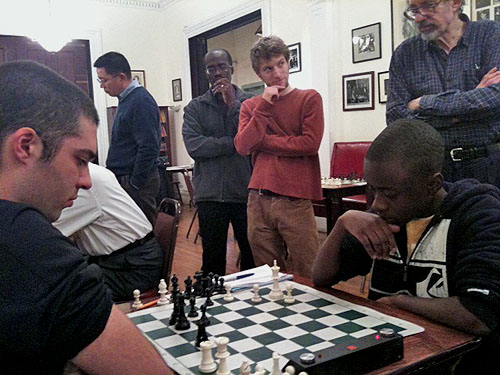
Have you seen the documentary movie Brooklyn Castle? It's an enthralling portrait of a group of New York City middle schoolers who triumph in the field of competitive chess and grow personally thanks to supportive adults, a strong after-school program, and tremendous motivation and hard work. But their success also depends on a factor that is just touched on in the movie: the existence of a robust chess scene, centered on New York's 97-year-old Marshall Chess Club (pictured).

I'd like to ask you to imagine a young chess player who attends a Chicago public school. Maybe the school has a coach provide after-school lessons one day a week; maybe not. Regardless, this young player shows promise and drive and would like to be able to get the same kind of practice and participate in the same kinds of competitive opportunities as the champs in Brooklyn Castle. Unfortunately, 90 percent of all competitive chess activity in the Chicago area takes place in the suburbs -- places like Northbrook, Wheeling and Oak Lawn -- and the player's school and family are unable to provide the necessary transportation to these events. If there were a club in the city, comparable to the Marshall, that offered opportunities to practice and receive structured guidance from experienced players, this player would at least have that chance. But the last such club in Chicago shut its doors 22 years ago.

Are you aware that out of the top 10 urban areas in the United States, Chicago is today the only one without a primary metropolitan chess club? The Chicagoland chess scene is like a collection of planets orbiting a large void where a star used to be -- and city residents of all ages and backgrounds are missing out on the benefits and pleasures of chess as a result.

We want to restore Chicago's place among America's great chess cities and revive the tradition that was lost with the dissolution of the Chicago Chess and Checker Club and our namesake, the original Chicago Chess Center. But we're not creating just another club: the new Chicago Chess Center will be a school of chess, a destination and gathering place, and the focus of a vibrant and expanded chess scene.

Donate now so that we can open our doors on our target date of May 1, 2013.


You may already know about how young people benefit from chess: not only in the logical reasoning skills that chess imparts but also in the "soft skills" of patience, attentiveness, self-discipline, conflict management, sportsmanship, and connecting effort and practice with success. But experience shows that chess is also part of a well-rounded, healthy lifestyle for adults -- like a gym workout for the mind. Your donation will allow us to begin offering classes, tournaments and open play to residents young and old across the city of Chicago.

Click here to make your tax-deductible donation before Dec. 31, 2012 -- or, if you're waiting until 2013 to make donations to charities, send us an e-mail pledging the amount you'll give before Jan. 18.

Sincerely,

Keith Ammann
President, Chicago Chess Center NFP Inc.

P.S. We're off to a great start . . . and we have a long way still to go. You can help us raise the $30,000 we need to secure and furnish a site by clicking here now. Thank you for your support.

Tuesday, December 25, 2012

Never say die!

The shortest decisive master game that wasn't a forfeit or protest is Z. Đorđević–M. Kovačević, Bela Crkva Open 1984, which went 1.d4 Nf6 2.Bg5 c6!? 3.e3?? Qa5+! (winning a bishop) and White resigned. In the 28 years since then, a number of other players have fallen into this trap. ChessBase's Mega Database 2013 shows 12 complete games with this line. Surprisingly, Black scored only 83.3%! He actually managed to lose the following game, letting his queen be trapped with 15...f6?? instead of saving it with 15...Qf6!

The moral of the story: "won games" don't win themselves! When you get a winning position, play accurately and finish your opponent off. By the same token, if you have a losing position, don't give up. Keep the position complicated and set your opponent as many problems as possible. My Wikipedia article on swindles has some inspiring examples of saves from seemingly hopeless positions.

Darrian Robinson at U of C

Story at The Chess Drum

Friday, December 21, 2012

Groucho and Kashdan


Evanston Chess update

Bill Smythe vs. FM Albert Chow
How many times have these two played each other?
Maret Thorpe writes:
Evanston Chess Club usually holds open chess for high school age and over on Tuesday evenings. Problem is, this year Christmas Day and New Year's Day both fall on Tuesday. But we have a solution! For two weeks only, Tuesday night chess will migrate to...Wednesday night. That's right, you can come to the Levy Activity Center on Wednesday, December 26 and Wednesday, January 2 and play chess from 6:30-9:00 p.m. As always, sets are supplied and there is no entry fee. On January 8, we'll be back to our usual Tuesday night schedule. Look forward to seeing you all there.
Follow the link for a report on last month's Tri-Level.

Thursday, December 20, 2012

A trap in Philidor's Defense

Philidor's Defense (1.e4 e5 2.Nf3 d6) has experienced a resurgence of popularity in recent years. However, Black often tries sophisticated move orders, such as 1.e4 d6 2.d4 Nf6 3.Nc3 e5 4.Nf3 Nbd7 5.Bc4 Be7, to reach the main line. The traditional 1.e4 e5 2.Nf3 d6 3.d4 Nd7, the Hanham Variation, seen in the game below, has tactical problems. After 4.Bc4!, Black must already be careful. Then 4...Be7? loses a pawn to 5.dxe5 Nxe5 (5...dxe5?? 6.Qd5!) 6.Nxe5 dxe5 7.Qh5!. So does 4...Nf6?, after 5.dxe5! Nxe5 (5...Nxe4?? 6.Qd5!; 5...dxe5? 6.Ng5!) 6.Nxe5 dxe5 7.Bxf7+ Kxf7 8.Qxd8 Bb4+ 9.Qd2 Bxd2+ 10.Nxd2. Also bad, though complicated, is 4...h6?, when White has 5.dxe5 dxe5 (5...Nxe5 6.Nxe5 dxe5 7.Bxf7+) 6.Bxf7+! Kxf7 7.Nxe5+! Kf6 (best) and now White's best is 8.Nc3!, offering another piece. Instead, Black usually plays 4...c6!, when the main line is 5.Nc3 Be7 6.dxe5 dxe5 7.Ng5! Bxg5 8.Qh5!, winning the bishop pair, which scores very well for White.

An unusual but promising alternative is 5.Ng5!? Nh6 6.a4. Then 6...exd4 may be best, although White won crushingly in Blehm-Popek, 2000. Also possible is 6...a5, although Black fared badly in Pavasovic-Barle, 1997. Nimzowitsch played the eccentric 6...Qf6?!, got a horrid position, but somehow managed to draw in Leonhardt-Nimzowitsch, match 1911.

The most plausible move is 6...Be7?. Amazingly, however, it loses Black's queen by force! After 7.Bxf7+! (again this shot!) Nxf7 8.Ne6! Black has only two squares for the queen. Best is 8...Qa5+ 9.Bd2 Qb6 10.a5! Qxb2 11.Bc3!, trapping the queen, as in Philidor (!) -NN, 1795. Even worse is 8...Qb6 9.a5!, also losing the queen, but for less material. In our subject game, Black resigned after 9...Qb4+ 10.c3! Qc4 11.Nc7+ Kd8 12.b3!

Wednesday, December 19, 2012

"Mate in 196"

Daniel Parmet reports from behind the scenes at the London Chess Classic for Chess Life Online.

Thirty Days

Imagine yourself playing chess in an attractive and comfortable gathering place, surrounded by players of all ages and backgrounds, knowing that you're part of a community and a larger scene. One of the things you love about it is that there's a rated tournament going on whenever you're in the mood, on weekday evenings as well as on weekends, including events for beginners and players new to tournament chess. Another is that, whatever your strength, there's a class you can take that will help you reach the next level. And it's not in New York, San Francisco or St. Louis, but right here at home in Chicago.

You can donate now to the Chicago Chess Center, because you'll be giving to support the creation of a new civic and educational institution.

DonateNow

Your donation will help the Chicago Chess Center secure a site, open its doors, and begin holding classes and tournaments starting this coming May. To make this happen, we're starting a 30-day fundraising campaign to raise $30,000 by Jan. 18, 2013. We're ready to fulfill our promise to you, and we need your support right now:

  • Make your tax-deductible donation now for 2012, or send us an e-mail and pledge the amount you'll give after the new year in 2013.

  • If you've already donated -- and even if you haven't yet -- share our message with family and friends, along with other chess enthusiasts, curious beginners, and anyone who supports education or civic improvement causes.

  • We've announced our membership rates and benefits! Have you thought of giving a Chicago Chess Center membership as a gift? Whether you join as a member yourself or buy a membership for a friend or family member, all memberships purchased before we open our doors will include free entry to up to three tournaments.

    In addition, whether you buy a regular membership or donate $250 or more and join our Founders' Court, you'll receive discounts on classes, lectures and tournament entry fees; eligibility to compete in the annual Chicago Chess Center championship tournament; free admission during open play hours; and wireless Internet access on-site.

Thank you for your interest and your support. As always, please feel free to e-mail us with any questions you may have.


P.S. Thirty thousand dollars in 30 days . . . that's $1,000 a day! We can do this with your help. Please give now and show that after 22 years without one, Chicago is ready to support a centrally located metropolitan chess club again. And please spread the word to everyone you know.

Monday, December 17, 2012

Sunday, December 16, 2012

2013 Winter Open Scholastic

If your child is new to tournament chess and you feel that playing in Tim Just's Winter Open might be a bit too challenging for her or him, there's a nice one- day event running alongside the TJWO on Saturday, January 5th.

Play begins at noon and you can be home in time for dinner: info here.