Sunday, December 30, 2012

University of Illinois ties for first in Pan-Am Intercollegiate

Results are in from this weekend's Pan-Am, hosted by Princeton University.  The University of Illinois finished in a five-way tie for first place with four teams that offer full chess scholarships.  Illinois drew Cornell and the University of Chicago, and won its other four matches. Crosstable is here.Congratulations to the Illini!

 The team includes three names long familiar to Chicago chess players, Eric Rosen, Aakaash Meduri, and Michael Auger. The Illini's fourth board, Xin Luo, scored a spectacular 6-0.

Look for story on Chess Life Online shortly. In the meantime, here's a game from U of I's last-round win over Columbia University, which proves once again that queen endings are too hard for mere human beings:

Chicago Chess Center: Our first milepost


The end of 2012, our first milepost, is nearly upon us. Thanks to supporters like you, we've raised nearly $4,000 so far, but we've still got a long way to go if we're going to be able to secure a site, open our doors, and begin holding classes and tournaments by our target date of May 1, 2013. The more donors like you have given by the end of the year, the better other supporters of Chicago chess will feel about giving.

Please make your tax-deductible donation now for 2012 -- or send us an e-mail and pledge the amount you'll give after the new year in 2013.

When you imagine yourself playing chess in an attractive and comfortable gathering place, surrounded by players of all ages and backgrounds, knowing that you're part of a community and a larger scene, does it ever occur to you how many people it takes to create a scene like that and keep it going? Experience shows that just 1 out of 10 users of a community-built place take an active role in it, and just 1 out of 10 active members are "stars" who make positive contributions to its development. As someone who's shown interest in the success of our mission, we'd like to ask you to be one of our "stars" now. You can do it because you know you're supporting the creation of a new civic and educational institution in Chicago.


This summer, when you're taking a class or playing in a tournament at the Chicago Chess Center, you'll look back on your donation and feel proud that you helped turn a vision into a reality. Donate now to help us reach our $30,000 goal.


A novelty!

Shockingly, I encountered an Internet opponent tonight who doesn't read Chicago Chess Blog! As such, he had failed to read my post from last night demonstrating that 3...f6 and 4...g5 is not an effective response to the King's Gambit. But I wasn't content with 7.Qf7+ and mate in two more moves (7...Kd6 8.Qd5+ Ke7 9.Qe5#) as in last night's partie, and uncorked the novelty (at least for me) 7.Qxg5+! I learned this trick from Wall-Greenwalt, Dayton 1983. If Black responds with 7...Kd6, he gets mated the same way - just without his g-pawn - by 8.Qd5+ Ke7 9.Qe5#. Or he can play 7...Ke8, and get mated by 8.Qh5+ Ke7 9.Qe5#, as Greenwalt did. But NN played a novelty himself with 7...Nf6, allowing me to mate a move faster with 8.Qe5#!

Saturday, December 29, 2012

Silly Internet Game No. 1048

This King's Gambit concludes with a sacrificial flurry. Had Black played 24...fxg6, 25.d6+ would have mated quickly; ditto with 24...Bg7 25.Rxg7+ Kxg7 26.Nxf7+. Incidentally, in the opening 5.e5 Nd5 6.Bc4 was better than my 5.d5, when Black would have been OK after 5...Ne7. On move 16, Houdini 3 points out the powerful shot 16.Nxf7! with a winning advantage.

A trap in the King's Gambit

In the King's Knight's Gambit (1.e4 e5 2.f4 exf4 3.Nf3), 3...h6 intending 4...g5 is a respectable line. 3...f6 with the same idea doesn't work so well. This game duplicates Trap No. 133 in Irving Chernev's book Winning Chess Traps, except that in that game Black played 3...g5 and 4...f6?

Thursday, December 27, 2012

A solar system without a sun

Source: The Chess Drum
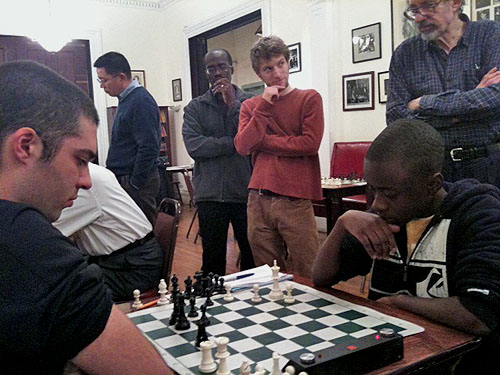
Have you seen the documentary movie Brooklyn Castle? It's an enthralling portrait of a group of New York City middle schoolers who triumph in the field of competitive chess and grow personally thanks to supportive adults, a strong after-school program, and tremendous motivation and hard work. But their success also depends on a factor that is just touched on in the movie: the existence of a robust chess scene, centered on New York's 97-year-old Marshall Chess Club (pictured).

I'd like to ask you to imagine a young chess player who attends a Chicago public school. Maybe the school has a coach provide after-school lessons one day a week; maybe not. Regardless, this young player shows promise and drive and would like to be able to get the same kind of practice and participate in the same kinds of competitive opportunities as the champs in Brooklyn Castle. Unfortunately, 90 percent of all competitive chess activity in the Chicago area takes place in the suburbs -- places like Northbrook, Wheeling and Oak Lawn -- and the player's school and family are unable to provide the necessary transportation to these events. If there were a club in the city, comparable to the Marshall, that offered opportunities to practice and receive structured guidance from experienced players, this player would at least have that chance. But the last such club in Chicago shut its doors 22 years ago.

Are you aware that out of the top 10 urban areas in the United States, Chicago is today the only one without a primary metropolitan chess club? The Chicagoland chess scene is like a collection of planets orbiting a large void where a star used to be -- and city residents of all ages and backgrounds are missing out on the benefits and pleasures of chess as a result.

We want to restore Chicago's place among America's great chess cities and revive the tradition that was lost with the dissolution of the Chicago Chess and Checker Club and our namesake, the original Chicago Chess Center. But we're not creating just another club: the new Chicago Chess Center will be a school of chess, a destination and gathering place, and the focus of a vibrant and expanded chess scene.

Donate now so that we can open our doors on our target date of May 1, 2013.


You may already know about how young people benefit from chess: not only in the logical reasoning skills that chess imparts but also in the "soft skills" of patience, attentiveness, self-discipline, conflict management, sportsmanship, and connecting effort and practice with success. But experience shows that chess is also part of a well-rounded, healthy lifestyle for adults -- like a gym workout for the mind. Your donation will allow us to begin offering classes, tournaments and open play to residents young and old across the city of Chicago.

Click here to make your tax-deductible donation before Dec. 31, 2012 -- or, if you're waiting until 2013 to make donations to charities, send us an e-mail pledging the amount you'll give before Jan. 18.

Sincerely,

Keith Ammann
President, Chicago Chess Center NFP Inc.

P.S. We're off to a great start . . . and we have a long way still to go. You can help us raise the $30,000 we need to secure and furnish a site by clicking here now. Thank you for your support.

Tuesday, December 25, 2012

Never say die!

The shortest decisive master game that wasn't a forfeit or protest is Z. Đorđević–M. Kovačević, Bela Crkva Open 1984, which went 1.d4 Nf6 2.Bg5 c6!? 3.e3?? Qa5+! (winning a bishop) and White resigned. In the 28 years since then, a number of other players have fallen into this trap. ChessBase's Mega Database 2013 shows 12 complete games with this line. Surprisingly, Black scored only 83.3%! He actually managed to lose the following game, letting his queen be trapped with 15...f6?? instead of saving it with 15...Qf6!

The moral of the story: "won games" don't win themselves! When you get a winning position, play accurately and finish your opponent off. By the same token, if you have a losing position, don't give up. Keep the position complicated and set your opponent as many problems as possible. My Wikipedia article on swindles has some inspiring examples of saves from seemingly hopeless positions.

Darrian Robinson at U of C

Story at The Chess Drum

Friday, December 21, 2012

Groucho and Kashdan


Evanston Chess update

Bill Smythe vs. FM Albert Chow
How many times have these two played each other?
Maret Thorpe writes:
Evanston Chess Club usually holds open chess for high school age and over on Tuesday evenings. Problem is, this year Christmas Day and New Year's Day both fall on Tuesday. But we have a solution! For two weeks only, Tuesday night chess will migrate to...Wednesday night. That's right, you can come to the Levy Activity Center on Wednesday, December 26 and Wednesday, January 2 and play chess from 6:30-9:00 p.m. As always, sets are supplied and there is no entry fee. On January 8, we'll be back to our usual Tuesday night schedule. Look forward to seeing you all there.
Follow the link for a report on last month's Tri-Level.

Thursday, December 20, 2012

A trap in Philidor's Defense

Philidor's Defense (1.e4 e5 2.Nf3 d6) has experienced a resurgence of popularity in recent years. However, Black often tries sophisticated move orders, such as 1.e4 d6 2.d4 Nf6 3.Nc3 e5 4.Nf3 Nbd7 5.Bc4 Be7, to reach the main line. The traditional 1.e4 e5 2.Nf3 d6 3.d4 Nd7, the Hanham Variation, seen in the game below, has tactical problems. After 4.Bc4!, Black must already be careful. Then 4...Be7? loses a pawn to 5.dxe5 Nxe5 (5...dxe5?? 6.Qd5!) 6.Nxe5 dxe5 7.Qh5!. So does 4...Nf6?, after 5.dxe5! Nxe5 (5...Nxe4?? 6.Qd5!; 5...dxe5? 6.Ng5!) 6.Nxe5 dxe5 7.Bxf7+ Kxf7 8.Qxd8 Bb4+ 9.Qd2 Bxd2+ 10.Nxd2. Also bad, though complicated, is 4...h6?, when White has 5.dxe5 dxe5 (5...Nxe5 6.Nxe5 dxe5 7.Bxf7+) 6.Bxf7+! Kxf7 7.Nxe5+! Kf6 (best) and now White's best is 8.Nc3!, offering another piece. Instead, Black usually plays 4...c6!, when the main line is 5.Nc3 Be7 6.dxe5 dxe5 7.Ng5! Bxg5 8.Qh5!, winning the bishop pair, which scores very well for White.

An unusual but promising alternative is 5.Ng5!? Nh6 6.a4. Then 6...exd4 may be best, although White won crushingly in Blehm-Popek, 2000. Also possible is 6...a5, although Black fared badly in Pavasovic-Barle, 1997. Nimzowitsch played the eccentric 6...Qf6?!, got a horrid position, but somehow managed to draw in Leonhardt-Nimzowitsch, match 1911.

The most plausible move is 6...Be7?. Amazingly, however, it loses Black's queen by force! After 7.Bxf7+! (again this shot!) Nxf7 8.Ne6! Black has only two squares for the queen. Best is 8...Qa5+ 9.Bd2 Qb6 10.a5! Qxb2 11.Bc3!, trapping the queen, as in Philidor (!) -NN, 1795. Even worse is 8...Qb6 9.a5!, also losing the queen, but for less material. In our subject game, Black resigned after 9...Qb4+ 10.c3! Qc4 11.Nc7+ Kd8 12.b3!

Wednesday, December 19, 2012

"Mate in 196"

Daniel Parmet reports from behind the scenes at the London Chess Classic for Chess Life Online.

Thirty Days

Imagine yourself playing chess in an attractive and comfortable gathering place, surrounded by players of all ages and backgrounds, knowing that you're part of a community and a larger scene. One of the things you love about it is that there's a rated tournament going on whenever you're in the mood, on weekday evenings as well as on weekends, including events for beginners and players new to tournament chess. Another is that, whatever your strength, there's a class you can take that will help you reach the next level. And it's not in New York, San Francisco or St. Louis, but right here at home in Chicago.

You can donate now to the Chicago Chess Center, because you'll be giving to support the creation of a new civic and educational institution.

DonateNow

Your donation will help the Chicago Chess Center secure a site, open its doors, and begin holding classes and tournaments starting this coming May. To make this happen, we're starting a 30-day fundraising campaign to raise $30,000 by Jan. 18, 2013. We're ready to fulfill our promise to you, and we need your support right now:

  • Make your tax-deductible donation now for 2012, or send us an e-mail and pledge the amount you'll give after the new year in 2013.

  • If you've already donated -- and even if you haven't yet -- share our message with family and friends, along with other chess enthusiasts, curious beginners, and anyone who supports education or civic improvement causes.

  • We've announced our membership rates and benefits! Have you thought of giving a Chicago Chess Center membership as a gift? Whether you join as a member yourself or buy a membership for a friend or family member, all memberships purchased before we open our doors will include free entry to up to three tournaments.

    In addition, whether you buy a regular membership or donate $250 or more and join our Founders' Court, you'll receive discounts on classes, lectures and tournament entry fees; eligibility to compete in the annual Chicago Chess Center championship tournament; free admission during open play hours; and wireless Internet access on-site.

Thank you for your interest and your support. As always, please feel free to e-mail us with any questions you may have.


P.S. Thirty thousand dollars in 30 days . . . that's $1,000 a day! We can do this with your help. Please give now and show that after 22 years without one, Chicago is ready to support a centrally located metropolitan chess club again. And please spread the word to everyone you know.

Monday, December 17, 2012

Sunday, December 16, 2012

2013 Winter Open Scholastic

If your child is new to tournament chess and you feel that playing in Tim Just's Winter Open might be a bit too challenging for her or him, there's a nice one- day event running alongside the TJWO on Saturday, January 5th.

Play begins at noon and you can be home in time for dinner: info here.

Saturday, December 15, 2012

The clock is ticking....

We're trying to get the Chicago Chess Center open by May 1, 2013, and in the next 35 days, we need to raise another $27,955—give or take a buck or two —to turn this vision into reality.

What's in it for you and me?  The CCC will be a home for serious tournament play virtually ever weekend, and for for individual and group instruction from absolute beginners to advanced levels.  And we want to make it accessible to everyone in Chicago—at the risk of setting an impossibly lofty goal, the CCC aspires to be to chess players what the Old Town School of Folk Music is to guitar players.

If you haven't already visited the CCC's home page, please stop by to learn more!  And if you have already donated, we'd appreciate it if you could consider upgrading your donation level to join our Founders' Court.  It's OK not to donate before December 31st—this stage of our fundraising campaign is open until January 18th, and we appreciate that many charitably inclined folks like to take the tax consequences into consideration.

Finally, if you'd like to make an in-kind donation (whether it be books for the Center's library or that 2005 Mercedes taking up space in your garage), please drop us a line.  We can turn cars etc. into cash via eBay's Giving Works auction program and provide you with the paperwork to making the charitable contribution kosher in IRS's eyes.  (Or if you'd like to go for the Caissic equivalent of sainthood, you can run eBay Giving Works auctions yourself, and the proceeds can be automatically donated to the Center via Missionfish: please don't hesitate to ask for help on this!)

It's been humbling to get so much support from the community: thank you all for you interest and your support!

Jan 5-6 in Oak Brook: Tim Just's Winter Open

Officially, they're calling it the XXVIIIth edition of the TJWO, but it became clear a couple years ago that Tim had lost count, so let's just say it's the "umpteenth" edition of this great event.

Details on the ICA website.

Enter here!  It's a fun weekend that draws a lot of underrated young players.

Thursday, December 13, 2012

ChessFlash KnightVision

This looks like a nice app for beginners: training in manuevering the horsie!  Available in Android now; Apple version under development.

The author, Glenn Wilson, wrote the ChessFlash reader used on this blog.


Monday, December 10, 2012

Sunday, December 9, 2012

Soundness never tasted so good

Another silly but amusing Internet blitz game. The reader will doubtless be able to find several thousand refutations of my play. 14.Kc2 e3+ 15.Bd3 looks like a good start.

As for the opening, after my 3...dxe4 we transposed to a Blackmar-Diemer Gambit. White's offbeat 4.Bg5!? seems to score very well in the databases, though I suspect that not too many of the players were GMs. Note that 3...Nxe4 4.Nxe4 dxe4, the Hubsch Gambit, was also possible. Gallagher in his book Beating the Anti-King's Indians (1996) says that "the Hubsch Gambit is not so bad and . . . Black can probably only obtain an equal game." OTOH, John Cox in Dealing with d4 Deviations (2005) says that White "finds it awkward to demonstrate any compensation at all" after 5.Bc4 Nc6 6.c3 e5 7.d5 Ne7 8.f3 exf3 9.Nxf3 c6! 10.Nxe5 Nxd5 (10.d6 Nf5 11.Nxe5 Qh4+) 11.Qe2 Be7 12.Be3 Be6 13.O-O O-O 14.Rad1 Qc7; 5.Be3 Bf5 6.g4 Bg6 7.Ne2 e6 8.h4 h6 9.Nf4 Bh7; or 5.f3 e5! 6.Be3 (6.fxe4 Qxd1+ 7.Kxd1 Bf5 8.fxe4 Bxe4 9.Nf3 Nc6 10.Bd3 Rd8 "may still offer White some chances to hold on") cxd4 7.Bxd4 Nc6 8. Be3 Qxd1+ 9.Rxd1 Nb4.