Showing posts with label Boris Gelfand. Show all posts
Showing posts with label Boris Gelfand. Show all posts
Saturday, October 27, 2012
The Ronen Horror Blunder Show!
Just in time for Halloween, Israeli GM Ronen Har-Zvi gives us Part I of The Ronen Horror Blunder Show!, a terrifying collection of blunders in 2012 by super-GMs like Carlsen, Aronian, Topalov, and Gelfand. If you thought your blunders were bad, wait till you see the whoppers produced by the 2700+ crowd. Good stuff.
An aside: Har-Zvi became famous, 10 years later, for having introduced a stunning novelty in the 3.Bb5+ Sicilian, 16...d5!!, in Rublevsky-Har-Zvi, 1993, a game that does not appear in the databases, nor in Chess Informant. Somehow that game, and 16...d5!!, remained unknown to almost everyone until 2003, when the move was "reintroduced" in Delchev-Ivanchuk and other games. Another fun fact: after 1.e4 c5 2.Nf3 d6 3.Bb5+ Bd7 4.Bxd7+, 4...Nxd7 is played much less often than the stock 3...Qxd7, but scores better. GM John Fedorowicz, at his lecture at the North Shore Chess Center earlier this month, revealed that 3...Bd7 4.Bxd7+ Nxd7 is his favorite line against 3.Bb5+. Then there's 3...Kxd7??!, played in the eight-move draw Kochyev-Levin, 1992, but somehow that one hasn't caught on.


Friday, September 21, 2012
Not all opposite-color bishop endings are drawn
Boris Gelfand just won a textbook ending against Hikaru Nakamura in the first round of the Grand Prix event in London:
On the queenside, Black's bishop and two pawns paralyze White's four pawns with a dark square blockade. On the kingside, Black's two connected passers are mobile, and the Black king, bishop, and pawns coordinate with each other.. (Nakamura was even up a meaningless pawn for several moves.) So the final position is an easy win, even for you and me. Opposite-color bishop endings are funny that way: you can be two pawns up and it's a dead draw, or material is equal and somebody's completely winning.I should add that I followed this game live from the new website of The Week in Chess.
P.S. Alejandro Ramirez annotates this game on ChessBase.
Chess Life Online covered yesterday's opening ceremonies.
Saturday, June 9, 2012
Gelfand interview, Part 2

Read it on ChessVibes. But allow me to steal a passage of interest to readers in Chicago, the Twin Cities, and New Jersey (not to mention Belarus, Israel...)
It was wonderful to see that you brought your four coaches to Moscow: Tamara Golovey & Leonid Bondar, Eduard Zelkind, and Albert Kapengut. Please briefly describe what they meant for your chess development.
Sure, it's my pleasure because they did a lot and they're part of my success. I was very happy when they accepted my invitation and came to Moscow to see the match and to cheer for me. Eduard Zelkind was my first coach. I started to work with him when I was six and we worked until I was 11, when he moved to the United States.
So he was the one who taught you that rook ending?
Yeah, exactly! He taught me the rook endings. I still have notes with the rook endings. So it's kind of a disappointment for me that I didn't win this totally winning rook ending in game 3 but it has nothing to do with chess knowledge.
Tamara took over when he moved to the States, and she accompanied me to many events, in Soviet Union Championships, and she gave me some valuable lessons, like before each game you should not only try to remember what you'll play, but you should also move the moves at a chess board because then you'll remember them well. I still do this.
Leonid Bondar is her husband and he was my teacher at the Chess University, the same as where Andrei Filatov was studying, and Ilya Smirin, and Zsuzsa Polgar... He had a lot of prominent students. His passion for chess is incomparable. There we talked about cities, and he told me that Geneva is the best city in the world because in the city parks they have big chess sets! I learnt a lot from his passion and his love for chess.
And of course Albert Kapengut was my trainer for many, many years, till 1993. With his help I won the first Interzonal; I worked the whole first Candidates cycle with him. He taught me a lot of things. Most importantly, he taught me how to deal with information and the importance of information, and how chess players should work on chess. This is the most important thing, I think. You can have the best trainers, the best computers, but if you don't know how to work, if you don't have passion for it, nothing else can help you. These are the most important lessons I got from them. And of course all of them taught me that you should win dignity and lose with dignity.
Wednesday, June 6, 2012
"Lady Gaga would never be invited to play in the Tretyakov Gallery"

Peter Doggers interviews Boris Gelfand on ChessVibes.
***
Tamara Golovey and Leonid Bondar (who taught young Gelfand in Belarus) went to Moscow to watch the match, as did Eduard Zelkind of Minnesota. Other former students of Tamara came from New York, Austria, and Belarus to lend support to Boris. Even the sponsor of the match, Andrey Filatov, was a former student of Leonid: he, Gelfand, Susan Polgar, and Ilya Smirin had all studied at the Academy of Sport in Minsk, where Leonid once worked. We're very fortunate to have Tamara and Leonid here in Chicagoland!
Wednesday, May 30, 2012
Vishy!
I watched the World Championship playoffs from 3 a.m. to 8 a.m Chicago time.: exciting stuff!
Viswanathan Anand first won the unified World Championship in 2007: this is his third successful defense (Kramnik 2008, Topalov 2010, and now Gelfand 2012). Understandably, Boris Gelfand's Chicago fans must be very disappointed, his childhood teachers Tamara Golovey and Leonid Bondar chief among them. But Tamara can be very proud of her student's playing Anand on an absolutely level footing.
The third game of the playoffs was incredibly bizarre, even if one overlooks the tactic Gelfand missed on move 26. Here's the rook ending:
The PGN has been cut and pasted from the official website, with Black's 51st move corrected
per Dennis Monokroussos (and confirmed by me from rewatching the video). (Hmm: the official website appears to be wrong in another respect. Ian Rogers includes a repetition of position on moves 55-57: see below.) Black's 51st move was indeed the blunder 51...Kf5? and not the correct 51...Kf4!: had 51...Kf4 52.Rc8 been played, I can't imagine Anand missing the elementary intermezzo 52...Rc2+ 53.Kg1 Ke5.
It's amazing (and amazingly painful) to see a supergrandmaster blunder in this position:

What in the world was Gelfand thinking when he played 61.59.Rh7?? (My best guess is that Gelfand was trying to prevent Anand from playing ...Kb7 and setting up the Vancura position with a subsequent ...Rg5+, ..Rg6, and ...Rc6. But there's no time for this: White's king simply runs immediately to the h-pawn and relives the Rh8 of guard duty. You can check this yourself with the Shredder endgame database. And as long as White has the rook on h8 and is threatening to push the pawn to h7, Black's king can't come any closer than the c-file because of the beginner's skewer trick (explained by Matt Pullin here).
Of course, when one is playing on a ten-second increment, as Gelfand was, there isn't any time for "thinking." What a painful way to toss away the win! (Time pressure blunders in world championship matches are nothing new, of course; and the mutual blunders in this rapid game are not at all representative of the overall high level of play in this match.)
If world champions and their challengers can get confused in positions with only five or six pieces on the board, we should be more forgiving of our own errors. (This past weekend, I managed to lose a queen for rook and pawn on the White side of a Catalan in only eleven moves: hmm.)
Chess is hard.
***
P.S. May 31
Gelfand had more time than I thought, and the hallucination was mutual. GM Ian Rogers quotes Anand in discussing the above position:
Viswanathan Anand first won the unified World Championship in 2007: this is his third successful defense (Kramnik 2008, Topalov 2010, and now Gelfand 2012). Understandably, Boris Gelfand's Chicago fans must be very disappointed, his childhood teachers Tamara Golovey and Leonid Bondar chief among them. But Tamara can be very proud of her student's playing Anand on an absolutely level footing.
The third game of the playoffs was incredibly bizarre, even if one overlooks the tactic Gelfand missed on move 26. Here's the rook ending:
The PGN has been cut and pasted from the official website, with Black's 51st move corrected
per Dennis Monokroussos (and confirmed by me from rewatching the video). (Hmm: the official website appears to be wrong in another respect. Ian Rogers includes a repetition of position on moves 55-57: see below.) Black's 51st move was indeed the blunder 51...Kf5? and not the correct 51...Kf4!: had 51...Kf4 52.Rc8 been played, I can't imagine Anand missing the elementary intermezzo 52...Rc2+ 53.Kg1 Ke5.
It's amazing (and amazingly painful) to see a supergrandmaster blunder in this position:

What in the world was Gelfand thinking when he played 61.
Of course, when one is playing on a ten-second increment, as Gelfand was, there isn't any time for "thinking." What a painful way to toss away the win! (Time pressure blunders in world championship matches are nothing new, of course; and the mutual blunders in this rapid game are not at all representative of the overall high level of play in this match.)
If world champions and their challengers can get confused in positions with only five or six pieces on the board, we should be more forgiving of our own errors. (This past weekend, I managed to lose a queen for rook and pawn on the White side of a Catalan in only eleven moves: hmm.)
Chess is hard.
***
P.S. May 31
Gelfand had more time than I thought, and the hallucination was mutual. GM Ian Rogers quotes Anand in discussing the above position:
Despite having built up almost a minute on the clock through four quick moves, Gelfand returns the favour. The obvious 61.Kg3-g4 wins, whereas the text move (i.e., 61.Rh8-h7) is too slow by one tempo. “I thought I would get a Vancura position,” said Anand, “but I don't.”And the official website appears to have an incorrect game score in another respect, omitting a repetition of position: the actual final moves were 55.Kg2 Re3 56.Kh2 Ra3 57.Kg2 Re3 58.h5! Re5 59.h6 Rh5 60.Rh8 Kxc6 61.Rh7 Kd6 62.Kg3 Ke6 63.Kg4 Rh1
Monday, May 21, 2012
Wow
Anand wins in 17 moves.: reminds me of games 9 and 10 of the Kasparov-Anand match.
Nice coverage on ChessBase: take their suggestion and check out the end of the game on the official video (beginning at 16:41:00 Moscow time). A whole bunch of 2700 players were shocked, not just Gelfand.
Nice coverage on ChessBase: take their suggestion and check out the end of the game on the official video (beginning at 16:41:00 Moscow time). A whole bunch of 2700 players were shocked, not just Gelfand.
Sunday, May 20, 2012
Gelfand draws first blood
After six consecutive draws in the World Championship match between world champion Viswanathan Anand and challenger Boris Gelfand, Gelfand finally broke through to win game 7. In the final position, Anand has no reasonable defense against 39.Ng6+ Kg8 40.Rg7#. After 38...Rh1+ 39.Kxh1 e1(Q)+ 40.Kh2, Black would have to sac his queen with 40...Qxe5 41.dxe5, leaving White a rook up. WGM Natalia Pogonina, commentating at chessgames.com, observed, "Anand lost this game after provocative/weak play. Nothing special by Boris. Ok, 4-3 in Gelfand's favor, and now we are looking forward to fighting chess in the remaining 5 rounds."
As Pogonina indicates, there are only five games left in "regulation play." If the match is tied at that time, the tie will be broken by a series of rapid games, then blitz games if necessary, and finally if necessary an "Armageddon" game.
Friday, May 18, 2012
Oh yes, the World Championship
Game 6 in progress: right now, Kasparov and Svidler are discussing Gelfand's and Anand's chances on the live site.
Monday, May 14, 2012
Shipov on Anand-Gelfand
Hard to keep up with the World Championship in Moscow (let alone the U.S. Championship in St. Louis) with so much going on in Chicago!
The score after three games is 1½-1½: Gelfand has White in Game 4 (Tuesday, 6 a.m. Chicago time).
Friday, May 11, 2012
Anand-Gelfand: Game 1 drawn
Small surprises, but no bombshell: Anand plays 1.d4, Gelfand plays the Grünfeld, Anand plays an obscure sideline, and Gelfand finds the critical equalizing move 14...Ra7! If anyone had slight winning chances in the final moves, it was Black.
Nigel Short's running video commentary to Game 1 is archived on the official site
Other free sites with coverage:
The Week in Chess
ChessBase
ChessPro (via Google Translate)
Game 2 begins at 6 a.m. local time Saturday.
Nigel Short's running video commentary to Game 1 is archived on the official site
Other free sites with coverage:
The Week in Chess
ChessBase
ChessPro (via Google Translate)
Game 2 begins at 6 a.m. local time Saturday.
Wednesday, May 9, 2012
"A Couch Potato's Guide to the 2012 World Championship"
GM Ian Rogers previews the World Championship match between Viswanathan Anand of India and Boris Gelfand of Israel. Play begins this Friday, May 11th, at 6 a.m. Chicago time.
The players checked out the site this morning: see more photos at ChessBase. Both players have known each other for decades: it's an interesting display of mutual respect that they agreed that no anti-cheating security measures would be needed.
Anand is a 5-1 favorite over Gelfand. (And George Foreman was a 4-1 favorite over Muhammad Ali in the Rumble in the Jungle.) Kids, don't disrespect the player who won the last two Interzonals. (Here's a good trivia question: name all the players who won or tied for first in more than one Interzonal.)
Local angle: our own Tamara Golovey was the first teacher of young Boris. On a couple occasions (World Cup and Candidates Matches), I've called Tamara to congratulate her on her student's win. It pains me to confess to her that I always root for Vishy in World Championship matches.
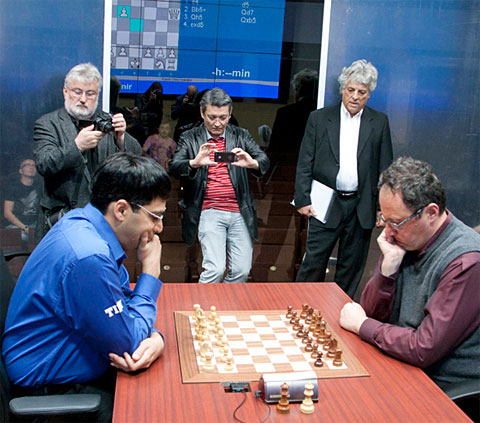 | |
| Anand and Gelfand earlier today: photo credit: H-W Schmitt for ChessBase |
Anand is a 5-1 favorite over Gelfand. (And George Foreman was a 4-1 favorite over Muhammad Ali in the Rumble in the Jungle.) Kids, don't disrespect the player who won the last two Interzonals. (Here's a good trivia question: name all the players who won or tied for first in more than one Interzonal.)
Local angle: our own Tamara Golovey was the first teacher of young Boris. On a couple occasions (World Cup and Candidates Matches), I've called Tamara to congratulate her on her student's win. It pains me to confess to her that I always root for Vishy in World Championship matches.
Monday, August 8, 2011
Wednesday, May 25, 2011
"Gelfand to Challenge Anand for World Championship!"

Tuesday, May 24, 2011
A bang or a whimper?
Boris Gelfand and Alexander Grischuk have been battling like sumo wrestlers or sprint cyclists. The match looks maddeningly peaceful to the spectators, but the experts assure us that they're both playing to win.
If you're reading this post Wednesday morning, check out Game 6, the final game of regulation. Chess in Translation has been live-blogging a translation of Shipov's commentary.
If you're reading this post Wednesday morning, check out Game 6, the final game of regulation. Chess in Translation has been live-blogging a translation of Shipov's commentary.
Monday, May 16, 2011
Bad news, good news
Bad news for the U.S.: Gata Kamsky lost a thriller in the Candidates Semi-Final to Boris Gelfand of Israel. Congratulations to Gata on a marvelous performance in the Candidates! It's heartbreaking to be one move away from moving on....
Good news for Chicagoans: Boris has plenty of local connections. Andi Rosen explained in this 2009 article for Chess Life Online.

I called Tamara Golovey immediately after the Gelfand-Kamsky playoff ended: she was positively giddy!
More at The Week in Chess and ChessVibes; trash talking (sometimes informed) at Chess Ninja.
Good news for Chicagoans: Boris has plenty of local connections. Andi Rosen explained in this 2009 article for Chess Life Online.

I called Tamara Golovey immediately after the Gelfand-Kamsky playoff ended: she was positively giddy!
More at The Week in Chess and ChessVibes; trash talking (sometimes informed) at Chess Ninja.
Friday, May 13, 2011
Thursday, May 12, 2011
Kamsky-Gelfand game 1 drawn
I'm glad to see that Kamsky has decided to do battle in current theoretical positions: the line after 20.Qa5 has been played several times before at the GM level. Didn't work today; might work on Saturday!
In the other Candidates Grischuk was surprised by a Kramnik novelty
In the other Candidates Grischuk was surprised by a Kramnik novelty
Sunday, May 8, 2011
Unnaturally tough resistance brings Kamsky victory
In annotating the final game of the Kamsky-Topalov match for ChessBase, Alejandro Ramirez wisely writes, "In most cases in chess, the position is as natural as it seems." In other words, most of the time, natural moves are sufficient to win a won game. Only the strongest players have the fighting spirit to offer maximum resistance even when the game is objectively lost.
Acccording to the computers, Gata Kamsky was hopelessly lost. But Kamsky drew convincingly, without an obvious blunder by Topalov.


Acccording to the computers, Gata Kamsky was hopelessly lost. But Kamsky drew convincingly, without an obvious blunder by Topalov.

Veselin Topalov-Gata Kamsky
2011 Candidates Match, Kazan, Round 4
After 42...Ke8: White to play
What would you play as White? How deeply would you calculate?

Veselin Topalov-Gata Kamsky
2011 Candidates Match, Kazan, Round 4
After 49.Qd8: Black to play
Black has several reasonable tries here (and perhaps more than one way not to lose), but only one move is clearly best. Can you find it?
Congratulations to Gata Kamsky! Later this week, he'll be facing Boris Gelfand, who has many friends in Chicago himself.
Monday, June 21, 2010
Chess in Translation
Here's a nice addition to the blogroll: mishanp (the handle of a popular commenter at The Daily Dirt) translates interesting articles and interviews from the Russian chess press.
Subscribe to:
Posts (Atom)