Friday, December 18, 2009

Unrated event at Temple Judea Mitzvah in Skokie on Sunday!


 Details here!

Kumbaya Scholastic in Skokie tomorrow

Well, we can't play Christmas Day, can we?  Details here!

World Chess Live

I was at a Christmas party in Evanston last night, and spoke for a few minutes with Joel Berez of the Internet Chess Club last night.  Joel explained to me that World Chess Live is intended to be a family-friendly, beginner-friendly companion of the ICC. 

I've heard nothing but good things about World Chess Live, so if you're looking for a place for you or your children to play online, I encourage you to check it out!


Chicago Chess Academy tourney tomorrow!

Time for the Magnificent Dozen.   Details here!

McHenry Quad Tournaments tomorrow


Details here!

game theory anecdote

I've already mentioned the awesome sauciness of iTunes U: there's a lecture series of special interest to chess players (and business and science and poker folks): Ben Polak's Introduction to Game Theory.  You don't need iTunes to access this content. 

This gives me an excuse to recycle my chess-meets-Freakonomics story (an earlier version was told on the ICA message board last year).

Memorial Day Weekend 2008: I was walking around the lobby of the Westin Chicago North Shore in Wheeling, waiting for the round one pairings of the Chicago Open.  A grad student from the U of C School of Business waves a copy of Stephen Levitt's Freakonomics at me, explains that she's taking a course with Prof. Levitt, asks me if I was rated over 2000, and whether I wanted the chance to make some money in an experiment.  "Sure."

(Freakonomics is a very entertaining book on economics in nontraditional settings: it's a fun read, and you can get a taste of Levitt's approach to the world from his blog.)

Between rounds, I'm taken to a hotel room & seated at a computer terminal with a proctor there to read me instructions.  I was told that I would be playing against another ELO 2000+ guinea pig in another hotel room (that's what I was told: I don't know this for a fact).  My moves in all games were sent by computer, and my opponent's moves were communicated to me by the proctor.

Game 1: I am player 1 in a two-player game for $10.  On my turn, I am to name an integer between 1 and 9 inclusive.  Then Player 2 does the same.  We are to keep track of the running total of all integers.  (So if I say "9" & s/he says "8", the running total is 17.)  The first to get the running total to 100 wins.  (Do you see a winning strategy for either player?)

Game 2: Again, I am player 1 in a two-player game for $10.  The rules are the same as Game 1, except we're now allowed to name integers between 1 and 10 inclusive.  Again, the first to get the running total to 100 wins.

Here comes the spoiler....


Games 1 and 2 are variants of the game of Nim.  Game 1 is won by player 2 by force; Game 2 is won by player 1 by force (assuming correct play; and indeed we played correctly).

In game 1, player 2 simply picks a number that will bring the running total to 10, 20, etc. I immediately grumbled to the proctor that I was handed a lost position; she smiled & continued reading the instructions. Once I realized that player 2 understood the correct strategy in game 1, I tried to resign; the proctor asked me to play on. I kept choosing "1" to suggest to my unseen opponent that I knew s/he knew that s/he would win by force.

The winning move is Game 2 is for player 1 to choose "1" as the first move, then bring the running total to 12, 23, etc., with the subsequent moves (because 1 + [9 x 11] = 100). I suspect that these first two games were intended to be trivial, to make sure the chess players were capable of thinking in a certain mindset, and perhaps even to trick us into thinking in that mindset.

Which brings us to Game 3.


Game 3:  Again, I am player 1.  Each player can make a maximum of three alternating "moves" each: the moves are simply "Continue the game" OR "Stop the game."  Whatever Player 2's decision on Move 3, the game ends.

Here's the payoff matrix:

If stopped by player 1 on move 1
1 gets $4
2 gets $1

If stopped by player 2 on move 1
1 gets $2
2 gets $8

If stopped by player 1 on move 2
1 gets $16
2 gets $4

If stopped by player 2 on move 2
1 gets $8
2 gets $32

If stopped by player 1 on move 3
1 gets $64
2 gets $16

If stopped by player 2 on move 3
1 gets $32
2 gets $128

Else Game Ends and...
1 gets $256
2 gets $64

There is a certain logic to stopping the game immediately, taking the $4 for Game 3 (plus whatever earlier winnings one had), and saying goodbye.  In fact, I later found out that that's what NM Owechukwu Iwu did when he was Player 1 in this game.  (And he's beaten me in two consecutive Chicago Opens, so he knows a little bit about games.)

Here's the logic for stopping immediately.  Assume that the first five moves of the game are "continue."  Player 2 would have to be rather magnaminous to "tip" Player 1 by continuing the game at the end of Turn 3: the game must then end immediately anyway, and Player 2 would only get $64 instead of $128.  If Player 1 knows that Player 2 will end on Turn 3, then Player 1 will end on Turn 3, which means that Player 2 should end on Turn 3, which means that Player 1 should end on Turn 2...etc.  (Keep in mind that the experimenters have done their best to prevent collusion between the players: the "grandmaster draw" or thrown game is not an option.)

It is my strong personal opinion that (given this particular payoff matrix), this extremely logical analysis is sub-optimal because we're not playing a zero-sum game.  In fact, the University of Chicago Grad School is injecting cash into the game with every move.  (After a very long pause, I moved "continue".  The game concluded: Player 2: "continue," Me: "continue"; Player 2: "stop."  So I lost and received $8 for Game 3; while my opponent received $32.


What do you think the grad students were looking for?  And why were they testing chess players?

Cheers in Chicago for Gelfand


Tamara Golovey and Boris Gelfand


Boris Gelfand and Tamara Golovey


The French have a word for it


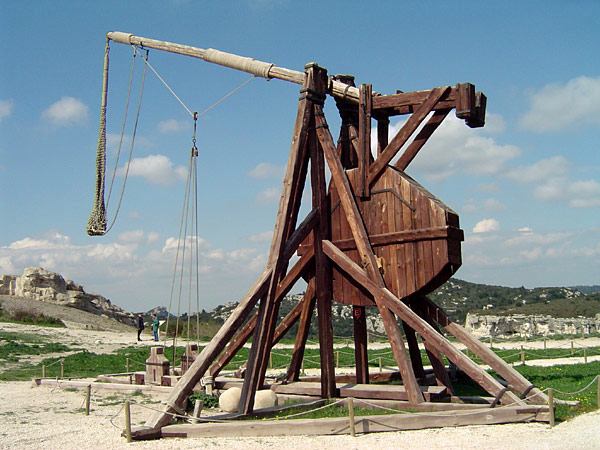
Le Trébuchet

What is White's best move in the above position?  (It is not often that a move is so bad that double question marks magically appear on the chessboard.)


The other kind of trébuchet: useful when besieging enemy fortresses
(but I don't see the resemblance)


Thursday, December 17, 2009

Young is a First Team All Star

Congratulations to IM Angelo Young of the Chicago Blaze for being named an all-star in U.S. Chess League's first team. The league has first, second, and third all-star teams, and Angelo is Board 3, behind GMs Hikaru Nakamura and Boris Gulko, on the first team. With NM Eric Rodriguez on board four, that's one heck of a team.

This comes as no surprise whatsoever, of course. Angelo was undefeated in six USCL games this year, extending his undefeated streak from the 2008 season. He's never lost a USCL game.

It's hard to find anything new to say about Angelo's extraordinary performance that hasn't been said before. He won the league Upset of the Week prize twice (a record), and won a game on Board 1 against a much higher rated player in a match where Angelo was filling in at the last minute for a sick teammate. Amazing.

Congratulations, Angelo!

Cross-posted from the Chicago Blaze blog.

Tuesday, December 15, 2009

chess on the iPhone (part 1)

Back in the 1980s, I was embarrassed when I started routinely losing to computers.  Now I lose to my telephone, and it doesn't bother me that much.  

Although I've lived my entire geek life in PC-land, I am a big fan of the iPhone.  The lectures on iTunes U are in my opinion enough to justify the two-year additional cost of ownership.  Having said that, I don't think the iPhone is an essential tool or even a particularly useful tool for chess players.  (They do make cheating on the toilet easier, so perhaps they are already de rigueur among a certain subset of World Open participants.)  But if you've already drunk the Apple Kool-Aid, there are a couple chess apps that are nice to have.  I thought I'd tell you about the ones I have.

ChessClock (Samuel Kass) is one of several chess timer iPhone apps.  It's not really suitable for tournament play.  No iPhone app ever could be, as the touch screen doesn't give you tactile feedback  (Nothing is more annoying than double-checking that you successfully stopped your clock in a time scramble.)  But you can put the iPhone in airplane mode, turn off the volume, and use it as an emergency tourament clock.  I've done this a couple times in the past year: it's acceptable for that limited purpose.

The clock is also the clock button!

There's also an "analog" mode: cute, but not very useful.


I play chess, so I'm not totally dense.  But I'm also one of those over-50 people who has delegated control of home entertainment systems to the teenager in the house, and I am intimidated by the non-intuitive methods of setting certain chess clocks.  ChessClock shines in this regard: it supports Fischer, Bronstein, and "USCF" (andante) modes (Bill Smythe explains the differences here) for any increment between 1 and 59 seconds.


There is no handicap option for giving one player a larger increment, but one can easily give one of the players more time in the main time control.  The settings are simple and intuitive.


You can only set the clock to the nearest minute, but the digital display gives you the nearest tenth of a second.  Strange. 

The price is right at $2.99: it's fine for casual rapid play (or family Scrabble games), and when the iPhone is fully charged, it can be used as an emergency substitute for a round of tournament play.  It won't work for blitz play because of the tactile feedback problem.  But if you use the app once, it pays for itself.  Recommended.

Monday, December 14, 2009

2009 Illinois Class Championships

Congratulations to Grandmaster (and reigning Illinois Open Co-Champion) Mesgen Amanov, winner of the top section of the 2009 Illinois Class Championships with a solid 3.5-0.5 score.  International Master Angelo Young, FIDE Master Aleksandar Stamnov, and Class A player Michael Chen of Michigan tied for second, each with 3-1. 

And congratualtions to the winners of the class sections: Mike Mei (Class A), Tony Christian (Class B), Roquito Bruno and Jae Lim (sharing Class C honors), Lauro Nava (Class D), and Pavithra Ramakrishnan (Class E / Unrated).  Thanks to Sevan Muradian of the North American Chess Association, who organized and directed this Illinois Chess Association event.

Here are the full results from the U.S. Chess Federation's Member Services Area (MSA).  (Click on the image below or the preceding link to get a legible copy.)


"Tasty" tactics


Black to play and win

Dvoretsky's problems typically make my head hurt. But I did (farily quickly) score 75% on the first four: the only one I missed was the one I'd seen before!

Gelfand wins World Cup

Back to work!

Gelfand leads 7-6 in playoffs

One more blitz game to go? You can follow the action here. (The London Chess Classic games are being broadcast on the same site.)

Gelfand - Ponomariov, tiebreak round 4

Gelfand-Ponomariov
Black to move played 25...Bxb3!?
 
Former FIDE World Champion Ruslan Ponomariov of Ukraine just won a clutch game with Black to tie up the playoffs with Boris Gelfand of Israel.  Match score is 4-4: play continues immediately.  

Sunday, December 13, 2009

Saturday morning chess in Wheaton

Bad pun alert: Knights in the Morning. We're told it's beginner-friendly!

Pawn endings are hard (part 2)


White to move
Bill Brock - Andrew Taylor, MCA FIDE, 6 Dec. 2009

Please consider the following notes provisional: I'm still not quite sure what's going on in this ending.

Every pawn ending starts as something else: in this case, a bishop ending.  In the diagrammed position, I thought I was slightly better despite the doubled f-pawns because the e5 pawn restricts the Black bishop's scope.  I should have been more worried about my kingside pawn structure.  My f2 pawn is on a dark square and part of a doubleton.


27. Kb4?! 
27. Be3 is equal
27... Bf8+ 28. Ka5
Is this king penetrating towards victory? Or is it hopelessly offsides?
28. Bc5 29. Be3 

After 29.Be3: Black to move

29...Bd4!
The pawn ending is not yet winning.  29... Bxe3 30. fxe3 g5 31.
Ka6?? h5 32. Kxa7 f5! 33. exf5 e4 34. fxe4 g4 35. f6 Kd7 is an easy win for Black.  But 31.Kb4! holds the draw.

30. Ka6??
I should have sacrificed a pawn to stay in the bishop ending with 30. Bg5!?
30... f5?
Black breaks through with 30... Bxe3!! 31. fxe3 g5 32. b4 h5 33. Kxa7

Analysis position: Black to move after 33. Kxa7
33...f5! is a beautiful breakthrough combination: if White takes the f pawn, then 34...e4! deflects the f3 pawn, after which the g5 pawn runs free.

31. exf5 gxf5 

After 31...gxf5: White to move
32. f4!
And somehow it's a draw again....
31... Bxe3 33. fxe3 exf4 34. exf4 b4!
I completely overlooked this strong and natural move (the b4 pawn paralyzes both a2 and b3).

White to move: 
there is nothing in the Rules of Chess that expressly prohibits counting on one's fingers
35. Ka5??
The only move is 35. Kxa7!: I simply did not believe that this move could possibly draw (it seems so time-consuming to grab a7, then run back to grab b4), but the a2 pawn runs quickly, and the Black king has to make a clearance move for the f5 pawn. 35... Kd5 36. Kb6 Ke4 37. Kc5 Kxf4 38. Kxb4 Kg3 39. a4 f4 40. a5 f3 41. a6 f2 42. a7 f1=Q 43. a8=Q

Analysis position: Black to play (looks like a draw)

Back to the game

35... Kc5 36. Ka4 h5 37. h4 Kd4 38. Kxb4 Ke4 39. Kc3 Kxf4 40. Kd2 Kf3! 41. b4 f4 0-1


Thursday, December 10, 2009

On the Complementarity of Queens and Knights


Interesting reading at Confessions of a Chess Novice.

Aloha


Retiring the colors
Naturalization ceremony, 9 Dec. 2009, U.S. District Court, Honolulu

I was subpoenaed to testify as a fact witness before a grand jury in Honolulu yesterday.  Of course, it was great to get away from our miserable weather for a couple days.  But spending seventeen hours on a plane is less fun than watching games from the London Chess Classic or the Ponomariov-Gelfand World Cup final.  And gorgeous tropical weather notwithstanding, I'll take Chicago.

When the grand jury recessed for a sushi break, I got to witness the end of a naturalization ceremony.

Pawn endings are hard (part 1)

I managed to fish out a win from a totally drawn position, but both of us missed a lot of subtleties in this innocuously vanilla position.

Tuesday, December 8, 2009

Knights Win USCL Title

In “stunning reversal of fortune,” losers are heroes in tiebreaks

Congratulations to the New York Knights, who have defeated the Miami Sharks to win the 2009 U.S. Chess League Championship. Last night's regulation match ended in a draw. As the USCL site reports:

“For the fourth year in a row the USCL Finals came down to a blitz tiebreaker. Two players lost during regulation, GM Giorgi Kacheishvili and IM Alejandro Moreno Roman. In a stunning reversal of fortune, both of these players were heros in the blitz tiebreaker. Moreno Roman knocked off everyone on New York's team except for Kacheishvili. Kacheishvili then turned around and did the exact same thing to Miami, finishing things off by defeating GM Julio Becerra with the black pieces.”

Perhaps because the Chicago Blaze were not in the playoffs, I have been remiss, I must admit, at covering the fairly exciting post-season action in the USCL, and as it happens I don't have time to redress that neglect at the moment with a lengthy post (all the usual excuses). Go to the USCL site to see all the playoff games.

In due course I'll try to bring Blaze fans up to speed on the thrilling 2009 USCL postseason.

(Cross-posted from Chicago Blaze blog)

Monday, December 7, 2009

"Gangly"?

Boris Gelfand is having a great performance in this year's World Cup.  Mig compares him to L.A. Lakers utility man Kurt Rambis.

After a 2005 Chicago simul. from left: pudgy blogger, Lana Pritzker, Boris Gelfand, Tamara Golovey, Leonid Bondar, nice person whose name I forgot

Mig writes:
The word "gangly" was invented to describe Boris Gelfand. He's got a Kurt Rambis vibe, that supporting cast feel that makes you think he's destined for a life as a character actor, never the leading man. But you sleep on him at your peril, as player after player has found out at the World Cup in Khanty-Mansiysk. The Israeli veteran, both the top seed in the event and one of the oldest players in the original field at 41, smoothly disposed of Jakovenko in the rapids, drawing the first with black and then winning two in a row. And he's already halfway to the final match, wasting no time and beating Sergey Karjakin with the black pieces in a sharp attack. Always one of the deepest calculators in the game, Gelfand's preference for slower play, and especially his recent dropping of his Najdorf for the Petroff, make this a welcome reminder of how tactically acute he is.

Sunday, December 6, 2009

Whose Plans Matter?

Bill has graciously invited me to guest blog here. I work with the Prospect High School chess team. The following game is from last week's match between Prospect and Rolling Meadows. Robert Moskva is a freshman at Prospect who came out for the team after the soccer season ended. This is his first experience with OTB, having only played on the internet before. We started him on 5th Board, moved him up to 3rd, and then moved him up to 1st against's Barrington's Zach Kasiurak, who he gave a whale of a game which can be found at ProspectChess.


To pursue your own plans or thwart your opponent's plans: that is the difficult question that comes up time and time again. Sometimes players ignore each others plans completely when they castle on opposite sides of the board and launch attacks against each other's kings because everything depends on who breaks through first. More commonly, however, the players must solve the problems their opponents are creating as well as create problems for their opponents to solve.

Before sending me his score from his game against Tom Chung in the Prospect-Rolling Meadows match, Robert Moskva wrote down what he was thinking at several points during the game. I found this very helpful as I usually have to guess at what might have been going through a player's mind. In the opening, Robert spent too much time defending against possibilities that were not very dangerous, but in the ending, he did a very good job of assessing which threats were worth worrying about.

My comments are in blue italics.

1.e4 c5 2.Bc4
This is a perfectly logical developing move, but it is rarely seen at the master level. In most cases, White would rather wait to see how Black develops before he decides where he wants this bishop. 2...Nc6 (2...e6 is more popular, but i wanted to play a solid, well thought-out game) My choice would have been 2...e6, but I like the thinking behind this move. Black isn't sure exactly how he wants to deploy his pawns, but he knows that he's going to want the knight here so he defers the decision about his pawns for a move. "Knights before bishops" is sometimes cited as a principle of opening development (although I don't think it qualifies as much more than a rule of thumb). I think the point is that the bishops have a lot more possible destinations, each of which requires a pawn move. Knights really only have two, so developing a knight first leaves more flexibility.


3.Nf3 d6 4.Nc3 Nf6 5.0-0 e6
(blocked my bishop, but it shortens opponents bishop diagonal and I'm planning to play d5 at one point) Interesting thing about the blocked bishop: other than the Classical Variation of the Caro-Kann, I cannot think of any mainline openings in which Black's light squared bishop ventures out to f5 or g4. I'm not really sure why this is so. 6.d3 Be7 7.d4? (? because he wasted 2 moves for the same idea) 7...cxd4 8.Nxd4


Now we have reached an Open Sicilian where White has an advantage in space and easy development. As compensation Black has a very solid compact position, an extra central pawn, and the possibility of counterplay on the c-file. If White wants to make something of his advantages, he is almost obligated to launch an attack against the Black king. Black usually expands on the queen-side, often targeting White's pawns. Sicilian endgames tend to be good for Black. Timing can be crucial in the middle game though, so the fact that White spent two moves to get the pawn to d4 is a serious drawback.
8...0-0 9.Nf3?! By bringing the knight back to f3, White is signaling peaceful intentions. It would be hard for him to get an attack going without advancing his f-pawn. 9...h6 (Once again, he makes an odd move order, but I played h6 in order to stop any funky bishop or knight g5 stuff followed by maybe bxe6 and then Nxe6. So in a way, I'm proving his light square bishop a bit more useless) This is a bit too much precaution for my tastes. I don't think that Bg5 is that dangerous when Black has already played ...e6, ...Be7, and ...0-0. There is a little tactic Black should know about that sometimes wins a pawn against Bg5. 9...a6 10.Bg5 h6 11.Bh4 Nxe4!? 12.Bxe7 Nxc3 13.Bxd8 Nxd1. As far as Ng5 goes, if White had been thinking about Nxe6, he would have left the knight on d4. 10.Bb5 a6 11.Ba4


11...Qc7
(I had to make a tough choice,did I want to win the pawn or not? I chose not to because my pawns would be very extended and my position would be slightly awkward, and from what I have realized I have a reputation for blowing good positions, so I played more solidly trying to prevent e5) Having played the Sicilian for years, I can say unequivocally that Black must be careful about trying to pick off the e-pawn this way. However, I would have gone for it for based on the following logic: (1) Black has developed reasonably in the usual Sicilian fashion; (2) White has lost time by using two moves to get his pawn to d4, moving his knight back to f3, and moving his light squared bishop three times. (3) If the Sicilian Defense is sound (which it undoubtedly is), Black should be able to take advantage of White's dilly-dallying. After 11...b5 12Bb3 b4 13 Ne2 Nxe4, Black's position is dominating.


It is not possible to calculate every possible line or visualize every possible position, particularly in shorter time controls. Therefore, a player has to factor in his assessment of the relative development when choosing between thwarting plans or pursuing. If he is confident that he has done a better job developing than his opponent, then the chances are that his own threats will be more dangerous and he shouldn't let them slip away.


12.Bxc6 bxc6 13.Re1 d5 ( I finally allow the pawn push but in exchange He now has to worry about the pawn a little and the only truly open side for play is the queen side, which I have the advantage in) An accurate assessment and quite typical of the Open Sicilian. 14.e5 Nd7 15.b3 Bb7 16.Bb2 c5 (Now I decided I was defensively solid, so I'm trying to win his pawn/storm him with my pieces) I think Robert was defensively solid several moves ago and that he has let his opponent get more solid in the meantime. 17.Nb1 Nb6!?(Better was 17...Rfb8, should've kept some pressure on e5) I like the rook move, but I think this is fine, too. I don't think that pressure against e5 would really do much for Black as White has it more than adequately protected. 18.Nd2 c4?! A good idea but it gives White a lovely square for a knight or a bishop on d4. I think Black could have increased the pressure with 18...a5 or 18...Rc8. 19.Bd4 Rac8 Why not the other rook? 20.Qe2 cxb3(20....Nd7 21. c3)21.Bxb6?(why give it up?)Qxb6 22.cxb3 Rc2 (I should've tried to open up my light-squared bishop with a5! but I got to excited with my position) Robert may be right about this. His neglect of that bishop was a problem in this game, but it is hard to resist the temptation of putting a rook on your opponent's second rank. 23.Rec1 Rfc8 24.Qe1 Qc7?!(24...Rxc1 25.Rxc1 Bc5! and black is clearly winning) I am always reluctant to use phrases like "clearly winning" when analyzing games between high school players, but Black certainly would have had a strong position. 25.Rxc2 qxc2 26.Ne1 Qxd1 27. Rxd1 Bg4?!


I think that most masters would prefer to have the two bishops in this ending, particularly with pawns on both sides of the board. The key to exploiting the bishops is opening lines for them. I would have liked to see 27...a5 to get the light squared bishop into the action or 27...f6 to open things a little on the king-side.

28.Nef3 Rc2 29.Nxg5 hxg5
Robert is stuck with a "bad" bishop because his pawns restrict its movements. 30.a3 Bc6? Robert finally tries to get his bishop into the game, but this allows White to get his knight to a more active square. 30...Rc3 would have kept the knight tied down defending the b-pawn. 31.Nf3 Rc3 32.Nxg5 Nxb3 33.Rc1 g6??


(All the advantage I had was lost, simply 33..Rxa3 and I'm fine, I just did the move for extra precaution on the back row, but in exchange white got a great knight) I think that "??" is unduly harsh, although 33...Rxa3 was certainly stronger.) 34.f3 Be8 35.Rc8 Kf8 36. Nh7+ Ke7 37.Nf6 Bb5 (It was essential that I play my defense in pin-point accuracy, and I'm glad to say that I did) "Pin-point" might be a little too strong, but I really do like the way Robert keeps his wits about him with a White rook and knight deep in his territory. 38.Rc7+ Kd8 This is a key point. Black's only chance to make progress is by giving up the f-pawn. If he plays 38...Kf8, White can force a repetition with 39.Rc8+ Ke7 because 39...Kg7 would give White nasty mating threats after 40.g4. 39.Rxf7 Rxa3 40.Rg6 Bd3(Seems like this move allows the deadly-looking Rd7+, but it is a harmless check and his position would end up the same in any way, I wasn't bothered by his possible little advantage, I was happy with my past a-pawn) After being unduly cautious earlier in the game, Robert does a very good job of figuring out which threats are really worth worrying about in the endgame. 41.Kf2 a5 42. Ra7 a4 43.Ra8+ By this point White is in serious time-trouble and he succumbs to the natural temptation to deliver some checks. It is a serious mistake, however, because it lets the Black king off the back rank and allows it to support the a-pawn. This is one of the most common errors that inexperienced players make in endgames, i.e., checking the opposing king and driving it where it wants to go rather than confining it. 43...Kc7! (important to play the kind here contrary to 43...Ke7 because that allows a bit of chance for a draw, while the more crazy looking 43...Kc7! maintains my advantage) 44.Ne8+ Again pushing the Black king where he wanted to go anyway. Inexperienced players tend to think "Always check because it might be mate." Stronger players know that checking is frequently a mistake and should not be done without good reason. 44...Kb7 45.Ra5 Bc2?(d4!) It would have been good. 46.Nd6+ Kb6 47.Ra8 Ra2 48.Rg8? a3 49. Ke2??(I'm guessing it was time trouble, but this blunder cost white the game) After 49.Ke3 Rb2, White is still losing because he is going to be forced to give up his rook to stop the a-pawn, but this does make Black's life easier.49...Ba4+!(Just a bit better than Bf5+ and less riskier by far) Actually, it is quite a bit better. 50.Ke3 Rxg2? This gives White a chance to prolong the game. 50...Re2+! 51.Kxe2 a2 would have been quicker. 51.Nc8+?? Once again, an impulsive check in time trouble. After 51.Ra8! Bd1 52.Rxa3 Rxh2, Black would be up a pawn but would have a lot of work left to do. Now there is no way for White to get to the a-pawn. 51...Ka5 52.Ne7 a2 53Ra8+ Kb4 54..Rb8+ Ka3!(Now all is lost. The earlier ...Ba4+ was a very useful move; it safeguards the king) and it shields the pawn. 55. Ra8 a1/Q 56.Kf4 Qd4#.


Crossposted at ProspectChess.

Illinois Class Championships in Skokie this Saturday

The Holiday Inn in Skokie is right off the Edens.
View Larger Map

We hope to see you there!

Tales from the front

Larry Cohen steamrollered me last night at the MCA FIDE Futurity.
Stop by and say hello: rounds today are at 11 and 3. Touch Move Chess Club is at 5639 N. Ashland.

Chess in Wikipedia

A chess-related article is on the Main Page of Wikipedia as Today's Featured Article for only the fourth time ever. The article, about the obscure 19th-century chess player and writer George H.D. Gossip, was almost entirely written by me. After today, the article will be available only at its usual location in the online encyclopedia.

Saturday, December 5, 2009

Before the Fischer-Larsen match

7/23/1971.

The Knight of the Iguana*

There’s some good news on the local chess front in the Windy City. Since my panicky post last summer about the imminent demise of the Chicago Chess Meetup Group, people have stepped up to rescue the group from extinction. Particularly active in the institution’s revival has been NM Bruce Kovalsky, who as far as I can tell moved here recently from the West Coast and has since put a lot of energy into chess organizing. First Bruce was scheduling meetups at various Starbucks on the Near North Side. Now he’s putting one together for the Iguana Café at 517 North Halsted on December 17. I’m told these get-togethers are a lot of fun. Go here for more information about the December 17 event and here to sign up for the Chicago Chess Meetup Group.

This is a good chance to get out of the house and away from the Internet, to meet some nice people, eat some good food, play some real, over-the-board chess, and support your local chess organizer.

* My apologies to those of you who are allergic to bad puns. Sometimes I just can't resist.


Friday, December 4, 2009

I don't know whether there are spots remaining in tomorrow's Futurity....

But if you're rated over 1500 USCF/FIDE and you feel like playing this weekend, you might call and ask. The event is being held at Touch Move (5639 N. Ashland): no on-site entries!

UPDATE: Just got off the phone with Chris Baumgartner: there might be two or so spots still open.

Scholastc tournament in West Chicago tomorrow!

Details on the Patrick Machaj Memorial are (as always) on the ICA Tournament Calendar.

1972 makes me think of Lubosh Kavalek...

...which in turn makes me think of his wonderful Washington Post column. Free registration is required: if the link doesn't work, just Google "Washington Post Kavalek" -- you'll find great material here.

A trick question


Black to play


1) Find a good move that gives Black (extremely slight) practical chances to win. 

2) So what's the trick?

A delightful diagram of 29...Bxh2

The graphics are worthy of John Madden. LIFE correspondent Brad Darrach is the author of Bobby Fischer vs. the Rest of the World: it's a page-turner that non-players will enjoy, too.

Wednesday, December 2, 2009

calling all web geeks

A technical question: I thought that ChessFlash left the game in "pure" PGN. When I cut & paste from ChessFlash to PGN (by clicking thru on the link, then highlighting the target page's PGN input), the PGN comes out garbled on ChessBase. Am I doing something wrong?

LIFE magazine, May 19, 1972

Training at Grossinger's.

Monday, November 30, 2009

Chicago Blaze tactics

The Chicago Blaze did not make the U.S. Chess League playoffs, but I think they had a much better season than the Chicago Bears are having. Our state co-champion, IM Florin Felecan, found a killer shot in this position:


White to move

Felecan - Mikhailuk, Chicago Blaze vs. Seattle Sluggers


Sunday, November 29, 2009

One way to stop Scholar's Mate

I'm sure we'll be hearing from Messrs. Nakamura and Parham soon.

Scholar's Mate: the Movie

Check out this hilarious film clip.


Of course, the opening sequence commonly known as Scholar’s Mate (1.e4 e5 2.Bc4 Bc5 3.Qh5 Nf6 4.Qxf7#) is not just a funny video; it is, as Chess Corner observes, “the most common trap a beginner falls into.”

It’s common because it’s an easy way for the attacker to get a fast and, some would say, cheap victory. Scholar’s Mate works by exploiting the weakness of the opponent’s f7 pawn, which at the beginning of the game is guarded only by the King. If you can quickly build up an attack on that square and send in your Queen with protection, your opponent’s King can neither escape nor capture the attacking piece. The heartbreaking result: checkmate on Move 4.

Because Scholar’s Mate is so widely played in scholastic tournaments and chess clubs, it should be one of the first things every new player learns. Learning the right defensive moves is all it takes.

Scholar’s Mate raises ethical questions, most notably: Should you yourself use it when you suspect your novice opponent may not be prepared for it? One could argue that every new player should be on the receiving end of Scholar’s Mate once, just so he or she knows what it’s like and learns to combat it. I won’t pass judgment on the issue, but if nothing else all chess kids should know Scholar’s Mate and how to avoid it. Note: I'd like to thank Bill Brock for inviting me to join his distinguished stable of bloggers at this site. I'm humbled to be among them. Bill made a special call for introductory instructional material, and Scholar's Mate is about as introductory as you can get.

World Cup tactics - Round 3


White to play

Judit Polgar - Boris Gelfand,  2009 World Cup

If only White could play 1.Bf6+.... (White has more than one way to win here, but only one instant kill.)

"Nakamura Blitzes Carlsen in Norway"


Story at Mig Greengard's The Daily Dirt; games at US Chess Online.