The Caro-Kann (1.e4 c6) is an annoying opening to play against; White gets only a small edge, if that. The trap below is essential to know if you play either side of the Caro-Kann. It can win you a lot of points as White. Those who play the 2.d4 d5 3.Nc3 dxe4 4.Nxe4 Bf5 line will often blithely play 4...Bf5 against the Two Knights Variation (2.Nc3 d5 3.Nf3) as well, erroneously thinking that there is no significant difference between the two lines.
Black should avoid this trap by playing ...Bg4 on move 3, 4, or even 5, or by playing 4...Nd7 or 4...Nf6, with a likely transposition to standard variations. On move 7, 7...Qd6! (Mayka-NN, c. 1975) is the best try. After 7...Bh7?, Lasker's 8.Qh5! forced 8...g6, leaving Black's bishop looking horrible on h7. His 9.Bc4 again threatened mate, making 9...gxh5?? impossible. Note that 9...Qxd2+ 10.Bxd2 gxh5 would avoid mate, but lose material to 11.Nxf7 or 11.Bxf7+. After 10.Qe2, Black should have played 10...Qe7! guarding f7, when Black has an ugly position but can still play on. 10...Be7 may also be possible. After 10...Bg7?? 11.Nxf7!, Black resigned in light of 11...Kxf7 12.Qxe6+ Kf8 13.Qf7#. Note that 10...Nf6?? (Alekhine-Bruce, Plymouth 1938) and 10...Nd7?? (McKenna-Stockinger, 1994) are met the same way.
Twenty-six years later, Lasker improved on his own play with 9.Qf3! (winning at least a pawn by force) Nf6 (9...Qd5?? 10.Qxd5 cxd5 11.Bb5+ Nc6 12.Nxc6 a6 13.Ba4 1-0 Tartakower-Ellinger, Horsington 1944) 10.Qb3! Qd5 11.Qxb7! Qxe5+ 12.Bxe2 Qd6 (White threatened Qc8#) 13.Qxa8 Qc7 14.a4! Bg7 15.Ra3 0-0 16.Rb3 and White won in Lasker-Müller, Zurich 1934.
Tuesday, July 13, 2010


Monday, July 12, 2010
Too much of a good thing?
Congratulations to Eric Rosen for a very solid win against a phenomenally strong opponent.
Recall that Eric's opponent, Conrad Holt, had a phenomenal result in the World Open, including a win against GM Evgeny Najer. Perhaps Conrad is "chessed out"?
In a field this strong, however, it's inevitable that a couple strong players will have mediocre results.
Eric's loss yesterday was also interesting...hope to get to that later.
Recall that Eric's opponent, Conrad Holt, had a phenomenal result in the World Open, including a win against GM Evgeny Najer. Perhaps Conrad is "chessed out"?
In a field this strong, however, it's inevitable that a couple strong players will have mediocre results.
Eric's loss yesterday was also interesting...hope to get to that later.
Last day for advance entry in Chicago Class
Got this in the mail from the Continental Chess Association this a.m., just getting around to posting it. (I occasionally do real work!) You have a few hours left to save $$...
Details on ICA website!
Enter here!
3rd annual CHICAGO CLASS
July 16-18 or 17-18 at Doubletree Oak Brook
$20,000 GUARANTEED PRIZE FUND
In 9 sections, no residence requirements. Master, Expert, Class A, Class B, Class C, Class D and Class E are 5 rounds, 40/2, SD/1, with two-day option of game/75 in the first two rounds. Under 1000 and Under 700 are 6 rounds, game/75, two days only, July 17-18. Players may play up one section only.
The Doubletree is believed to be sold out. Nearby hotels are available- for details see the Chicago Class page of the CCA website.
LAST DAY FOR ADVANCE ENTRY IS MONDAY, JULY 12
Details on ICA website!
Enter here!
Self-mate in the Sicilian
Here is an amusing trap - if that is not too grandiose a word - in the Sicilian. According to my sources, Slavoljub Marjanovic played White. However, since GM Marjanovic wasn't born until 1955, nine years after this game, he can't be blamed for it.
The Rubinstein Trap
The Rubinstein Trap is a frequently seen trap in the Queen's Gambit Declined. It occurs in various different settings, and is characterized by White's Nxd5!, a pseudo-sacrifice of the knight that wins at least a pawn, since if Black plays ...cxd5, Bc7 will trap Black's queen. The trap is so named because the great Akiba Rubinstein, arguably the strongest player who never got a shot at the world championship, managed to fall into it twice - against Euwe at Bad Kissingen 1928 and against Alekhine at San Remo 1930. According to Edward Winter, the following game, predating Rubinstein's misadventures with the trap by over 20 years, is the earliest known example:
Sunday, July 11, 2010
A Chicago original
J.R. Houghteling was a strong Chicago player around the turn of the 20th century. Here is his most famous game. White's play is feeble, but Houghteling concludes the game with a beautiful checkmate. Irving Chernev, in his classic The Thousand Best Short Games of Chess, noted that Bigelow called the final position "a rainbow of Bishops and Knights." Francis Wellmuth in The Golden Treasury of Chess wrote that it was "[o]ne of the most extraordinary mates ever given in actual play."
The wonderful chess writer and novelist Tim Krabbé once questioned the game's veracity (scroll down to No. 355), but later acknowledged, "A communication by Frederick Rhine makes it clear that speculations of [Dodge-Houghteling] being a hoax, are unjustified." In the same post, he gave several later examples of similar mates.
The wonderful chess writer and novelist Tim Krabbé once questioned the game's veracity (scroll down to No. 355), but later acknowledged, "A communication by Frederick Rhine makes it clear that speculations of [Dodge-Houghteling] being a hoax, are unjustified." In the same post, he gave several later examples of similar mates.
The one that got away....

Rosen-Robson, US Junior Invoitational 2010
After 42...Rb2
White to play and win
Rosen holds Robson to draw!
In the first round of the 2010 U.S. Junior Invitational Championship, NM Eric Rosen of Illinois, the lowest-rated player, held the highest-rated player, GM Ray Robson - rated 404 points higher! - to a draw. Or maybe that should be "Robson held Rosen to a draw"? Robson blundered on move 37, losing a whole rook to a knight fork, and was fortunate that he was able to scrounge a draw with his passed a-pawn. In either case, way to go, Eric!
Board Two featured a full-point upset, as the second-highest-rated player, IM Sam Shankland, lost to NM Parker Zhao. Maybe announcing your retirement isn't the best way to psych yourself up for a big tournament.
In the U.S. Women's Championship, which also began Saturday, last year's champion, IM Anna Zatonskih, offered a draw to WGM Katerina Rohonyan when both were down to about a minute on the clock, but managed to win after Rohonyan declined the draw. Zatonskih said, "It was a game of blunders. I won in time pressure."
Another favorite, IM Irina Krush, won as Black against WIM (and former USCF President) Beatriz Marinello. The opening, a Queen's Indian, was almost symmetrical. An error by Marinello allowed Krush to win the bishop pair, whereupon she ground down Marinello in a two bishops versus bishop and knight ending. All five games in the first round of the Women's Championship finished decisively - as did the last 20 games in last year's championship! More information and games from the tournaments are available on the USCF website.
Here is Eric's game:
Board Two featured a full-point upset, as the second-highest-rated player, IM Sam Shankland, lost to NM Parker Zhao. Maybe announcing your retirement isn't the best way to psych yourself up for a big tournament.
In the U.S. Women's Championship, which also began Saturday, last year's champion, IM Anna Zatonskih, offered a draw to WGM Katerina Rohonyan when both were down to about a minute on the clock, but managed to win after Rohonyan declined the draw. Zatonskih said, "It was a game of blunders. I won in time pressure."
Another favorite, IM Irina Krush, won as Black against WIM (and former USCF President) Beatriz Marinello. The opening, a Queen's Indian, was almost symmetrical. An error by Marinello allowed Krush to win the bishop pair, whereupon she ground down Marinello in a two bishops versus bishop and knight ending. All five games in the first round of the Women's Championship finished decisively - as did the last 20 games in last year's championship! More information and games from the tournaments are available on the USCF website.
Here is Eric's game:
Friday, July 9, 2010
Thursday, July 8, 2010
Fashion plate?
I admit that I was surprised. This is certainly a step up from the ill-fitting sponsor-adorned clothing that Carlsen (and Anand) typically wear.
 The eyes are Kasparovian.

Wednesday, July 7, 2010
Evanston Tri-Level this Saturday
Eight hours of fun for $5: not a bad deal!
Levy Senior Center, 300 Dodge Ave., Evanston, IL 60202
Evanston Chess Presents:
Jul 10, 2010, 9:00am-5:00pm
Tri-Level, 4SS G/45
Three Sections, USCF Dual Rated
Section Gold: 1700 and over
Section Silver: 1200 - 1699
Section Bronze: Under 1200 and Unrated
1600 - 1699 may play up to Gold.
1100 - 1199 may play up to Silver.
Published USCF Regular Rating determines eligibility.
Unrated players may be placed up at TD discretion.
From time to time Evanston Chess pays one or more titled players to play in our events. We usually do not pair them against each other. Even if they should lose (it does happen) we may pair them with the highest score groups.
Four rounds. Digital clocks are required and will be set to G/40 plus 5 seconds delay. Accelerated or decelerated pairings at TD discretion. Sections may be combined at TD discretion.
Registration from 9:00 to 9:30 AM. Players must check in by 9:30 am; players who arrive late will receive a half-point bye for the first round. First Round 9:45 am, last round over roughly 5:00 pm.
You may take one half-point bye in any round but the last.
Entry fee is $5, please pay cash (no checks) at the door. Masters and Experts play free.
Send name, USCF number, and telephone number to enter@evanstonchess.org
Junior players (under fourteen years) rated 900+ are welcome. Sorry, but we do not accept junior players rated under 900. Must be accompanied by a parent throughout the event.
Bring clocks. -- Wheelchair accessible. No Smoking.
Sam Shankland quits (!?)
Check out Dana Blogs Chess.
I would not advise any brilliant 18-year-old to make a career of playing chess unless he or she were already well over 2600. (The world needs molecular biologists, writers, physicists....)
But still....
I would not advise any brilliant 18-year-old to make a career of playing chess unless he or she were already well over 2600. (The world needs molecular biologists, writers, physicists....)
But still....
Tuesday, July 6, 2010
The dangers of mah-jongg
At least that's how I prefer to interpret an article titled "A Dangerous Blood Clot Is Linked to Hours Sitting and Playing a Game":
Hat tip to Andi Rosen. I'm off to get more coffee.
Doctors from Hunan Province in China reported a case of “mah-jongg-related deep-vein thrombosis.”Of course, anyone who's been to a chess tournament knows that good players spend a lot of time away from the board. Everything in moderation: Sitzfleisch is good, but so is walking! Kotov's Think Like a Grandmaster offers suggestions for organizing your thinking time away from the board: walking is a good time for long-range planning.
Hat tip to Andi Rosen. I'm off to get more coffee.
2010 Illinois Open Championship, Sept. 4-6 in Oak Brook
Have fun this Labor Day weekend! 2009 U.S Open Champion GM Dmitry Gurevich, GM Nikola Mitkov, 7-time Illinois Open champion IM Angelo Young, and defending Co-Champion IM Florin Felecan have confirmed participation! (Rumor has it that ICA is working on other players as well....)
And for those who don't want to commit to the entire weekend, there's a Game/25 side event, and a Scholastic event, both on Saturday.
Details here!
Register here!
And for those who don't want to commit to the entire weekend, there's a Game/25 side event, and a Scholastic event, both on Saturday.
Details here!
Register here!
Monday, July 5, 2010
World Open through Round 7
Earlier today, Jon Burgess updated the results of top Illinois players on the ICA Forum.
Round 9 is already underway: Angelo Young lost to Mark Paragua, Mesgen Amanov drew. As of now, I don't know how William Aramil or the other Illinois players did. If you're onsite, an update in the comments would be welcome....
Angelo Young knocks off a GM
Last night, Angelo beat Colombian GM Alonso Zapata. Right now, Angelo has White against fellow Filipino GM Mark Paragua (who's perhaps best known to Chicagoans for winning the 2000 Master Challenge as a teenager). You can follow the game live at the World Open website.
Sunday, July 4, 2010
Three pieces is a mate!

.
World Open through round 5
Nice article by Jonathan Hilton for Chess Life Online! There's a little color commentary on the Amanov-Robson game.
a cool game from the World Open
The field is so top-heavy at the World Open that GMs have been playing each other from Round 2. Yesterday, Illinois Co-Champion Mesgen Amanov took down prodigy Ray Robson in a bizarre Botvinnik Semi-Slav sideline.
Friday, July 2, 2010
U.S. Junior Championship
Jon Burgess reminds us that Niles North junior Eric Rosen will be playing in the U.S. Junior Closed Championship, which begins July 9th in St. Louis. It's a tough field, headed by GM Ray Robson and IM Sam Shankland. Good luck to Eric!
MCA First Saturday event at Touch Move, tomorrow, July 3
Details, as always, on the ICA Tournament Calendar.
Tomorrow's event is NOT FIDE-rated, but it is USCF-rated. No prizes, but only $10 to play all day! Preregistration is strongly recommended!
Tomorrow's event is NOT FIDE-rated, but it is USCF-rated. No prizes, but only $10 to play all day! Preregistration is strongly recommended!
A nasty trap in the Dutch
The Dutch Defense (1.d4 f5) is one of the most uncompromising defenses to 1.d4. A lot of people are afraid to play it because White has a lot of sharp ways to try to destroy it, such as the Staunton Gambit (2.e4), 2.Bg5, and 2.Nc3. Illinois master Alan Watson wrote a book in 1995 about various anti-Dutch gambits with g4, including 2.g4, 2.Qd3 d5 3.g4, and 2.h3 followed by 3.g4. If Black knows the theory, or can manage to find the right moves over the board, he or she can successfully counter all of White's sharp lines. If not, Black may be in for a nasty shock, as in the game below.
Take a look at the diagram position. White has sacrificed a pawn to obtain semi-open g and h files - sort of like a kingside Benko Gambit. At first glance, Black's last move, 5...Ng4-f6, might seem like a reasonable move, holding onto the extra pawn. At second blush, you realize that it is a terrible blunder, which is simply annihilated by White's sixth move, which mates or wins a rook.
Korchnoi introduced 2.h3!? and 3.g4 to modern master play in 1979, winning a crushing victory against the Swiss master Kaenel. The point is to avoid allowing Black to return the gambit pawn with a timely ...g3, e.g. 1.d4 f5 2.Qd3 d5 3.g4 hxg4 4.h3 g3 ("!" - Watson) 5.fxg3 Nf6 6.Bf4 c5 7.c3 Qb6 and Black stood well in Quigley-DeFotis, Midwest Masters 1985. It wasn't long before analysts found the strongest defense to Korchnoi's 2.h3. Well, actually rediscovered it - well over a century earlier Howard Staunton (yes, he of Staunton Gambit and Morphy-avoiding fame) had recommended declining White's gambit with 2...Nf6 3.g4 d5! 4.g5 Ne4, leading to an even game (The Chess Player's Handbook (1857!), pp. 381-82). One hundred and thirty-two years later, GM Larry Christiansen and IM Jeremy Silman recommended the same line (Dutch Defense (1989), p. 144), referring to 3...d5! as "Christiansen's move." Nothing new under the sun and all that.
Take a look at the diagram position. White has sacrificed a pawn to obtain semi-open g and h files - sort of like a kingside Benko Gambit. At first glance, Black's last move, 5...Ng4-f6, might seem like a reasonable move, holding onto the extra pawn. At second blush, you realize that it is a terrible blunder, which is simply annihilated by White's sixth move, which mates or wins a rook.
Korchnoi introduced 2.h3!? and 3.g4 to modern master play in 1979, winning a crushing victory against the Swiss master Kaenel. The point is to avoid allowing Black to return the gambit pawn with a timely ...g3, e.g. 1.d4 f5 2.Qd3 d5 3.g4 hxg4 4.h3 g3 ("!" - Watson) 5.fxg3 Nf6 6.Bf4 c5 7.c3 Qb6 and Black stood well in Quigley-DeFotis, Midwest Masters 1985. It wasn't long before analysts found the strongest defense to Korchnoi's 2.h3. Well, actually rediscovered it - well over a century earlier Howard Staunton (yes, he of Staunton Gambit and Morphy-avoiding fame) had recommended declining White's gambit with 2...Nf6 3.g4 d5! 4.g5 Ne4, leading to an even game (The Chess Player's Handbook (1857!), pp. 381-82). One hundred and thirty-two years later, GM Larry Christiansen and IM Jeremy Silman recommended the same line (Dutch Defense (1989), p. 144), referring to 3...d5! as "Christiansen's move." Nothing new under the sun and all that.
Wednesday, June 30, 2010
Enter the Dragon

After 10...Rc8: a mainline of the Yugoslav Attack against the Sicilian Dragon
Jeff Caveney annotates Arjun Nandy's win against Rohan Mhaskar (Yugoslav Attack, Sicilian Dragon) from February's Greater Chicago Scholastic Championships.
And Jeff shares a nice story about another game....

A cheap trap
In the Italian Game (1.e4 e5 2.Nf3 Nc6 3.Bc4), the move 3...Nd4?! wastes time. White should get the advantage by playing 4.Nxd4 or 4.0-0. However, as the game below shows, the move also sets a diabolical trap that may lead to a quick win for Black. It is worth trying in speed chess, albeit not in regular tournament chess unless one is the gambling type. It is tempting for White to try to punish the "silly" 3...Nxd4 by taking the pawn that Black has left unguarded. However, the attractive-looking 4.Nxe5!? actually loses material to 4...Qg5!, forking White's knight and g-pawn. Then 5.Ng4, trying to hold on to the extra pawn, would run into 5...d5! with another double attack, this time on White's bishop and knight. The natural 5.Nxf7 is even worse, as Kostic demonstrates.
White's best after 4...Qg5 is 5.Bxf7+! Ke7 6.0-0!, sacrificing a piece, counting on his two pawns, rolling pawn center and Black's exposed king to provide compensation. Graham Burgess notes G. Chandler-NN, Stockbridge 1983, which concluded 6...Qxe5 7.Bxg8 (7.Bc4!?) Rxg8 8.c3 Nc6 (8...Ne6 9.d4! Qxe4 10.d5 Nf4?? 11.Re1 wins) 9.d4! Qa5? (9...Qf6 10.e5 Qf7 may be best) 10.d5 Ne5? 11.Qh5! Nf7? (11...d6 12.Bg5+ Kd7 13.Qxh7 also wins for White) 12.d6+! 1-0 (in light of 13.Qxa5).
Steinitz mentioned 3...Nd4?! in his Modern Chess Instructor (Part II, 1895, p. 63). The name "Blackburne Shilling Gambit" is sometimes given to the line, on the basis that the great English player Joseph Henry Blackburne, a/k/a "The Black Death" (1841-1924), supposedly used it to win shillings from amateurs. No games have been found to support this claim, but it makes a nice story.
White's best after 4...Qg5 is 5.Bxf7+! Ke7 6.0-0!, sacrificing a piece, counting on his two pawns, rolling pawn center and Black's exposed king to provide compensation. Graham Burgess notes G. Chandler-NN, Stockbridge 1983, which concluded 6...Qxe5 7.Bxg8 (7.Bc4!?) Rxg8 8.c3 Nc6 (8...Ne6 9.d4! Qxe4 10.d5 Nf4?? 11.Re1 wins) 9.d4! Qa5? (9...Qf6 10.e5 Qf7 may be best) 10.d5 Ne5? 11.Qh5! Nf7? (11...d6 12.Bg5+ Kd7 13.Qxh7 also wins for White) 12.d6+! 1-0 (in light of 13.Qxa5).
Steinitz mentioned 3...Nd4?! in his Modern Chess Instructor (Part II, 1895, p. 63). The name "Blackburne Shilling Gambit" is sometimes given to the line, on the basis that the great English player Joseph Henry Blackburne, a/k/a "The Black Death" (1841-1924), supposedly used it to win shillings from amateurs. No games have been found to support this claim, but it makes a nice story.
Sunday, June 27, 2010
A Weird Mate
Here is an amusing blitz game I played many years ago. It ends with a very unusual checkmate effected by a bishop and pawn. I later learned from Jimmy Adams' book Richter Veresov System that the entire game was analysis by Yudovich, although I had no idea of that at the time. After my 4...exf6!? (4...gxf6 is more solid), 5.e3 is probably best, intending to give Black an isolated queen pawn with a later dxc5. After 5.dxc5?, my pieces became dangerously active.
At move 7, White should have played 7.Nd6+, when Sanchez-Larrea, Mexico 1953 continued 7...Bxd6 8.cxd6 Qxd6 9.Nf3 Nc6 10.c3 0-0-0 11.cxd4 (better is 11.Nxd4) Qb4+ 12.Qd2 Nxd4!! 13.Rc1+? (13.Qxb4? Nc2#; 13.Nxd4! Qxd2+ 14.Kxd2 Rxd4+ 15.Kc3 Rhd8 with large advantage to Black - Adams) Nc2+!! 14.Rxc2 Bxc2 15.Qxb4 Rc1#.
Czerniak-Pirc, Mar del Plata 1950 diverged from that game with 9.Qd2 Nc6 10.a3 O-O 11.Nf3 Rac8 12.c3? Rfd8 13.Rd1 dxc3!, when White got in terrible trouble but managed to scrounge a draw after 14.Qxd6 Rxd6 15.Rxd6 cxb2 16.Nd2 Nd4 17.f3 Nb3 18.e4 Rc1+ 19.Kf2 g6 20.Nxb3 b1(Q) 21.Nxc1 Qxc1 22.Rd3 Be6 23.Rg1 f5 24.exf5 Qb2+ 25.Be2 Bc4 26.Re3 gxf5 27.Re1 Kg7 28.f4 b5 29.Kg3 Be6 30.Bf3 a5 31.Rd1 a4 32.Bd5 Qc2 33.Rdd3 Kf6 34.h3 h5 35.h4 Qc1 36.Rc3 Qg1 37.Bf3 Kg6 38.Rcd3 Bc4 39.Rd6+ Kg7 40.Re5 Qc1 41.Rxf5 Qxa3 42.Rb6 Qc3 43.Rg5+ Kf8 44.Rb8+ Ke7 45.Re5+ Kf6 46.Rb6+ Be6 47.Rbxb5 a3 48.Ra5 Kg7 49.Rg5+ Kf8 50.Ra8+ Ke7 51.Re5 Kf6 52.Raa5 Bc4 53.Rec5 Qe1+ 54.Kh3 a2 55.Rf5+ Kg7 56.Rg5+ Kf8 57.Rgc5 Ke7 58.f5 Qc1 59.Ra4 Qh1+ 60.Kg3 Bb3 61.Ra7+ Kd6 62.Rca5 Qe1+ 63.Kh3 Qh1+ 64.Kg3 1/2-1/2. You can play over Czerniak-Pirc here.
At move 7, White should have played 7.Nd6+, when Sanchez-Larrea, Mexico 1953 continued 7...Bxd6 8.cxd6 Qxd6 9.Nf3 Nc6 10.c3 0-0-0 11.cxd4 (better is 11.Nxd4) Qb4+ 12.Qd2 Nxd4!! 13.Rc1+? (13.Qxb4? Nc2#; 13.Nxd4! Qxd2+ 14.Kxd2 Rxd4+ 15.Kc3 Rhd8 with large advantage to Black - Adams) Nc2+!! 14.Rxc2 Bxc2 15.Qxb4 Rc1#.
Czerniak-Pirc, Mar del Plata 1950 diverged from that game with 9.Qd2 Nc6 10.a3 O-O 11.Nf3 Rac8 12.c3? Rfd8 13.Rd1 dxc3!, when White got in terrible trouble but managed to scrounge a draw after 14.Qxd6 Rxd6 15.Rxd6 cxb2 16.Nd2 Nd4 17.f3 Nb3 18.e4 Rc1+ 19.Kf2 g6 20.Nxb3 b1(Q) 21.Nxc1 Qxc1 22.Rd3 Be6 23.Rg1 f5 24.exf5 Qb2+ 25.Be2 Bc4 26.Re3 gxf5 27.Re1 Kg7 28.f4 b5 29.Kg3 Be6 30.Bf3 a5 31.Rd1 a4 32.Bd5 Qc2 33.Rdd3 Kf6 34.h3 h5 35.h4 Qc1 36.Rc3 Qg1 37.Bf3 Kg6 38.Rcd3 Bc4 39.Rd6+ Kg7 40.Re5 Qc1 41.Rxf5 Qxa3 42.Rb6 Qc3 43.Rg5+ Kf8 44.Rb8+ Ke7 45.Re5+ Kf6 46.Rb6+ Be6 47.Rbxb5 a3 48.Ra5 Kg7 49.Rg5+ Kf8 50.Ra8+ Ke7 51.Re5 Kf6 52.Raa5 Bc4 53.Rec5 Qe1+ 54.Kh3 a2 55.Rf5+ Kg7 56.Rg5+ Kf8 57.Rgc5 Ke7 58.f5 Qc1 59.Ra4 Qh1+ 60.Kg3 Bb3 61.Ra7+ Kd6 62.Rca5 Qe1+ 63.Kh3 Qh1+ 64.Kg3 1/2-1/2. You can play over Czerniak-Pirc here.
Friday, June 25, 2010
Quad in Downers Grove!
Maybe one or two of you will see this in time...always happy to plug events!
Hi friends,
I am running a quad at downers grove tomorrow.
3-round quad, G/61 plus 5 sec delay. Fairview Village, 200 Village Drive, Downers Grove, IL 60516. Entries: Entry fee is $5, pay cash (no checks) at the door. Prize: $10 for first and $5 for second in each quad. First Round: 9:30am. Onsite registration: 9:00 to 9:20 am . Clocks and sets provided. Free parking, but park only in a space marked for visitors. "200 Village Drive" is the "Village Apartments" building. Enter its main entrance, and tell receptionist you are there for the chess tournament. USCF rated, USCF membership required.
I hope to see you there.
-Daniel
Tuesday, June 22, 2010
Karklins-Dlugy
Bill mentioned in an earlier post that Chicago FM Andrew Karklins has beaten about 20 grandmasters. Here is one of those wins, against the super-solid American GM Maxim Dlugy. (Is he one of those "Maxims of Chess" John Collins wrote a book about?) Note that Karklins' offbeat 5.Bg5!? already set the trap 5...h6?? 6.Nd6+! winning the queen. Dlugy blundered on move 10, falling into another unusual queen trap. After winning the queen, Karklins was not content to quietly exploit his material advantage, but continued to play the most incisive move at every turn. I like how in the final position, Black could play 21...Rxd1 mate - if only it were legal!
Monday, June 21, 2010
Chess in Translation
Here's a nice addition to the blogroll: mishanp (the handle of a popular commenter at The Daily Dirt) translates interesting articles and interviews from the Russian chess press.
Gaddiel Tan wins MCA FIDE Futurity XI
Congratulations to Gaddiel Tan!
Mark Robledo Jr., George Stone, and yours truly tied for second; a good time was had by all. Thanks to organizer Chris Baumgartner and arbiter Sevan Muradian.
And here's the crosstable....
A trap in the Wing Gambit
Lest you think from my earlier post on the 5-move Shirazi-Peters game that the Wing Gambit against the Sicilian is a complete joke, here is a cautionary tale. I fell into the same trap myself on the Internet a few months ago. After 3.Bb2, the immediate 3...d5 is most accurate, rather than 3...Nc6, which encourages White to kick the knight with d4-d5. On move 7, Black should have retreated with 7...Qd8 8.Nf3 e6. After 7...Qxd4?? 8.Nd5! Black was busted, since 8...Qxb2 9.Nc7 is mate. Even after the game continuation 8...Qxd1+ 9.Rxd1, White again threatened mate, which Black could not stop without losing the rook on a8.
Sunday, June 20, 2010
Magnus Carlsen breaks 2820
The #1 ranked player in the world is putting some distance between himself and the Topalov / Anand / Kramnik / Aronian quartet.
As of today, Carlsen is provisionally rated 2821, and numbers 2-5 are bunched at 2783-2803.
You can follow the Super-GM event in Bazna, Romania at the official site. ChessBase and The Week in Chess also have regular updates.
Andrew Karklins available for lessons at reasonable rates
In the early 1970s, Life Master Andrew Karklins was one of the top 400 players in the world. He has about twenty wins against grandmasters, including one against five-time Russian champion Peter Svidler. A few months ago, Andrew beat GM Jaan Ehlvest, who peaked at #3 in the world rankings.
If Chicago's Lakeview neighborhood (not too far from Sheridan and Diversey) is convenient for you, you couldn't go wrong by taking lessons from Andrew! His rates are ridiculously reasonable.... Drop me an email if you're interested and I'd be happy to pass along his contact info.
En passant mate
It's very rare to checkmate by capturing a pawn en passant. Chess historian Edward Winter observed in Chess Facts and Fables (p. 99), "As far as we are aware, there is still only one game in chess literature that ended in an en passant capture which administered mate: Gunnar Gundersen v A.H. Faul (Melbourne Christmas Tourney, 1928-29)." A few years ago, a second such game, played on the Free Internet Chess Server, was published in Chess Life. (Coincidentally, I was on FICS that night and saw the game shortly after it was played.) Last month, I played a third such game. My 37.h5! threatened Rh8#, which Black could only stop by moving the g-pawn, leading to the historic denouement. (Thank goodness he didn't play 37...g6!)
Friday, June 18, 2010
Saturday in Joliet: US Game / 15 Championship!
More info here! Each player has 15 minutes to play the game. With six games to play, Chicagoans can leave the city at 9 a.m. (registration ends at 10:50 a.m, but please don't come at the last minute!) and be home for dinner by 6 p.m.
Rumor has it that the reigning US Game/30 co-champion may play: appearance fees are still being negotiated.
"Chess under attack in Bay Area"
Chicago native Daaim Shabazz reports in The Chess Drum.

I think the comparison between Market Street in San Francisco and Harper Court in Chicago's Hyde Park is apt. Chess is integral to the urban landscape: it shouldn't be confined to the lakefront.
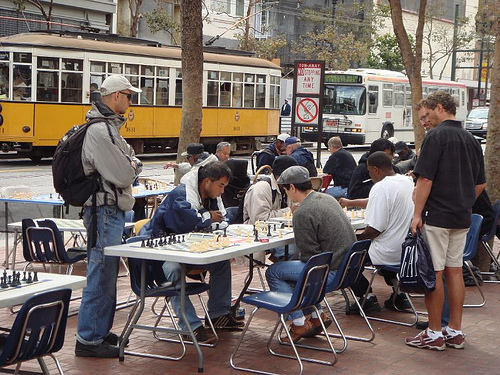
I think the comparison between Market Street in San Francisco and Harper Court in Chicago's Hyde Park is apt. Chess is integral to the urban landscape: it shouldn't be confined to the lakefront.
Wednesday, June 16, 2010
A miniature
Dean Arond, whom I have known since we were on opposing high school chess teams over 30 years ago, recently won the following amusing tournament game against a player who shall remain nameless.
A trap in the Kan Sicilian
Continuing with the theme of unexpected queen checks, after 1.e4 c5 2.Nf3 e6 3.d4 cxd4 4.Nxd4 a6 (the Kan Sicilian), White can play almost anything: 5.Nc3, 5.c4, 5.Bd3, 5.Be2, 5.Be3, 5.g3, etc. Er, almost anything except 5.Bf4??, that is. Black wins a piece with 5...e5! (forking bishop and knight) 6.Bxe5 Qa5+ (forking king and bishop), winning the bishop.
Felecan wins 26th North American Masters

International Masters Angelo Young and Arjun Vishnuvardhan tied for second with 6½ points each.
NMs Gauri Shankar, Trevor Magness, and Jon Burgess were competing for International Master norms, but the IMs were not very accommodating in this event. (Due to a family emergency, Burgess was unable to play the final four games.)
Sevan Muradian of the North American Chess Association organized and directed.
Crosstable here!
Tuesday, June 15, 2010
Shirazi-Peters
The (in)famous Shirazi-Peters game, the shortest-ever decisive game in a U.S. Championship, provides another example of a queen check and fork leading to a quick win. After 1.e4 c5 2.b4?! (the dubious Wing Gambit) cxb4 3.a3 d5! 4.exd5 Qxd5, Shirazi fell into the known trap 5.axb4?? After 5...Qe5+, forking his king and rook, he resigned. IM Shirazi, a very strong player whose style may have been too "coffeehouse" for the U.S. Championship, went on to score .5-16.5 in the Championship. (In fairness, he played in other U.S. Championships, doing much better in some of the others.)
Beware of queen checks!
Many, many opening traps involve a surprise queen check that picks up an errant piece. This includes the shortest decisive master game in history (apart from no-move forfeits, 1.c4 Resigns and such), given below. Black's 3...Qa5+ forks White's king and bishop, winning the latter. If you look at big databases, you'll see that this trap has also occurred a number of times since. Occasionally White has even drawn the game, despite dropping a clear piece on move 3! The website 365chess.com (highly recommended; it allows you free access to a 3.5 million game database) has seven games with this trap, two of which ended in draws!! The Black players who only drew were rated 2259 and 2199. These games provide further proof of the truth of the adages, "You can't win [or even draw] by resigning." and "The hardest thing in chess is to win a won game."
A trap in the Vienna Game
The trap below has caught a number of players over the years. After 1.e4 e5 2.Nc3 Nf6 3.Bc4, 3...Nxe4 is the well-known "fork trick," envisioning 4.Nxe4 d5, when Black regains the piece with equality. More common is the sharp 4.Qh5! (attacking both f7 and e5) Nd6 (virtually forced) 5.Bb3 (5.Qxe5+ is equal). Then Black can choose between the solid 5...Be7 6.Nf3 Nc6 7.Nxe5 0-0, and the wild sacrificial line 5...Nc6!? 6.Nb5! g6 (6...Nxb5?? 7.Qxf7#) 7.Qf3! f5 8.Qd5! Qe7 (8...Qf6!? is also playable) 9.Nxc7+ Kd8 10.Nxa8 b6, which Eric Schiller christened the "Frankenstein-Dracula Variation."
White's 4.Bxf7+?!, as in the game below, isn't very good unless Black falls into the trap in this game. After 4...Kxf7 5.Nxe4, Black should play 5...d5!, meeting 6.Qf3+ with 6...Kg8! 7.Ng5 Qd7!, when Black has the bishop pair, his king is safe, he owns the center and will soon drive back White's pieces. After the plausible 5...Nc6?! 6.Qf3+! Kg8?? (6...Ke8!) 7.Ng5! Black is suddenly lost. White has the terrible dual threats of 8.Qf7# and 8.Qd5#, and 7...Qxg5 8.Qd5# doesn't help.
The British chess writer G.H. Diggle wrote an amusing account of having lost a club match game this way (Davids-Diggle, London 1949) in all of two minutes, while his teammates' games were just getting started. His later investigation revealed the same game had been played in 1899 between Imbusch and Goering (see Irving Chernev's 1000 Best Short Games of Chess, p. 6) and that the British Chess Magazine in 1901 had described 6...Kg8?? as "a common blunder in this and similar positions."
White's 4.Bxf7+?!, as in the game below, isn't very good unless Black falls into the trap in this game. After 4...Kxf7 5.Nxe4, Black should play 5...d5!, meeting 6.Qf3+ with 6...Kg8! 7.Ng5 Qd7!, when Black has the bishop pair, his king is safe, he owns the center and will soon drive back White's pieces. After the plausible 5...Nc6?! 6.Qf3+! Kg8?? (6...Ke8!) 7.Ng5! Black is suddenly lost. White has the terrible dual threats of 8.Qf7# and 8.Qd5#, and 7...Qxg5 8.Qd5# doesn't help.
The British chess writer G.H. Diggle wrote an amusing account of having lost a club match game this way (Davids-Diggle, London 1949) in all of two minutes, while his teammates' games were just getting started. His later investigation revealed the same game had been played in 1899 between Imbusch and Goering (see Irving Chernev's 1000 Best Short Games of Chess, p. 6) and that the British Chess Magazine in 1901 had described 6...Kg8?? as "a common blunder in this and similar positions."
Monday, June 14, 2010
One downside of playing in out-of-state events
A reliable correspondent writes:
A moment of sympathy for Jim Egerton. He comes all the way to Las Vegas to play chess. He has to schedule a bye for Sunday evening to catch his plane back. His opponent Sunday morning never showed up. Not a very chess eventful day for Jim.
In multiple-section events, there will usually be someone else in another section with a similar problem. So if one seeks out the TD, then one might be able to play a game (though probably not at the original time control; it takes one hour to claim the forfeit).
A trap in the Robatsch
I managed to pull off the amusing trap below in an Internet game about a month ago. (My game began 1.d4 d6 2.Nf3 Nd7 3.e4.) Note that after 5.Bxf7+! Kxf7?? (5...Kf8! is best) 6.Ng5+, Black loses either his king (as in the game) or queen (after 6...Kf8 7.Ne6+ or 6...Ke8 7.Ne6, smothered mating the queen). On move 4, Black should have averted the bishop sac with 4...e6!, intending to play the Hippopotamus Defense with ...Bg7, ...Ne7, ...b6, etc.
Dimitri Kosteris wins big at National Open
This past weekend in Vegas, Dimitri scored a wonderful 5.5 in six games. Welcome to Class A!
Hat tip to Daniel Parmet at on the ICA Forum.
GM Timur Gareev took first overall: story at Chess Life Online.
Hat tip to Daniel Parmet at on the ICA Forum.
GM Timur Gareev took first overall: story at Chess Life Online.
Alpha nerd alert!
(And when there's a nerd alert on a chess blog, you KNOW it's alpha nerdy!)
The path planning and promotion features are impressive/hilarious.
This LEGO Mindstorms set will be at the Brickworld convention here in Chicago this coming weekend, June 17-20!
The path planning and promotion features are impressive/hilarious.
This LEGO Mindstorms set will be at the Brickworld convention here in Chicago this coming weekend, June 17-20!
Sunday, June 13, 2010
Cute!
Matt Pullin explains a very nice pawn endgame study. I guessed the first two moves immediately, but it took me awhile to fathom the point.
Saturday, June 12, 2010
Chicagoans in Las Vegas
Actually, IM Enrico Sevillano doesn't live in Chicago any more. But he used to live around the corner from me (we once met in the laundromat).
Even though NM Ken Wallach gets into trouble early, he shows why he's a master by offering stubborn defense in an unattractive position.
A forgotten masterpiece
The following game appears in the chapter "Perfect Games" in Fred Reinfeld and Irving Chernev's classic The Fireside Book of Chess. Reinfeld and Chernev observe, "In the opinion of the writers, Parr's masterpiece has well-founded claims to being considered the finest attacking game of all time." A lot of great games have been played in the five decades since their book was published, but the game remains an incandescent brilliancy. The winner, Frank Parr (1918-2003), won the famous Hastings Premier tournament in 1938-39, the one occasion on which he played in it.
Missed by the Masters
The game score below is taken from the tournament book and ChessGames.com. The players, whose names I have omitted to avoid embarrassing them, were prominent local masters. In the diagrammed position, Black played 8...a6. Do you see anything better?
Friday, June 11, 2010
Game/30 event at A Place for Us
"Hold my hand and we're halfway there / Hold my hand and I'll take you there..." Sorry, I can't carry a tune in a bucket.
It's co-sponsored by the Midway Chess Club and the South Suburban Chess Club. Details here!
Spectators welcome
The second half of the 26th North American Masters begins tonight! Details here.
I'll be playing in a concurrent invitational event at the same site (the Holiday Inn on Touhy in Skokie), the MCA FIDE Futurity XI
Thursday, June 10, 2010
"...kicks above the waistline..."
Theo Ubique's production of Chess won seven non-equity Jeff awards.
Andrew Karklins - Brock 2010, continued
This position from the Chicago Open is still haunting me!


White to move
A. Karklins - Brock, Chicago 2010
Time to put on your thinking cap!
In the game, young Mr. Karklins could have played 23.c5 with some advantage: my bishop on b6 is shut out of play. Instead, he blundered with 23.Re3? I'm pretty sure that my reply, 23...Ne5! gives Black a nice advantage, but the complications after 24.Nxe4!? are rather amazing.
In the game, I went wrong with 24...Ng4? What is White's best reply? Evaluate the position and give Black's best reply to White's best reply.
I could have played the superior 24...Ref8! Now Rybka says that 25.Kg1 is best. But what should Black do if White plays 25.g3 instead?

Black to play
A. Karklins - Brock, Chicago Open 2010 (variation)
If you find a good move, look for a better one!
Break On Through to the Other Side

White to play
Lu Shanglei - Ji Dan
2010 Chinese Championship, Xinghua
The move is obvious once you see it! Lu Shanglei shows us how; Karsten Müller annotates for ChessBase.
Tuesday, June 8, 2010
2010 National Open in Las Vegas this weekend!
Details here! You'll see many familiar faces from Chicago there.
Even at the last minute, rooms and airfare should be reasonable. You can fly in Thursday night and have three days of serious chess (and perhaps a little recreation, too).
$5 Swiss in Evanston this Saturday!
Details here!
(I was temporarily confused abut the date, so please allow me to repeat...)
(I was temporarily confused abut the date, so please allow me to repeat...)
Levy Senior Center, 300 Dodge Ave., Evanston, IL 60202
Swiss Groups, 3SS G/70
Multiple Sections, USCF Regular Rated
ICA President Tom Sprandel and his wife Marie will be emulating Kerouac this summer (but Tom will still be running the ICA show via phone and the Intertubes). If he's not too busy with last-minute packing, you may have a chance to wish Tom bon voyage!
Monday, June 7, 2010
What is zugzwang?
For the answer to this question, see the Kavalek column.
We take turns in chess: first White moves, then Black, then White.... Usually, "having the move" is a big advantage: if both sides are threatening mate, you would like it to be your move!

Whoever moves first, wins
I hope it's my turn!
This is particularly true in the opening: when we speak of tempo (plural "tempi"), we're often talking about getting your pieces into battle more quickly than your opponent does. Having the move can only help! If you look at the three Marshall Defense traps that Frederick posted earlier this week, you'll see that White gained one or more tempi by forcing Black to recapture the d5 pawn, then retreat the recapturing piece. If you move four pieces out with your first moves and I've only moved one piece out, then you've gained three tempi on me! It's a little more complicated than that, but this gives you an idea....
But sometimes (more frequently than most chessplayers realize), having the moving is a burden, not a privilege.

White to play
A complicated position!
I remember trying to explain the king and rook versus king mate to elementary students. They found this position difficult, so I asked their parents to help. The parents were confused, too!
First, let's pretend it's Black's move:
- How many legal moves does Black have?
- In each case (heh!), can you find White's best reply?
- What is the fastest way for White to win?
- With White to play, what is the fastest way for White to win this position?

White to play
Another complicated position!
(Remember that the White pawns generally travel "up" the page (or in this case, the screen) and Black pawns travel "down": the queening square for the d6 pawn is d8.)
No answers for the time being: try to figure this out yourselves!
Not your typical checkmate in three moves
A recent Huffington Post column by GM Lubomir Kavalek used one of my favorite chess problems to illustrate the concept of zugzwang. (I like it so much that I've posted it on the blog once before!) The author of this problem is the nineteenth-century French playwright Alfred de Musset.


de Musset
White to play and checkmate in three moves
Sunday, June 6, 2010
A Trap in the Marshall Defense #3
Here is yet another trap in the Marshall Defense, one that I have pulled off many times. I learned of it from Lev Alburt's column in Chess Life. Some Marshall players vary from the normal 3...Nxd5 with 3...Qxd5?! After 4.Nc3, they usually continue with 4...Qa5 a la the Scandinavian Defense. (Note that after the better 4...Qd8, White should play 5.Nf3 rather than 5.e4?!, which allows Marshall's idea 5...e5!) After 4...Qa5, 5.Bd2! is strong, intending to follow up with e4 and Nd5, for example 5...Bf5?? 6.e4! Bg6 7.Nd5 and Black resigned in Steller-Reig, Stroebeck 1982. About 90% of my Internet opponents instead find 5...Qb6, forking White's b and d pawns, and after 6.Nf3! they dive in with 6...Qxb2?? 7.Rb1 Qa3 8.Nb5!, when the queen has no way to guard c7.
A Trap in the Marshall Defense #2
I invented another trap in the Marshall Defense to the Queen's Gambit. Continuing from the line given in the previous post (4...Nc6?!), White can vary with 6.d5!? Then 6...Nb8! is best. Most of my opponents on the Internet, however, have played 6...Nxe4?, expecting 7.dxc6? Qxd1+ 8.Kxd1 Nxf2+ 9.Kel Nxh1. However, 7.Be3! (guarding the f-pawn and threatening 8.dxc6) refutes this. Black loses the queen knight after 7...Nb4 8.Qa4+, or the king knight after 7...Nb8 8.Qa4+.
A Trap in the Marshall Defense #1
Frank Marshall, the U.S. Champion from 1909 to 1936, had some important ideas in the openings. The gambits named for him in the Ruy Lopez (1.e4 e5 2.Nf3 Nc6 3.Bb5 a6 4.Ba4 Nf6 5.0-0 Be7 6.Re1 b5 7.Bb3 0-0 8.c3 d5!?) and Semi-Slav (1.d4 d5 2.c4 e6 3.Nc3 c6 4.e4 dxe4 5.Nxe4 Bb4+ 6.Bd2 Qxd4 7.Bxb4 Qxe4+) remain theoretically critical even today. The defense to the Queen's Gambit named for him (1.d4 d5 2.c4 Nf6) has been less successful. It is never seen today in high-level play, though it remains a mainstay among lower-rated players.
The following game shows a nice trap that is often seen. After 3.cxd5! Nxd5, Marshall's idea was that the natural 4.e4?! Nf6 5.Nc3 e5! gives Black a reasonable game, since after 6.dxe5 Qxd1+, Black regains the pawn with 7.Nxd1 Nxe4 or 7.Kxd1 Ng4. Instead, 4.Nf3! prepares e4; on 4...Bf5, 5.Qb3 is awkward to meet. 4...Nc6, as in the game below, is inferior, but popular on the Internet. White's 5.e4 Nf6 6.Nc3 Bg4 7.d5! set a trap, which Black fell into with 7...Ne5?, allowing 8.Nxe5!, a pseudo-queen sacrifice that wins material by force. After 9.Bb5+, Black's best was the abject 9...Nd7 10.Bxd7+ Qxd7 11.Nxd7, leaving White a piece up in the endgame. Black's 9...c6? was even worse. After 11.cxb7+, Black resigned in the face of 11...Kd8 12.Nxf7# or 11...Nd7 12.bxa8(R)+ Qd8 13.Bxd7#.
The following game shows a nice trap that is often seen. After 3.cxd5! Nxd5, Marshall's idea was that the natural 4.e4?! Nf6 5.Nc3 e5! gives Black a reasonable game, since after 6.dxe5 Qxd1+, Black regains the pawn with 7.Nxd1 Nxe4 or 7.Kxd1 Ng4. Instead, 4.Nf3! prepares e4; on 4...Bf5, 5.Qb3 is awkward to meet. 4...Nc6, as in the game below, is inferior, but popular on the Internet. White's 5.e4 Nf6 6.Nc3 Bg4 7.d5! set a trap, which Black fell into with 7...Ne5?, allowing 8.Nxe5!, a pseudo-queen sacrifice that wins material by force. After 9.Bb5+, Black's best was the abject 9...Nd7 10.Bxd7+ Qxd7 11.Nxd7, leaving White a piece up in the endgame. Black's 9...c6? was even worse. After 11.cxb7+, Black resigned in the face of 11...Kd8 12.Nxf7# or 11...Nd7 12.bxa8(R)+ Qd8 13.Bxd7#.
Thursday, June 3, 2010
Another $5 Swiss at the Evanston Chess Club this Saturday!
Details here!
Levy Senior Center, 300 Dodge Ave., Evanston, IL 60202
Swiss Groups, 3SS G/70
Multiple Sections, USCF Regular Rated
ICA President Tom Sprandel and his wife Marie will be emulating Kerouac this summer (but Tom will still be running the ICA show via phone and the Intertubes). If he's not too busy with last-minute packing, you may have a chance to wish Tom bon voyage!
Victor Mikhalevski quiz from the 2010 Chicago Open
The Israeli GM presents several of his positions from the Chicago Open and asks you to find the best move.
Statistics utility for USCF members
Wayne Zimmerle wrote this nifty application to access your records in the U.S. Chess Federation's Member Services Area.
Works like a charm!
Works like a charm!
2010 Chess Camps: Chess Education Partners

The kids are getting out of school soon, and Chess Education Partners has wonderful camps taught by masters to keep their mischievous minds (ages 6 to 14) occupied:
- June 14-18 - Hinsdale
- June 21-25 - Latin School, Chicago
- June 28-July 2 - Mount Prospect (with GM Nikola Mitkov!)
Wednesday, June 2, 2010

The Check Is in the Mail
Interesting correspondence game by Dr. Tansel Turget of Decatur, who is a strong over-the-board player and an extraordinarily deep correspondence player.


Tuesday, June 1, 2010
Noah's Ark on the Kingside?
In the previous post, I mentioned the silly trap 1.e4 c5 2.Bb5?! a6 3.Ba4?? b5 4.Bb3 c4 and Black wins a piece. As you can see from the game below, the mirror image of this on the kingside is also a trap - but for Black! Pushing all the pawns in front of your king is dangerous!
Noah's Ark Trap
If you play the Sicilian on the Internet, sooner or later you'll run into someone who plays 1.e4 c5 2.Bb5?! a6 3.Ba4?? against you, losing the bishop after 3...b5 4.Bb3 c4. The Noah's Ark Trap in the Ruy Lopez (supposedly called that because of its antiquity) is a slightly more sophisticated version of this. The game below shows Endre Steiner falling into it against Capablanca at Budapest 1929. White's 5.d4 is considered inferior to 5.0-0, 5.c3, and 5.Bxc6+ if White is playing for a win. After Capablanca's 6...Nxd4! 7.Nxd4 cxd4, it is a little awkward for White to regain his pawn, as Steiner discovered to his chagrin. He could have done so safely with 8.Bd5 Rb8 9.Qxd4, or played 8.c3, when after 8...dxc3 he could choose between gambitting a pawn with 9.Nxc3!? and forcing a draw with 9.Qd5 (threatening both the rook and Qxf7#) Be6 10.Qc6+ Bd7 11.Qd5 Be6 12.Qc6+. Instead, poor Steiner fell into the trap with 8.Qxd4??, allowing Capa to trap his bishop with 8...c5! 9.Qd5 Be6 10.Qc6+ Bd7 11.Qd5 c4!
Betsy Dynako covers the Chicago Open
Photos and story at Chess Life Online.


Tatev
Abrahamyan earned an IM norm at the Chicago Open
Photo: Betsy Dynako for Chess Life Online
Chicago Open class sections - Illinois winners
Chess is not all about the Benjamins (there are much easier ways to make much more money), but when a class player wins a large prize, that usually means the player has made exceptional improvements in his or her game. Here are some local players who did very well this weekend:
In the Under 1000 Section, Jim Nowak tied for third with a score of 5.5. $366.67: nice!
In the Under 1300 Section, Evanston Township High School grad Ashok Raife won a cool $4,000 towards his college education with a very impressive 6.5. Jack Mallers, Dimitar Stanatov, and Imtiaz Al Garcia scored 6 points and took home $1,500 apiece. Kyle M. Frapolly and Santiago Mata scored 5.5, good for $533.34 to each.
In the Under 1500 section, Todd M. Scarlett and Christian Kavouras earned $2,500 apiece for their 6-1 score. Adele Padgett (who tied for first in the Illinois Girls Invitational), Rob Eaman of CICL fame, and Alexander Bologna each won $650.
In the Under 1700 section, Eric Emer won $1,675 for his 6-1 score; Robby Hecht, Benjamin Hutter, and Jeremy Berman won $500 each, finishing tied at 5.5.
In the Under 1900 section, Gwayne Lambert won $3,333.34 (nice!) for his undefeated 6-1 score; Hazim Malkoc and Oleg Trivonov took home $640 for 5.5.
And in the Under 2100 section, Matthew Wilber, Andrew Hubbard, and Mark Robledo Jr. each took home $1,075 for their 5.5 score. (I have to play Mark on Friday: hmm.)
Congratulations to our local prizewinners and to all who played well!
6th Annual Yury Shulman Chess Camps
The 2008 U.S. Champion and second-place finisher in the 2010 U.S. Championship is offering three separate day camps:
- June 14-18, Barrington
- July 12-16, Barrington
- August 2-6, Palatine
You'll find a link to registration and contact info at this link.
Erik Karklins is my hero
The elder Mr. Karklins is 95 years old, and he scored 5-2 this weekend in the Under 2100 section, winning $150! Erik closed out the event with three straight wins against players with ratings solidly above 1900.
I believe Erik Karklins will now become the top Illinois player over age 65--he's spotting the field thirty years!
Congratulations to Loek Van Wely!
The Dutch grandmaster recently wrote an article for New in Chess about his American travels: playing in US events was a good way to spend time with special Facebook friends, but not an especially good way for unlucky Loek to make money (I'm paraphrasing from memory).
This Memorial Day weekend, however, Van Wely won six games and drew three: 7.5 points was good for 10,000 and clear first in the Chicago Open!
My general impression: aside from tournament visitor Yury Shulman (who's been doing his part lately), we in Chicago need to up our level of play to compete with the rest of the world. GM Mesgen Amanov was the top local finisher with 6 points out of 9.
Among local juniors in the Open Section, Adarsh Jayakumar drew GMs Ehlvest and Lein, and could have drawn GM Finegold (coulda woulda shoulda), NM Eric Rosen dropped IM Daniel Fernandez. Tommy Ulrich had an even score after five rounds and gained a ton of rating points.
Among local juniors in the Open Section, Adarsh Jayakumar drew GMs Ehlvest and Lein, and could have drawn GM Finegold (coulda woulda shoulda), NM Eric Rosen dropped IM Daniel Fernandez. Tommy Ulrich had an even score after five rounds and gained a ton of rating points.
I scored 2 points out of 7 and appear to have gained a few points!
More results from the other sections as soon as I recover from my "chess hangover." Full results here!
More results from the other sections as soon as I recover from my "chess hangover." Full results here!
Monday, May 31, 2010
Classic Michael Adams
It's interesting that a top GM is willing to use the Four Knights to avoid the Berlin Defense, and interesting that 4...Bd6!? has become a perfectly respectable line in the Four Knights.
Enjoy Adams's Capablanca-like technique!
Enjoy Adams's Capablanca-like technique!
Caïssa giveth and Caïssa taketh away....
...is a fancy way of saying that chess luck tends to even out. Dana Mackenzie demonstrates the wins he missed against Gavin McClanahan and me.
Sunday, May 30, 2010
Real-life tactics (or, when good combinations go wrong)
I have yet to beat Andrew Karklins. On Saturday, I botched my best opportunity to date:

A. Karklins - Brock, 2010 Chicago Open
White to play
Although I was feeling optimistic here, I'm struggling for equality if Karklins shuts down my bishop with the natural 24.c5. Instead, he erred with another natural looking move, 24.Re3?
I found the first move of the (probably winning) combination but went wrong in the complications (there are several cute points, one of which Karklins used to turn a probable loss into a well-deserved win).
See if you can do better than me! Use your brain, not the computer!
I found the first move of the (probably winning) combination but went wrong in the complications (there are several cute points, one of which Karklins used to turn a probable loss into a well-deserved win).
See if you can do better than me! Use your brain, not the computer!
Subscribe to:
Posts (Atom)