Grand Opening of the North Shore Chess Center
After many weeks of planning, the North Shore Chess Center will celebrate our Grand Opening on Saturday October 9, 2010. This day also happens to be National Chess Day (not to mention my youngest daughters birthday!). For this special occassion we have a number of activities planned, open to everyone free of charge.
To kick things off, Mr. George Van Dusen, who is the Mayor of Skokie, will cut the ceremonial ribbon to help inaugurate the Chess Center. Mr. Van Dusen has been very supportive of chess in Skokie having also done the ceremonial pawn push at the Chicago Blaze inaugural match 2 years ago. The ribbon cutting ceremony will take place at 10:30am.
Our next chess adventure leads us to a 30 board simul by Grandmaster Mesgen Amanov, who has just returned from the 39th Chess Olympiad in Khanty-Mansiysk, Russia where he played 1st board for his native country of Turkmenistan. This simul is available on a first come, first seated basis. Make sure you're there for the ribbon cutting to get your spot! The simul will begin between 11:15 and 11:30am
The third activity of the day will be a G/15 + 10/sec increment quick rated chess tournament. USCF membership will be required for this. This will be a 4R-SS tournament. The tournament will begin at 3pm
The final activity of the day will be a group lesson provided by a member of the Chicago Blaze. We will review a few games from the current season of the Chicago Blaze. The group lesson will begin at 7pm
On Sunday October 12 beginning at 1pm we will host a 4R-SS Game/30 + 30/sec increment tournament. USCF membership will be required.
The address of the North Shore Chess Center is 5500 West Touhy Ave Suite A, Skokie, IL 60077. You turn on Linder Street from Touhy. The parking lot entrance is on Linder, but the Chess Center faces Touhy. We are directly across the street from Pet Smart. We are about 3 blocks west of the Holiday Inn on the same side of the street.
Friday, October 8, 2010
Grand opening details....
Well, at least he got the announcement out more than twelve hours in advance!


Grand opening of North Shore Chess Center this weekend!
Friday Night [tonight!] 10/8 @ 7pm - Casual Chess with Blitz event based on attendance
Saturday 10/9 - 10:30am Ribbon Cutting by Mayor of Skokie, Between 11-11:30am Simul by GM Mesgen Amanov, 3pm 4R-SS G/15 + 10/sec increment tournament, 7pm Group Lecture on Chicago Blaze games
Sunday 10/10 @ 1pm - Casual Chess with 4R-SS G/30 + 30/sec increment event based on attendance
All events are free this weekend!
Check for details at the North Shore Chess Center's site.
Thursday, October 7, 2010

Nighttime Chess on Michigan Avenue
Also from Mark Weeks's blog!

Here's a beautiful photo of a scene many of you will recognize. The proprietor will soon be packing up for the season: look in front of the Art Institute (or south of the Art Institute on the east side of Michigan, as in the photo).

Photo Jaedub: some rights reserved under Creative Commons
Cool collectible (preceded by mild whining)
1. My wife and son hate The Dave Matthews Band; I'm more indifferent.
2. Said wife and I were waiting at a Thai restaurant for said son on September 17, 2010 (our last dinner together before he left town). He was delayed because he & his guitar case couldn't get on a Red Line train packed with obnoxious fans going to see the concert at Wrigley.
Now that I've vented: some blog reader might enjoy tracking down one of these posters as a collector's item.

Mark Weeks's blog (where I saw this item) has some interesting posts on chess collectibles.
Wednesday, October 6, 2010
West Town: Chess Club for Kids

From the Chicago Public Library website:
Chess Club for Kids
Date: Thu. October 07, 2010
Time: 5:30 pm - 6:30 pm
Location:
West Town
1625 W. Chicago Avenue
60622
About this event:
Whether you want to improve your game or simply learn how to play, join us for this weekly after-school program led by volunteer Mark Hirsch. No registration required.
St. Louis 2½ - Chicago 1½
The sleep-deprived Hikaru Nakamura led St. Louis to victory, as the other matchups were drawn.
Board 2: GM Mesgen Amanov (Chi) - GM Ben Finegold (StL) ½-½
Board 3: IM Michael Brooks (StL) - IM Florin Felecan (Chi) ½-½
Board 4: WIM Cindy Tsai (Chi) - Spencer Finegold (StL) ½-½
More coverage to come...but not tonight!
Board 2: GM Mesgen Amanov (Chi) - GM Ben Finegold (StL) ½-½
Board 3: IM Michael Brooks (StL) - IM Florin Felecan (Chi) ½-½
Board 4: WIM Cindy Tsai (Chi) - Spencer Finegold (StL) ½-½
More coverage to come...but not tonight!
The cheapo as art form
In US English, "cheapo" is a mildly derogatory term for a cheapskate. In chess circles, however, it means something different: a tactical trap that both players should be able to see through.
For example, "I was winning, but I fell into a cheapo." Setting a cheapo is not at all cheap: a strong player may set dozens of "simple" tactical traps during the game: miss one and you're dead. We all feel silly when we fall for a cheapo, but there's nothing unsportsmanlike about setting up a cheapo.
Of course, if there's a much better move to be made, one should make the best move on the board. But if one can set devious little traps for one's human opponent while making good moves, so much the better.
Here's an example from a game that finished just a few minutes ago.
Here's an example from a game that finished just a few minutes ago.
GM Dmitry Gurevich of the Chicago Blaze had a dubious position against GM Hikaru Nakamura, and was down almost an hour on the clock to boot. But Dmitry fought back to equality. Then, with less than five minutes left on the clock against one of the world's best blitz players (and perhaps the world's best player of "bullet" chess), Dmitry fell for a cheapo....

Nakamura (St. Louis) - Gurevich (Chicago)
October 6, 2010
1. How can White to play set a cheapo?
2. Why is the trap psychologically plausible?
3. What's Black's best reply?
2. Why is the trap psychologically plausible?
3. What's Black's best reply?
P.S. Matt Pullin questioned my word choice. Is it fair to call a simple trap set by a good move (perhaps the best move on the board) a "cheapo"? Or should "cheapo" be reserved for traps set by inferior moves?
Stolen from Facebook
But hey, Aaron Sorkin suggests that Facebook was stolen....
Daniel Parmet writes:
Daniel Parmet writes:
The Chicago Blaze takes on St. Louis tonight live at 7pm! Board 1 Features GM Hikaru Nakamura vs GM Dmitry Gurevich. Board 2 has returning Olympiad making his Blaze Debut GM Mesgen Amanov against GM Ben Finegold (who has had the unfortunate pleasure of 6 out of 7 blacks this season!). Board 3 sees Kansas City IM Michael Brooks playing... against Chicago's own Flying Florin Felecan. Board 4 sees a rematch with colors reversed of WIM Cindy Tsai against Spencer Finegold (Cindy won the previous encounter as black see NM Jeremy Kane's excellent analysis of the game here: http://www.chicagoblazechess.com/2010/09/the-other-blaze-game-of-the-week/
The last match against St.Louis ended in a draw as St.Louis' 3GM lineup was held to a 2-2 score. But since then, the Chicago Blaze has caught FIRE! We are currently leading the standings for West Division and hope to remain there when the fire settles tonight! GO BLAZE!!!!
Tuesday, October 5, 2010
Blaze rematch against St. Louis tomorrow at 7 p.m.!
Someone associated with the Blaze (no, not a player!) was noting the probable absence of Nakamura & Shulman (both coming home from Siberia) and confidently predicting another victory.

The games begin at 7 p.m. Chicago time.
Follow the action on the Internet Chess Club (subscription required).
Or stop by the North Shore Chess Center at 5500 West Touhy Avenue, Suite A, in Skokie.

The games begin at 7 p.m. Chicago time.
Follow the action on the Internet Chess Club (subscription required).
Or stop by the North Shore Chess Center at 5500 West Touhy Avenue, Suite A, in Skokie.
A problem for the morning
So what would you do if you were given two consecutive moves?


White makes two consecutive moves in this position
The first move cannot be a check
The second move must be checkmate
If you're stumped, be concerned: the problem is from a beginner's book!
Answer in this review. (Permalink not available yet.)
Monday, October 4, 2010
Scholastic club at Algonquin Area Public Library
Details here!
Chess Club
Chess players in grades 2nd-8th are invited to practice their game in a friendly environment. Various skill levels are welcome to compete. If you have a chess board, please bring it along.Contact: library, 847-458-6060
www.aapld.org
I'm sure you were all following the Turkmenistan-Zambia match
Local GM Mesgen Amanov (a dual national) was playing Board 1 for Turkmenistan, and had a solid event. But Stanley Chumfwa (FIDE 2315) plays a wonderful game to lead Zambia (initial ranking: 121st!) to 47th place.
Ukraine wins Olympiad teams; Russia wins Women's teams
Final results:
Gold: Ukraine
Silver: Russia 1
Bronze: Israel
Team USA (ranked #9 at the outset) finished 9th, beating Cuba 2½-1½ in the final round.
Women's team results:
Gold: Russia 1
Silver: China
Bronze: Georgia
The USA women (ranked #6 before play began) finished 5th.
More results at the official site. And here are a few wrapups around the web:
ChessBase (Check out the crucial game Svidler-Salgado, in which the young Spanish GM spoiled Russia's chances for gold. It's also featured by GM Yermolinsky at chessclub.com.)
ChessVibes
The Week in Chess
Friday, October 1, 2010
U.S. - Israeli tensions rising
Right here, right now! Nakamura-Gelfand games tend to be decisive.
If the official site is overloaded, try The Week in Chess. (There's a drop-down box above the live chessboard: the US-Israel games will probably be games 9 through 12 from the top.)
If the official site is overloaded, try The Week in Chess. (There's a drop-down box above the live chessboard: the US-Israel games will probably be games 9 through 12 from the top.)
Thursday, September 30, 2010
2010 Illinois Chess Association Banquet Honoring Helen Warren

Most of us think of Helen Warren as the emeritus heart and soul of the Illinois Chess Association. Back in 1961, Helen Hendricks was one of the signers of our Articles of Incorporation (along with our respected friends Jim Brotsos and the late Frank Skoff, future U.S Women’s Champion Eva Aronson, and Peter Wolf). Along the way (after marrying Jim Warren, an Expert who drew Fischer twice on his 1963 simul tour), she organized umpteen Midwest Masters, the 1989 U.S. Open, a couple of the best U.S. Masters ever, and other events too numerous to mention, she brought World Championship Candidates Viktor Korchnoi and Robert Hübner to Chicago for the 1982 Cloverline International, she founded the wonderful American Postal Chess Tournaments, served for decades in various USCF leadership positions, edited the Illinois Chess Bulletin, and, not least (my apologies for the unavoidable runon sentence), she was the voice of the ICA, even in those years when she didn’t officially have the title of President.

Life's simple pleasures: blitz chess and beer
Helen Warren vs. Ed Radavicius
1973 Chicago Industrial Chess League Banquet Blitz Championship
You may not realize that Helen also loves to play chess, and is pretty good at the game, as I discovered at the inaugural Master Challenge in 1979. Even though the wallchart said my rating was about 450 points higher, I was the one on the run:
Bill Brock—Helen Warren
1. e4 c6 2. d4 d5 3. exd5 cxd5 4. Bd3 Nf6 5. c3
Almost a decade after the famous Fischer-Petrosian game in Belgrade, everyone in Illinois from senior master to patzer was still playing this line against the Caro-Kann. Larry Chachere and Allen Kornfeld were among its partisans in the early 1980s, while Dr. Eugene Martinovsky never hesitated to defend the line. Kornfeld beat the good Doctor in a 1981 Palmer House battle royal after 5...Nc6 6.Bf4 Bg4 7.Qb3 Qd7. Then-current theory said that 7...Qc8 was a better choice, but fashions change.....
5...e6 6. Bf4 Bd6 7. Bxd6 Qxd6 8. Nf3 O-O 9. Nbd2 Nbd7 10. O-O Re8 11. Qa4 Nb6 12. Qb3 Bd7 13. Ne5?!
Threatening to tickle the Nb6 with 13. a4 would have been better.
13...Ba4!
13...Ba4!

Bam! Fritz thinks the position is equal, but I think this is one of those positions that humans understand better than Fritz.... Helen looked both happy and determined.
14. Qb4 Qxb4 15. cxb4 Rac8 16. Rac1 Red8 17. b3
If I were to play 17.b5 here, Black looks good after 17...Ne4. Jim’s visits to the board were becoming more frequent, and I was getting nervous.
17... Be8 18. a4 Nbd7 19. f4 Nxe5 20. fxe5 Nd7 21. Bb5

21...a6?!
Black would have retained a slight pull after 21...Nb8!
I played 22.Bxd7 with relief and ground out a slightly superior ending. After Helen resigned, I started to explain her missed opportunity, but she cut me off quickly: “Good knight against bad bishop, I understand.”
***
Attentive readers may have figured out that I omitted one of Helen’s biggest accomplishments. She saw that Illinois had many talented junor players who were stalling at a critical level in their development because they weren’t getting the same quality training as the kids from New York and California (let alone the Soviet Union).
So she did something about it by starting the ICA Warren Junior Chess Program. Its mission is simple: to identify nationally ranked Illinois boys and girls, and to offer merit-based financial assistance to these students for individual and small group instruction with masters and grandmasters. The goal of the program is to nurture the highest-potential Illinois students so they can be competitive on a national and international stage.
Currently, Illinois has several dozen boys and girls who are nationally ranked in their age group. As talented as our teens are, I’m even more excited about our crop of young players. Success in chess requires a combination of innate talent and hard work. Intensive mentoring at a young age can propel our talented students to the very top levels of success. The program works, as evidenced by the results of Warren Junior Chess Program alumni. For the past four years, Andi Rosen has continued the work that Helen began, maintaining her tradition of excellence.
On November 7, 2010, the Illinois Chess Association will do its darndest to honor Helen Warren's five decades of service. Please join us at Buca di Beppo, 90 Yorktown Road, in Lombard, from 1 p.m. to 4 p.m.
Please follow this link to view your invitation!
And you can purchase banquet tickets here!
(Part of this blog entry was adapted from an article that appeared in the January-February 2006 Illinois Chess Bulletin)
USA 2½ - Bulgaria 1½
Big win for Kamsky over Cheparinov! Nakamura drew Topalov with Black, which is something of an accomplishment in its own right.

Story at Chess Life Online, as usual! If you're wondering what was going on at the end of the Kamsky-Cheparinov game, my working theory is that Gata was afraid of a blockade position in which rook plus three healthy pawns might well draw against queen and two isolated pawns. So Kamksy sacked the queen back, preferring the rook ending as cleaner.

Onischuk watches Kamsky: Photo Tony Rich
Story at Chess Life Online, as usual! If you're wondering what was going on at the end of the Kamsky-Cheparinov game, my working theory is that Gata was afraid of a blockade position in which rook plus three healthy pawns might well draw against queen and two isolated pawns. So Kamksy sacked the queen back, preferring the rook ending as cleaner.
Wednesday, September 29, 2010
USA-China 2-2 tie: monster win for Yury Shulman!
Local boy makes good in Siberia. Shulman lost to Grischuk in this line five years ago; that game was also in Khanty Mansiysk. The Marshall Gambit in the Semi-Slav (4.e4) is incredibly difficult...and very entertaining!
Tuesday, September 28, 2010
So what's a doubled g-pawn worth?
To appreciate how close the Blaze came to running up the score, take a look at GM Dmitry Gurevich's near-miss on Board 1.
Compare the diagram in Dmitry's game to the diagram in Arjun's game!
Endgame question: Black is a pawn up in the final position. Why was a draw agreed?
Compare the diagram in Dmitry's game to the diagram in Arjun's game!
Endgame question: Black is a pawn up in the final position. Why was a draw agreed?
Closer to home: Blaze win!
It was very disconcerting listening to the Bears on streaming audio and watching the Blaze on the Internet Chess Club. I felt that the Bears' squeaker could easily have been a ten-point loss, but I was never worried about Philadelphia beating Chicago on the chessboard.
IM Arjun Vishnuvardhan (still a teenager!) makes an impressive debut for the Blaze!
IM Arjun Vishnuvardhan (still a teenager!) makes an impressive debut for the Blaze!
The people's champion
That's the title New in Chess bestowed upon Ukraine's #1 player, Vassily Ivanchuk. I have absolutely no idea what's going on in the following game: enjoy!
Coffeehouse tactics question: why didn't Ivanchuk take the "free" queen offered by Baadur Jobava (who's having an amazing tournament despite this loss) with 31...Qc1? What's wrong with 32.Nxc1??
Coffeehouse tactics question: why didn't Ivanchuk take the "free" queen offered by Baadur Jobava (who's having an amazing tournament despite this loss) with 31...Qc1? What's wrong with 32.Nxc1??
Round 7: Instant Karma
USA and Poland tied 2-2. Onischuk wins, Nakamura loses his first game.
Coverage at Chess Life Online.
Coverage at Chess Life Online.
Monday, September 27, 2010
Tomorrow's breakfast match
Let's be honest: you probably have a friend or two, perhaps even a family member, rooting for the Packers tonight.
Tomorrow's breakfast match might generate similar divided loyalties, especially along the artery mentioned in an earlier post, Milwaukee Avenue. It's USA vs. Poland.
I've previously hyped Poland's number-one player, Radosław Wojtaszek, as the world's hottest player since the Anand-Topalov match. Working with Anand for several months can't be bad for one's chess!
There are three teams with 11 match points: Ukraine and darkhorse Georgia face off, while Armenia is paired down to archrival Azerbaijan. Other teams tied with the USA at 10 match points: Russia 2 plays Russia 1 (!), and Hungary is paired down to Brazil.
Follow the action here!
(sotto voce) USA! USA!
USA 2½, Vietnam 1½: a peaceful and not at all imperialistic victory! Read all about it on Chess Life Online.
Are Hikaru Nakamura's tweets vetted by his P.R. person?
Are Hikaru Nakamura's tweets vetted by his P.R. person?
P.S. from Siberia
North Shore Chess Center founder Sevan Muradian is currently attending the FIDE Executive Board Meeting in Khanty-Mansiysk, Russia! So we have three Chicagoans there: Muradian, Yury Shulman (representing USA in the Olympiad), and Mesgen Amanov (of Turkmenistan and Milwaukee Avenue). Walter Brown (not the former US Champion Browne, but the national TD hailing from Illinois) is also in Khanty-Mansiysk.
Amanov led Turkmenistan to victory today with a brutal win in a topical line of the Queen's Indian. His victim was the Lithuanian opening theoretician Eduardas Rozentalis:
Amanov led Turkmenistan to victory today with a brutal win in a topical line of the Queen's Indian. His victim was the Lithuanian opening theoretician Eduardas Rozentalis:
Tonight's Big Showdown (starting time corrected)
No, not that one. (Our office manager has tickets for tonight's White Sox-Red Sox tickets that she can't give away!)
The Philadelphia Inventors (hmm, "cheesesteakheads"?) and the Chicago Blaze face off tonight at 7:15 p.m. Really, I have to have a sit-down with whoever dreamed up this schedule!
The games begin at 7:15 p.m. Chicago time.
Follow the action on the Internet Chess Club (subscription required).
Or stop by the North Shore Chess Center at 5500 West Touhy Avenue, Suite A, in Skokie.
"Chess as a Survival Skill"
Check out the article in today's Wall Street Journal, via Jerry Neugarten.
Wonderful things are being done by our friends in St. Louis:
 | ||
| photo: Patrick T. Fallon for The Wall Street Journal |

Wonderful things are being done by our friends in St. Louis:
[...]
Chess has been a part of after-school programs for at least 40 years, but mainly in the suburbs. In the last decade, it has exploded in popularity in urban areas as research showed that students who play chess do better on achievement exams, especially math.
But few schools offer chess as an academic subject—and fewer still require it, especially for students already labeled as troublemakers, like the ones here.
Innovative Concept Academy was opened last year by a St. Louis Juvenile Court Judge Jimmie Edwards. Tired of watching teenagers get kicked out of school, land in his courtroom and then drop out, Mr. Edwards created his own school to nurture students back to academic, emotional and mental health. The city's school district pays for the building and teachers, while money from not-for-profit groups provides the rest of the funding.
The Academy, housed in a three-story former middle school, caters to sixth through 12th graders who have either been suspended or expelled for fighting, bringing weapons to class, getting caught with drugs or other illegal or disruptive behavior.
The top floor of the three-story school is occupied by teenagers who have been criminally charged and gone through the juvenile court system.
Students attend class from 9 a.m. until 5:45 p.m. and have access to counselors, psychologists and mentors. [...]
The twice weekly chess classes are mandatory for most of the school's 97 students and are an integral part of Mr. Edwards's strategy to curb bad behavior and teach alternatives to violence. He knows that chess won't solve all the behavior problems, but says it offers lessons about self-control and critical thinking.
"Most of my kids are impulsive, reactionary and they lash out without thinking through the consequences," said Mr. Edwards, who walks the school's halls almost daily. "Chess teaches them patience and teaches them that there are consequences to bad decisions."
"In chess, you can lose your queen," he added. "In life, you can lose your life."
The chess program at the Academy is paid for by the Chess Club and Scholastic Center of St. Louis, which opened in 2008 and already has 700 members [....]
2010 FIDE Election Update

Anatoly Karpov
Tony Rich / CCSCSL for Chess Life Online
The refreshingly sensible John Donaldson provides a précis of the facts at Chess Life Online.
Sunday, September 26, 2010
USA - Vietnam Monday morning in Chess Olympiad
One of the big stories of this Olympiad is the emergence of Vietnam as a world chess power. And they're going to be around for awhile: their top two boards were born in 1991 and 1990, and their alternate was born in 1989.

USA bounced back from its Friday loss to Russia 1 with a nice win against Argentina in Round 5 (details on Chess Life Online)

So both the USA and Vietnam are 4-1 in match points, and they're paired for Round 6. Check out the pre-dawn action (games begin at 4 a.m., which means you can enjoy the middle games with your morning coffee).
Follow the games here!

Vietnam's Board 1, 19-year-old Le Quang Liem
(from ugra-chess.com)
USA bounced back from its Friday loss to Russia 1 with a nice win against Argentina in Round 5 (details on Chess Life Online)

Hikaru Nakamura
photo: Tony Rich CCSCSL / Chess Life Online)
photo: Tony Rich CCSCSL / Chess Life Online)
So both the USA and Vietnam are 4-1 in match points, and they're paired for Round 6. Check out the pre-dawn action (games begin at 4 a.m., which means you can enjoy the middle games with your morning coffee).
Follow the games here!
Kids Making Trouble
Kent Cen and Maximillian Zinski, both of whom are somewhat younger than I am, won the Gold Section of yesterday's Evanston Chess Club's 3x3. The presence of NM Jon Burgess added a touch of class. Evan Spiegel and Matthew Stevens won the Silver section, and Keith Amman and Dennis Doyle won the Bronze Section.
Ryan Chiu and Maret Thorpe directed for the Evanston Chess Club. You can find crosstables here!
Midwest Class Championships in Wheeling, October 15-17
More info at the CCA website and the ICA website
Friday, September 24, 2010
Olympiad update on Chess Life Online

Correction to my last blog entry: would you believe the Russians have five teams??
Russia 3 - USA 1
Russia has three teams in the Olympiad: the USA just lost to Russia's #1 team 3-1. Ouch.
Nice draw (King's Indian!) by Nakamura against Kramnik.
Kamsky overextended against Grischuk.
Karjakin beat Onischuk.
Shulman won a pawn against Malakhov, but not quite enough!
Hungary just beat China: Judit Polgar is going to score massively on Board 3. Thanks to a win by Aronian, Armenia beat Russia 3 (whose first three boards are Jakovenko, Motylev, and Rublevsky!).
Several matches are finishing right now: check it out here.
P.S. Jobava beat Magnus Carlsen in the Georgia-Norway match.
Chicago Industrial Chess League season begins
The persuasively charming duo of Fred Furtner and Rob Eaman talked me into returning to the Chicago Industrial Chess League. If you'd like to play in the CICL, check out the FAQs.
This was the inaugural match for Trading Technologies: first board Josh Hunter won two pawns against me in the opening, and I was more than a bit nervous.
This was the inaugural match for Trading Technologies: first board Josh Hunter won two pawns against me in the opening, and I was more than a bit nervous.
Thursday, September 23, 2010
Jon Burgess simul at the Evanston Chess Club!
If you've never seen a simultaneous exhibition before, or you've never visited the Evanston Chess Club before, next Tuesday is your chance!
Levy Senior Center, 300 Dodge Ave, Evanston, IL 60202
Evanston Chess Presents:
Tuesday, Sep 28, 2010, 6:50 pm - 9:00 pm
Simul vs. NM Jon Burgess
Only a few seats remain for our Simul next Tuesday, 9/28. Register by email now to hold your place.
Bring your best game and challenge NM Jon Burgess in a simultaneous exhibition. Entry fee is FREE. NM Burgess will play up to 10 players. Boards are first-come-first-served. To reserve your board, send an email to enter@evanstonchess.org, including your name, rating and phone number. Like our Tuesday evening club meetings, this event is limited to players high school age and older. We will have open club play for those who don't play in the simul.
Pre-registrants: Please arrive by 6:50 p.m. At 6:55 p.m., we will fill any remaining seats with wait-listed or walk-in players who would like to participate. The simul will begin promptly at 7:00 p.m., and we need to finish by 9:00 p.m.
For those who have never played a simul: The master plays white on all boards, all challengers play black. The master will make his move at your board, then go to the next board. You will wait to make your move as black until the master returns to your board and is watching. Challengers are allowed up to three "passes" when the master comes to their board. Score sheets will be provided and we hope to publish as many of the games as we can.
Thanks to Jon Burgess for doing the simul!
Send name, USCF number, and telephone number to enter@evanstonchess.org
Wednesday, September 22, 2010
another wonderful Bent Larsen game
Not quite correct, but quite entertaining! I don't know any games of Jelen other than this one: the loser can be very proud, too!
In case you were wondering, the box below the ChessFlash diagram is white when it's White to move (as is the case here after 35...Kh3), and black when it's Black to move.... Jelen makes an amazing move, and Larsen makes an amazing reply.
In case you were wondering, the box below the ChessFlash diagram is white when it's White to move (as is the case here after 35...Kh3), and black when it's Black to move.... Jelen makes an amazing move, and Larsen makes an amazing reply.
Women: USA 3, Estonia 1
Wins by Krush and Zatonskih on Boards 1 and 2
At 7-1, the US is among the leaders, though not much is expected of this team because of the firepower of Russia, China, and Ukraine. We'll see!
Results and games here.
At 7-1, the US is among the leaders, though not much is expected of this team because of the firepower of Russia, China, and Ukraine. We'll see!
Results and games here.
USA 3.5, Mongolia 0.5
After two rounds, the USA is solidly among the leaders with 7½ points. I believe that Ukraine, Poland, and dark horse Georgia all have a perfect 8-0.
Games are here! If you click on the floppy-disk icon in the upper-right hand corner, you can download PGN from Rounds 1 and 2.
Games are here! If you click on the floppy-disk icon in the upper-right hand corner, you can download PGN from Rounds 1 and 2.
A tough pairing
In the Cuba-Turkmenistan match, Mesgen Amanov lost to one of the top players in the Western Hemisphere, Cuba's Leinier Dominguez Perez.
I won't have time to try to digest this interesting-looking game (Sicilian Najdorf, English Attack), but you might take a look for yourself.
I won't have time to try to digest this interesting-looking game (Sicilian Najdorf, English Attack), but you might take a look for yourself.
Board 4: A smooth win by Eric Rosen
White gets the two bishops, but the pawn structure after 22...f5!? 23.Kh1? d4! was made for knights. How could White have made the position more bishop-friendly?
There's a lot of tacking between moves 22 and 36: note that Black has already doubled on the g-file by move 29, but waits until move 36 to break. It's all about control: Eric doesn't create the crisis until all the positional details are in his favor.
There's a lot of tacking between moves 22 and 36: note that Black has already doubled on the g-file by move 29, but waits until move 36 to break. It's all about control: Eric doesn't create the crisis until all the positional details are in his favor.
Tuesday, September 21, 2010
Chicago Blaze Board 3: comic relief
IM Angelo Young played very creatively in this game and got a pleasant pull in the endgame. But Rensch found some good defensive moves, and Angelo is forced to milk a suddenly unpromising position. Around the time the Blaze clinches the match, Young overextends and is forced on the defensive. A rook and knight ending in time pressure is no picnic!


Young-Rensch, US Chess League, September 20, 2010
White to play and draw
White has a virtually forced draw in this position: can you find it?
What move did the International Master and five-time Illinois Champion make in time pressure?
It's easy to make a silly mistake when you're trying to win a drawn position for the team's sake. (So go easy on yourself the next time you blunder!)
Over in Siberia: Board 3 for the Faroe Islands is kinda strong!
Yury Shulman won this game very smoothly, as the US got off to a 4-0 start. Chicago's other home team, Turkmenistan, rolled 4-0, with Mesgen Amanov sitting out round 1.
But the Faroe Islands (population less than 50,000, or less than 1/140th the population of metropolitan Chicago) fields a very respectable team!
But the Faroe Islands (population less than 50,000, or less than 1/140th the population of metropolitan Chicago) fields a very respectable team!
Board 2: A very strange draw
I honestly don't understand this game! I think Black was more or less OK after 10...Qa5, but that Felecan probably overestimated White's "primitive" mating attack: 14...fxg6 seems playable. It's not clear that White is winning the final position, but in the final position, White seems to have the choice between a pleasant middle game and a a pleasant endgame.
Florin Felecan saves a very iffy position: good news for the home team!
Florin Felecan saves a very iffy position: good news for the home team!
Gurevich annotates his Blaze win
GM Dmitry Gurevich annotates last night's win on the Blaze blog!


Gurevich-Barcenilla, USCL 2010 (analysis)
variation after 29...Qe8!? 30.Rh6 R8g4
White to play
I-only-know-what-my-engine-tells-me dept.: Dmitry analyzes a beautiful Queen sac combination after 31.h3!! Rg6 32.Rxh7! Kxh7 33.Qh5+ Kg8; however, Black can also sac the Queen with 33...Rh6! Perhaps both variations lead to a draw; perhaps Black retains some winning chances in the 33...Rh6 variation.
Fun with Morphy Numbers
Ever hear of Bacon numbers? They are derived from the concept of Six Degrees of Separation. If you are the actor Kevin Bacon himself, you have a Bacon number of 0. If you played in a movie with him, you have a Bacon number of 1. If you played in a movie with someone who played in a movie with Bacon, you have a Bacon number of 2, and so on.
Bacon numbers were inspired by Erdős numbers, which Caspar Goffman introduced in 1969, 25 years before Bacon numbers. The brilliant, eccentric and prolific mathematician Paul Erdős authored or co-authored about 1400 published mathematical papers, more than anyone else in history. If you co-authored a paper with him, you have an Erdős number of one; if you co-authored a paper with someone who co-authored a paper with Erdős, you have an Erdős number of two, etc. Danica McKellar, who played Winnie Cooper on the TV series The Wonder Years (1988-93), has an Erdős number of 4 and a Bacon number of 2. For more on Erdős, I recommend the fascinating book The Man Who Loved Only Numbers: The Story of Paul Erdős and the Search for Mathematical Truth by Paul Hoffman, who later wrote King's Gambit: A Son, a Father, and the World's Most Dangerous Game.
Tim Krabbé was apparently the first to adapt the concept to chess, introducing Morphy numbers. Taylor Kingston then took up the cudgels in an article on chesscafe.com. Someone who played Morphy (in any sort of game, including an offhand game or simultaneous exhibition) has a Morphy number of 1 (MN1). Someone who played someone who played Morphy has a Morphy number of 2 (MN2), etc. For example, Emanuel Lasker played many games against Henry Bird, who played 12 games with Morphy in 1858 and 1859. Bird thus was an MN1, and Lasker an MN2. Anyone who played Lasker is an MN3.
As you might imagine, everyone who played Morphy died long ago. The lowest Morphy number held by anyone alive today is 3. Until very recently, it was thought that there were only a handful of living MN3s. Kingston in his article pointed out two: GMs Andor Lilienthal and Arturo Pomar. Lilienthal played R.P. Michell at Hastings 1934-35; Michell played the Rev. John Owen at Hastings 1895 (Amateur Section); and Owen played Morphy a number of games in 1858. Pomar played a match against Jacques Mieses in 1946; Mieses played Louis Paulsen at Nuremberg 1888 and Henry Bird at Hastings 1895; and both Paulsen and Bird played a number of games against Morphy. Leonard Barden, in his comments to another article about Morphy numbers, by Tim Harding, added three more living MN3s, all of whom played Mieses in the Premier Reserves section at Hastings 1948-49 or 1949-50: Dennis Horne, Peter Swinnerton-Dyer, and Barden himself.
Sadly, the great Lilienthal died earlier this year at age 99. That left only four living MN3s from the Kingston-Barden list. But wait, there's more! On April 28, 1938, 8-year-old Melvin Chernev (Irving's son), played a game against Emanuel Lasker (MN2) when the great man visited the Chernevs' home. Melvin Chernev lives near San Francisco; I spoke with him on the phone in June of this year. He is the fifth known living player with a Morphy number of 3.
Chicago's own Erik Karklins, age 95, recalls losing to Lasker in a simul in Riga, Latvia circa 1928. Karklins is thus the sixth known living player with a Morphy number of 3.
T.H. George of Essex, England may have been the last surviving player with a Morphy number of 2. The British Chess Magazine wrote in his 1971 obituary, "Essex chess players suffered a severe loss with the death of T.H. George on April 19th at the age of 85. He was the doyen of Essex chessplayers . . . . He was rather proud of having played a man who had played Morphy. This happened in his young days when he beat Jas. Mortimer in a club match; Mortimer had played friendly games with Morphy in Paris in the early sixties of the last century." British Chess Magazine, July 1971, p. 249. The claim that Mortimer played Morphy is corroborated by Chess Monthly, which had an article about Mortimer (1833-1911) in 1892. "In 1853, he was appointed attaché of the United States Legation in Paris, where he had an opportunity of renewing his acquaintance with Paul Morphy. The two countrymen thus became intimate friends. Both being passionately fond of chess, many hundreds of games were played by the master and pupil . . . ." Chess Monthly, Sept. 1892, p. 66.
Leonard Barden, in an e-mail to me yesterday morning, made a fascinating point:
Other opponents of Tartakower's who are still living include Fridrik Olafsson, Lothar Schmid, and possibly Gudbjartur Gudmundsson. In addition, Mortimer played Marshall at Monte Carlo 1902, and Marshall played Louis Levy in the 1941 Marshall Chess Club Championship. As far as I can tell from the USCF and FIDE websites, Levy is alive and living in California.
One wonders whether anyone alive today played Frederick Karl Esling (1860-1955). Esling, who became the first Australian champion in 1886, won an offhand game against Adolf Anderssen in 1878. Unfortunately, he does not seem to have played much in his later years; the last game of his that I have seen was from 1922. Since Anderssen of course played a match against Morphy, anyone who played Esling would have a Morphy number of 3 (and, incredibly, an Anderssen number of 2, even though Anderssen predeceased Morphy). UPDATE: According to Chess World, Vol. 5, No. 7 (July 1, 1950), page 156, Esling's last serious chess game occurred in 1924, when he played for Victoria in a match against New South Wales.
I played (and managed to draw) a 15-minute online game against Barden earlier this year, giving me a Morphy number of 4. But I also played two simul games against Bisguier around 1978, making me an MN4 through the Bisguier-Tartakower-Mortimer route as well.
In sum, here's an alphabetical list of known living MN3s: Leonard Barden, Pal Benko, Arthur Bisguier, Melvin Chernev,Andrija Fuderer, Svetozar Gligorić, Dennis Horne, Borislav Ivkov, Erik Karklins, Louis Levy, Aleksandar Matanović, Fridrik Olafsson, Jonathan Penrose, Oliver Penrose, Arturo Pomar, Lothar Schmid, and Peter Swinnerton-Dyer. Possibles include Peter Clarke (if he played T.H. George) and Gudbjartur Gudmundsson (if still alive).
ADDENDUM: Barden has pointed out on the English Chess Forum that Mortimer also played Ossip Bernstein at Ostend 1907. Bernstein lost to Frans Kuijpers at the 1961 IBM tournament. That apparently makes Kuijpers, now 69, the youngest living MN3. Bernstein also played Bent Larsen, who died earlier this month, twice at the 1954 Olympiad.
UPDATE: I have stricken through the names of MN3s who have died since this was first posted.
Bacon numbers were inspired by Erdős numbers, which Caspar Goffman introduced in 1969, 25 years before Bacon numbers. The brilliant, eccentric and prolific mathematician Paul Erdős authored or co-authored about 1400 published mathematical papers, more than anyone else in history. If you co-authored a paper with him, you have an Erdős number of one; if you co-authored a paper with someone who co-authored a paper with Erdős, you have an Erdős number of two, etc. Danica McKellar, who played Winnie Cooper on the TV series The Wonder Years (1988-93), has an Erdős number of 4 and a Bacon number of 2. For more on Erdős, I recommend the fascinating book The Man Who Loved Only Numbers: The Story of Paul Erdős and the Search for Mathematical Truth by Paul Hoffman, who later wrote King's Gambit: A Son, a Father, and the World's Most Dangerous Game.
Tim Krabbé was apparently the first to adapt the concept to chess, introducing Morphy numbers. Taylor Kingston then took up the cudgels in an article on chesscafe.com. Someone who played Morphy (in any sort of game, including an offhand game or simultaneous exhibition) has a Morphy number of 1 (MN1). Someone who played someone who played Morphy has a Morphy number of 2 (MN2), etc. For example, Emanuel Lasker played many games against Henry Bird, who played 12 games with Morphy in 1858 and 1859. Bird thus was an MN1, and Lasker an MN2. Anyone who played Lasker is an MN3.
As you might imagine, everyone who played Morphy died long ago. The lowest Morphy number held by anyone alive today is 3. Until very recently, it was thought that there were only a handful of living MN3s. Kingston in his article pointed out two: GMs Andor Lilienthal and Arturo Pomar. Lilienthal played R.P. Michell at Hastings 1934-35; Michell played the Rev. John Owen at Hastings 1895 (Amateur Section); and Owen played Morphy a number of games in 1858. Pomar played a match against Jacques Mieses in 1946; Mieses played Louis Paulsen at Nuremberg 1888 and Henry Bird at Hastings 1895; and both Paulsen and Bird played a number of games against Morphy. Leonard Barden, in his comments to another article about Morphy numbers, by Tim Harding, added three more living MN3s, all of whom played Mieses in the Premier Reserves section at Hastings 1948-49 or 1949-50: Dennis Horne, Peter Swinnerton-Dyer, and Barden himself.
Sadly, the great Lilienthal died earlier this year at age 99. That left only four living MN3s from the Kingston-Barden list. But wait, there's more! On April 28, 1938, 8-year-old Melvin Chernev (Irving's son), played a game against Emanuel Lasker (MN2) when the great man visited the Chernevs' home. Melvin Chernev lives near San Francisco; I spoke with him on the phone in June of this year. He is the fifth known living player with a Morphy number of 3.
Chicago's own Erik Karklins, age 95, recalls losing to Lasker in a simul in Riga, Latvia circa 1928. Karklins is thus the sixth known living player with a Morphy number of 3.
T.H. George of Essex, England may have been the last surviving player with a Morphy number of 2. The British Chess Magazine wrote in his 1971 obituary, "Essex chess players suffered a severe loss with the death of T.H. George on April 19th at the age of 85. He was the doyen of Essex chessplayers . . . . He was rather proud of having played a man who had played Morphy. This happened in his young days when he beat Jas. Mortimer in a club match; Mortimer had played friendly games with Morphy in Paris in the early sixties of the last century." British Chess Magazine, July 1971, p. 249. The claim that Mortimer played Morphy is corroborated by Chess Monthly, which had an article about Mortimer (1833-1911) in 1892. "In 1853, he was appointed attaché of the United States Legation in Paris, where he had an opportunity of renewing his acquaintance with Paul Morphy. The two countrymen thus became intimate friends. Both being passionately fond of chess, many hundreds of games were played by the master and pupil . . . ." Chess Monthly, Sept. 1892, p. 66.
Leonard Barden, in an e-mail to me yesterday morning, made a fascinating point:
Mortimer played Znosko-Borovsky and (most notably) Tartakover at Ostend 1907 which blows up Morphy 3 as a finite one-hand number[.]
Z-B played at London 1948 (two Penrose brothers), Tartakover met Gligoric, Benko, Bisguier, Fuderer (Bled 1950) , Matanovic, Ivkov, J Penrose and others[.] Tom George likely played Peter Clarke who was a young member of Ilford CC in the early 1950s when George was still active.
I reckon now the traceable living Morphy 3s number around 15-20.
Other opponents of Tartakower's who are still living include Fridrik Olafsson, Lothar Schmid, and possibly Gudbjartur Gudmundsson. In addition, Mortimer played Marshall at Monte Carlo 1902, and Marshall played Louis Levy in the 1941 Marshall Chess Club Championship. As far as I can tell from the USCF and FIDE websites, Levy is alive and living in California.
One wonders whether anyone alive today played Frederick Karl Esling (1860-1955). Esling, who became the first Australian champion in 1886, won an offhand game against Adolf Anderssen in 1878. Unfortunately, he does not seem to have played much in his later years; the last game of his that I have seen was from 1922. Since Anderssen of course played a match against Morphy, anyone who played Esling would have a Morphy number of 3 (and, incredibly, an Anderssen number of 2, even though Anderssen predeceased Morphy). UPDATE: According to Chess World, Vol. 5, No. 7 (July 1, 1950), page 156, Esling's last serious chess game occurred in 1924, when he played for Victoria in a match against New South Wales.
I played (and managed to draw) a 15-minute online game against Barden earlier this year, giving me a Morphy number of 4. But I also played two simul games against Bisguier around 1978, making me an MN4 through the Bisguier-Tartakower-Mortimer route as well.
In sum, here's an alphabetical list of known living MN3s: Leonard Barden, Pal Benko, Arthur Bisguier, Melvin Chernev,
ADDENDUM: Barden has pointed out on the English Chess Forum that Mortimer also played Ossip Bernstein at Ostend 1907. Bernstein lost to Frans Kuijpers at the 1961 IBM tournament. That apparently makes Kuijpers, now 69, the youngest living MN3. Bernstein also played Bent Larsen, who died earlier this month, twice at the 1954 Olympiad.
UPDATE: I have stricken through the names of MN3s who have died since this was first posted.
Monday, September 20, 2010
A crush on Board 1

Gurevich-Barcenilla,
Chicago Blaze - Arizona Scorpion
U.S. Chess League September 20, 2010
White to play and win quickly
Dmitry Gurevich is a specialist in the 9.Ne1 variation of the King's Indian. He decides that maintaining a knight on e6 is worth a little trouble, and he's proved right!
Blaze vs. Arizona Scorpions at 8 p.m tonight!
Catching up on last week's news: the Blaze lost their first match, 3-1 to Los Angeles.
Tonight, the 2½-1½ Blaze take on the 4-0 Arizona Scorpions.I am pinch-hitting as TD; therefore, it would be unethical for me to guarantee victory. Betsy Dynako has volunteered to TD, so I am now free to guarantee victory. (If we don't have a offensive line that can block, we'll go to the three-step drop and play West Coast Offense.)
The games begin at 8 p.m. Chicago time.
Follow the action on the Internet Chess Club (subscription required).
Or stop by the North Shore Chess Center at 5500 West Touhy Avenue, Suite A, in Skokie!
Tonight, the 2½-1½ Blaze take on the 4-0 Arizona Scorpions.
The games begin at 8 p.m. Chicago time.
Follow the action on the Internet Chess Club (subscription required).
Or stop by the North Shore Chess Center at 5500 West Touhy Avenue, Suite A, in Skokie!
Olympiad begins tomorrow!
More info here.
Local angles: Grandmaster Yury Shulman of Barrington is once again representing the USA, this time on Board 4.
Grandmaster Mesgen Amanov of Northbrook is once again representing Turkmenistan on Board 1.
Local angles: Grandmaster Yury Shulman of Barrington is once again representing the USA, this time on Board 4.
Grandmaster Mesgen Amanov of Northbrook is once again representing Turkmenistan on Board 1.
Sunday, September 19, 2010
cheap publicity dept.

We already knew that Donald Trump needs attention. I don't know what to say about silliness like this, however. (Here's the proposal on Kirsan's own site.) For those of us who have grown sick of both the manufactured "Ground Zero mosque" controversy and the 2010 FIDE election, I suppose we can save time expressing our contempt.
Back from hiatus shortly...not with links to music videos or fashion shows or contrived contretemps, but with notes about the game of chess.
Deep Blue
(Taps microphone): anyone here?
From the new Arcade Fire album The Suburbs :
From the new Arcade Fire album The Suburbs
:Here
Are my place and time
And here in my own skin
I can finally begin
Let the century pass me by
Standing under night sky
Tomorrow means nothing
I was only a child then
Feeling barely alive when
I heard a song from the speaker of a passing car
And prayed to a dying star
The memory's fading
I can almost remember singing la, la la, la la la la
La la, la la, la la la la
We watched the end of the century
Compressed on a tiny screen
A dead star collapsing and we could see
That something was ending
Are you through pretending
We saw its signs in the suburbs
You could never have predicted
That he could see through you
Kasparov, Deep Blue, nineteen-ninety six
Your mind's pulling tricks now
The show is over so take a bow
We're living in the shadows la, la la, la la la la
La la, la la, la la la la
La la, la la, la la la la
La la, la la, la la la la
La la, la la, la la la la
La la, la la, la la la la
Hey
Put the cellphone down for a while
In the night there is something wild
Can you hear it breathing?
And hey
Put the laptop down for a while
In the night there is something wild
I feel it, it's leaving me
La la, la la, la la la la
La la, la la, la la la la
La la, la la, la la la la
La la, la la, la la la la
Thursday, September 16, 2010
Wednesday, September 15, 2010
Is Liv talking about me again in People?
Unfortunately, no.

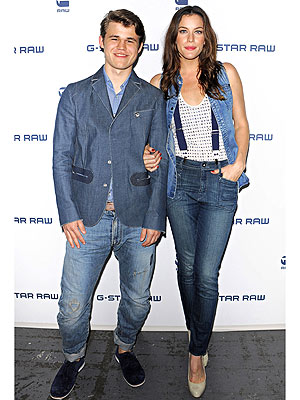
"Liv Tyler Dishes on Her Surprisingly Cool Chess Player Co-Star"
Elsewhere, Jennifer Shahade writes:
Those jeans reminded me of Dvoretsky
. Anyone under 2000 should not be reading his books and I'm guessing anyone over size four would be ill-advised to wear what one woman called a "3-dimensional cut which follows the natural curve of the body."
Fashion makes impossible demands on all of us. I resolve to read Dvoretsky (but on days when I'm over 2000), break 2200, and get back to a 32 waist!
Blaze vs. L.A. Vibe - tonight at 8 p.m.!
Follow the action on the Internet Chess Club (subscription required).
Or stop by the North Shore Chess Center at 5500 West Touhy Avenue, Suite A, in Skokie!
"The Role of Deliberate Practice in the Acquisition of Expert Performance"
What's the best way to improve at chess? This famous study doesn't offer any easy answers, but it does suggest a road to mastery.
A popularization of this study is the basis of one chapter in Malcolm Gladwell's Outliers: The Story of Success (which you really should read even if you don't particularly care for chess!).
A popularization of this study is the basis of one chapter in Malcolm Gladwell's Outliers: The Story of Success
(which you really should read even if you don't particularly care for chess!).
Tuesday, September 14, 2010
It's on craigslist, so it must be legal
No warranty, express or implied. (I don't know who posted this ad.)
But teaching chess to kids is always a fun gig!
But teaching chess to kids is always a fun gig!
Sunday, September 12, 2010
The opening trap that wasn't
Page 271 of Tony Miles' posthumously published biography, It's Only Me (an anagram of "Tony Miles"), mentions an opening trap in the Semi-Slav Defense with which Miles won a piece at move 9, but almost lost the game! The game is given below. It's very wild, and major improvements are doubtless possible for White. One possibility is 14.Bg5, which won quickly after 14...Ne4 15.Qxg8+ Kd7 16.Qxf7+ Kc6 17.Qe8+ 1-0 in Dimitar Marholev (2419)-Miroljub Lazic (2493), Cutro Open 2006. Unfortunately, Black gets to deviate too. Instead of 6...Bb4, as Jelling played against Miles, Black has scored 88% (+10 =1 -1) with 6...Qb6.
Winter article on Larsen
Edward Winter has published a new feature article about Bent Larsen, Bent Larsen (1935-2010), which has a lot of interesting quotes from him.
I once met Larsen. I was attending Columbia Law School in New York, and went to see the end of New York 1984. I saw Larsen, introduced myself, and thanked him for ranking my game against Sprenkle the most theoretically important in Informant 32. (Byrne ranked it second, Razuvaev ranked it tenth, and the other judges were underwhelmed. Overall it ranked 8th-9th, tying with Fedorowicz-Plaskett. See Informant 33, p. 9.) He kindly remarked that some of my moves in that game had been hard to find. A very nice man. How often does an ordinary master get such a compliment from a living legend?
I once met Larsen. I was attending Columbia Law School in New York, and went to see the end of New York 1984. I saw Larsen, introduced myself, and thanked him for ranking my game against Sprenkle the most theoretically important in Informant 32. (Byrne ranked it second, Razuvaev ranked it tenth, and the other judges were underwhelmed. Overall it ranked 8th-9th, tying with Fedorowicz-Plaskett. See Informant 33, p. 9.) He kindly remarked that some of my moves in that game had been hard to find. A very nice man. How often does an ordinary master get such a compliment from a living legend?
Blaze game of the week
NM Jeremy Kane takes a closer look at Dmitry Gurevich's blowout win on the Blaze blog.
Angelo Young's notes
...to his game with Steven Zierk of the San Francisco Mechanics (see previous post) are on the Blaze blog!
Board 3: an optical advantage?
Back to last week's Blaze win against the San Francisco Mechanics....
The London System has an innocuous reputation, but it's a dangerous weapon in Angelo Young's hands. White has a beautiful-looking (almost winning?) position after 17 moves, but Angelo couldn't find a way to convert.
18.e6!? is an interesting try in the diagrammed position below: the Rh8 gets trapped in some variations. But Black seems to be able to defend here, too. Thoughts?
Subscribe to:
Posts (Atom)