OK, not really. My opponent, the celebrated NN, played the "Clarendon Court Defense," 1.d4 c5 2.d5 f5!?, so named by its originator, the British GM Jonathan Levitt, who lived in a building by that name. I responded with the Staunton Gambit-like 3.e4!? fxe4 4.Nc3 Nf6 5.g4, vaguely recalling the game Seirawan-Mamedyarov, World Team Championship 2011. Here, IM Gary Lane recommends 5...g6!?, when Matros-Ehlvest, Stockholm 1998 continued 6.g5 Nh5 7.Nxe4 d6 8.Ng3 Nxg3 9.hxg3 Nd7 10.Nh3 Qb6 11.f4 Qb4+ 12.Kf2 (12.c3?? 12...Qe4+) 12...Qd4+ 13.Be3? Qxb2 14.a4 Bg7 15.Rb1 Qa2 16.Ng1 Nb6 and Black won shortly. Much weaker is 5...d6?, when Feingold-R. Benjamin, Missouri Invitational 2011 concluded 6.g5 Bg4 7.Bb5+! Kf7 (7...Nbd7? 8.Be2! Bxe2 9.Qxe2 and Black cannot move his hanging knight on account of Qh5+ and mate next) 8.Be2! Bxe2 9.Qxe2 Ne8 10.g6+ hxg6 11.Nxe4 Nc7 12.Ng5+ Kg8 13.Ne6 Nxe6 14.Qxe6+ Kh7 15.Qh3+ Kg8 16.Qe6+ Kh7 17.Nf3 Qd7 18.Ng5+ Kh6 19.Qe4 Kh5 20.Ne6 1-0.
NN, like Mamedyarov, played the natural 5...h6. Here, Seirawan played 6.h3 and won in just 29 moves; in Asensio Linan (2276)-Hernandez Funes (2144), Barbera del Valles 2007, White played the amazing 6.Nxe4?! Nxe4 7.Bd3 and won after 7...Qb6 8.Nf3 Ng5 9.Ne5 d6 10.Nc4 Qc7 11.h4 Nf7 12.Bg6 e6 13.Qe2 Qc7 14.Rh3 b5 15.Rf3 Kd8 16.Rxf7, but surely 7...Qa5+ improves? Instead, I responded 6.Bg2, and now 6...Qb6 was played in Conquest (2540)-Becerra Rivero (2530)
Cienfuegos 1996, which continued 7. Nge2 d6 8.h3 g5 9.Nxe4 Nxe4 10.Bxe4 Qb4+ 11.Nc3 Bg7 12.Bd2 Qxb2 13.Rb1 Qa3 14.Rb3 Qa6 15.Nb5 Kd8 16.Qe2 b6 17.O-O Nd7 18.a4 Ne5 19.a5 bxa5 20.Ra3 a4 21.c4 Rb8 22.Rb1 Bd7 23.Bc2 Qc8 24.Ba5+ Ke8 25.Rf1 Rf8 26.Bg6+! and White won. Our game continued instead 6...d6 7.Nxe4 Nbd7 (7...Nxg4) 8.Qe2 (threatening 9.Nxd6#) Nxe4 9.Bxe4 Ne5 10.Nf3, and now my opponent fell for 10...Bxg4? My 11.Nxe5! won material in light of 11...Bxe2? 12.Bg6#, a cousin of Légal's Mate. Black struggled on with 11...Qa5+, but resigned after six more moves.
Wednesday, May 2, 2012


Soundness never tasted so good
In this blitz game, I blundered a pawn with 8.Nf3?, but mated my opponent off the board after he thoughtfully gave up his fianchettoed bishop with 16...Bxe5? In the final position, Black resigned in light of 24...fxg6 (24...Kh8 25.Bb1#) 25.Qh4+ Kg8 26.Qh8+ Kf7 27.Qg7+ Ke8 28.Qe7#.
Monday, April 30, 2012
Noted without comment
I used to wonder why GM Larry Evans stopped writing about chess and became obsessed with chess politics.
From FIDE's website:
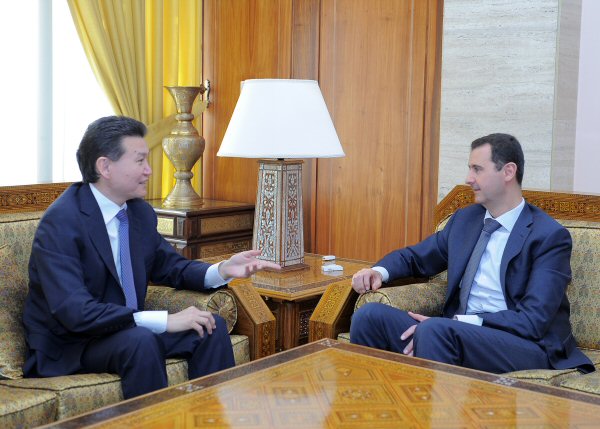 | |||
| President of the World Chess Federation (FIDE) Kirsan Ilyumzhinov (left) and President of Syria Bachar Assad |
The 1st President of Kalmykia, President of the World Chess Federation (FIDE) Kirsan Ilyumzhinov visited Syria on 28-29 April 2012. As Mr. Ilyumzhinov noted, on the 29th April he had a three-hour talk with the President of Syria Bachar Assad in Damascus. Mr. Assad underlined during the discussion, that he tasked the Syrian Ministry of Education to sign an Agreement to join the "Chess in Schools" project with the World Chess Federation. Mr. Ilyumzhinov informed the "Nezavisimaya Gazeta" that "in early June, as a dedication to the International Day of Children, we are planning to organize the first international youth chess tournament, where young players of Arab countries, will participate, in Damascus". The FIDE President did not exclude the possibility that Mr. Assad might participate in the opening of the youth chess event. According to Mr. Ilyumzhinov, "The Syrian President plays chess very well - since his studies in London".
[....] During the discussion the Syrian President informed Mr. Ilyumzhinov of his intention to invite H.H. the Dalai Lama to Syria on an official visit. Ilyumzhinov said: "President Assad said that on the Syrian territory there is one of the most ancient Buddhist temples erected about two thousand years ago. He would like to invite H.H. Dalai Lama to sanctify this temple".
 |
| With Qaddafi, June 2011 |
 | ||
| With Saddam Hussein, 1998 |
 |
| With Max von Sydow, 1957 |
Friday, April 27, 2012
(Not) Winning a Won Game
Here's another game from last month's ICA Girls' Invitational Championship at the North Shore Chess Center. I hope that both Adele and Miranda will forgive me for publishing a game in which they made 51 good moves and only one bad one. But I found this game so instructive because it's so typical.
The stylish way to win a game is by direct attack against the enemy king. In real life, we don't get to be stylish as often as we'd like. So we win a piece instead. When we talk about "winning a piece" in chess, we mean winning a bishop or a knight, worth about three pawns. In this game, Miranda wins a piece for a pawn: in quiet middlegame positions, this advantage is usually sufficient for a win.
When you win a piece for a pawn, what's the easiest way to win? Well, you'd like to use your extra material to queen a pawn and then checkmate with overwhelming force.
But put yourself in your worthy opponent's shoes. You may be winning, but you have one less pawn than she does. So if the defender could keep trading one of her pawns for one of your pawns until there was only one pawn left, that extra pawn would be hers. True, you would still be up a piece, but you'd have to look for a way to checkmate without making a queen. That's much harder! (Rule of thumb: in pawnless endings, one often has to be up by five "points" to win.)
DEFENDERS WANT TO TRADE PAWNS, NOT PIECES. (Here, we use "pieces" in a second sense: kings, queens, rooks, bishops, and knights, but not pawns. Yes, I know we can't trade kings. And yes, we usually talk about chess sets having thirty-two pieces, not sixteen pieces and sixteen pawns: this third meaning of "piece" is actually the most common one.)
THE SUPERIOR SIDE WANTS TO TRADE PIECES, NOT PAWNS. Every pawn is a potential queen. Guard your potential queens just as you do the one that's already on the board!
Adele Padgett – Miranda
Liu [D45]
ICA Girls’ Invitational
March 31, 2012
1.d4 d5 2.c4 e6 3.Nc3 Nf6 4.Nf3 Be7 5.e3 0–0
6.Be2 c6 7.0–0 Nbd7 8.Bd2 dxc4 9.Bxc4 b5
 |
| White to play |
Miranda chooses a Meran Variation setup. As
White's bishop is not that active on d2, Black should get nice play.
10.Bd3 Bb7 11.e4 a6 12.Rc1 c5
 |
| White to play |
The typical Meran break.
Thursday, April 26, 2012
Saddam, Qaddafi, and Tom Dart?
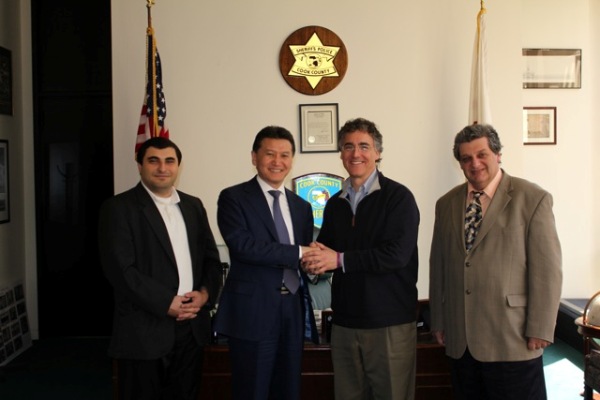
Left to right: Sevan Muradian, FIDE President Kirsan Ilyumzhinov,
Cook County Sheriff Tom Dart, Mikhail Korenman
Check out this story currently featured on FIDE's home page. The U.S. Secret Service (we know how diligent and task-oriented these fellows are) did let Kirsan meet former Presidents Clinton and Carter. So perhaps I shouldn't be so uptight....
And I don't want Chicago to get a reputation as an ungracious host. It's important to talk to people with whom we don't agree. Some of them will be in town next month for the NATO summit.
Having said that, I can only reiterate my earlier post.
Both Sevan and Mikhail are friends of mine, so I feel rather awkward posting this. I would feel even more awkward if I were silent.
Wednesday, April 25, 2012
Tuesday, April 24, 2012

Evanston Chess $5 Swiss on May 5th
Another email cut-and-paste (fortunately for Sam Schmakel's rating, I'll be in Florida that weekend). More Evanston Chess info here.
Levy Senior Center, 300 Dodge Ave., Evanston, IL 60202
Levy Senior Center, 300 Dodge Ave., Evanston, IL 60202
Evanston Chess Presents:
May 5, 2012, 9:00am-5:00pm
May 5, 2012, 9:00am-5:00pm
Three x Three, 3SS G/65 delay 5
Three Sections, USCF Regular Rated
Our guest master will be NM Sam Schmakel
Section Gold: 1700 and over
Section Silver: 1200 - 1699
Section Bronze: Under 1200 and Unrated
1600 - 1699 may play up to Gold.
1100 - 1199 may play up to Silver.
Published USCF Regular Rating determines eligibility.
Unrated players may be placed up at TD discretion.
From time to time Evanston Chess pays one or more titled players to play in our events. We usually do not pair them against each other. Even if they should lose (it does happen) we may pair them with the highest score groups.
Three rounds. Digital clocks are required and will
be set to G/65 plus 5 seconds delay. Accelerated or decelerated
pairings at TD discretion. Sections may be combined at TD discretion.
Registration from 9:00 to 9:30 AM. Players must check in by 9:30 am;
players who arrive late will receive a half-point bye for the first
round. First Round 9:45 am, last round over roughly 5:00 pm. No Lunch Break: We need to be finished by 5:00 PM, so there will be no extra time between rounds for lunch.
You may take one half-point bye in any round but the last.
Entry fee is $5, please pay cash (no checks) at the door. Masters and Experts play free.
Pre-registration is encouraged: Help us start on time. Send name, USCF number, and telephone number to enter@evanstonchess.org
Junior players (under fourteen years) rated 900+ are welcome. Sorry,
but we do not accept junior players rated under 900. Must be accompanied
by a parent throughout the event.
Bring clocks. -- Wheelchair accessible. No Smoking.
Monday, April 23, 2012
"At Chicago chess tournament, girls rule the board"

Caeley Harihara of Rogers Park is a freshman at Payton
Photo: Phil Velasquez, Chicago Tribune
Nice coverage in this weekend's Trib.
Local highlights:
Caeley Harihara (photo above) was playing on the top board in final round of the 16 & Under Section. She lost to 16U winner Lilia Poteat of New York, and finished tied for third with 4-2.
Anjali Toly tied for second in the 12 & Under section, finished 5-1, and gained a bucket of ELO.
Miranda Liu (post-event rating 1675!) scored 5-1 in the 10 & Under Section, finishing tied for third in a 59-player field.
Shreya Managalm (already 1397!) "only" scored 4½-1½ in the 8 & Under Section: Shreya won her first four games, drew the second-place finisher in round 5, and lost to Maggie Ni of Texas in round 6.
Crosstables here. The KCF All-Girls National Championship (organized by the Kasparov Chess Foundation and Renaissance Knights) drew 230 players in six sections. And the event will return to Chicago next year!
Kayser Roll
The Black Knights' Tango (1.d4 Nf6 2.c4 Nc6!?) is an offbeat but playable opening that many opponents aren't prepared for. GM Joel Benjamin wrote of it (in 2004, admittedly) "Opponents under 2200 tend to be a bit confused. They aren't programmed to meet this move; they can't pull something out of their repertoire." Best for White may be the restrained 3.Nf3 e6 (avoiding 4.Nc3 e5!) and now either 4.Nc3 Bb4 (transposing to a line of the Nimzo-Indian) or the prophylactic 4.a3, as Kasparov has played. My opponent in the game below played 3.d5, which IM Richard Palliser calls "The Lunge." White is probably thinking, "Let's blow this ridiculous opening off the board!," but it's not so easy. After 3...Ne5, he should have continued with the consistent 4.e4 e6 (4...Nxe4?? 5.Qd4) 5.f4 (or, more sedately, 5.Nf3, as Gligoric once played). Instead, he played the flaccid 4.b3?! e6 5.Bb2. After 5...Bb4+, he should have played 6.Bc3!, keeping a playable game. His 6.Nd2?? got crushed by 6...Ne4! 7.Bc1 Qf6! 8.Nf3 and now, while I was contemplating my next move, White resigned. I probably would have played 8...Ng4 followed by crashing in on f2, rather than 8...Nxf3+ 9.gxf3 (9.exf3? Nc3! 10.Qc2 Qe5+ is crushing) Qxa1 (9...Nxf2!?) 10.fxe4, when White could pretend that his "big center" gives him compensation.
Believe it or not, through 7...Qf6, I was following a game between two strong grandmasters! In Marshall-Torre, 1925, the U.S. champion resigned after 7...Qf6. This was an offhand game that they played on board the S.S. Antonia while en route to the Baden-Baden 1925 tournament. Maybe Marshall was seasick. Kayser was not the first player who has fallen into this trap in an Internet blitz game against me. In a 2011 game I played on FICS, rather than play the abject 7.Bc1, White gave up his queen with 7.Bxe5 Bxd2+ 8.Qxd2 Nxd2 9.Kxd2 d6 10.Bb2 (10.Bxg7? Qg5+) exd5 11.cxd5 Qg5+ 12.e3 Qxd5+ and I won.
If you want to learn to Tango, check out Benjamin's articles here and here.
Saturday, April 21, 2012
A trap in the Ponziani
The Ponziani Opening (1.e4 e5 2.Nf3 Nc6 3.c3) is an odd duck. No wonder it was a favorite of the Hungarian IM Andreas Dückstein. (Yeah, yeah, I know, his name isn't really pronounced like "duck.") It can lead to wild play after 3...d5 4.Qa4 or 3...f5!?, or a dull endgame after 3...Nf6 4.d4 Nxe4 5.d5 Ne7 (5...Nb8 is also OK, while 5...Bc5?! is another crazy line) 6.Nxe5 Ng6 7.Qd4 Qe7 8.Qxe4 Qxe5 9.Qxe5+ Nxe5. Here is a trap that those who defend double-king pawn openings should be aware of. Black's 6...d6? is a oft-seen blunder according to Dave Taylor and Keith Hayward in their book "Play the Ponziani," especially in blitz games. (Incidentally, I got the book today for only $5 at North Shore Chess Center's book/DVD sale. Check it out!) The pedestrian way to lose would have been 8...bxc6! 9.Nxc6 Qb6! 10.Nd4+ Kd8, when Taylor and Hayward observe that Black "has zero compensation for the pawn and his king is in trouble." Black went down in more picturesque fashion.
The John Wooden of chess
Elizabeth Spiegel is a teaching dynamo who is absolutely devoted to her students at Brooklyn's I.S. 318. She says she isn't a genius, she just works hard. Hard work is a form of genius....

She's in town this weekend with her students at the All-Girls National Championships at the Swissotel. Last night, Keith Ammann and I had the pleasure of congratulating Elizabeth and trying to learn from the master.

She's in town this weekend with her students at the All-Girls National Championships at the Swissotel. Last night, Keith Ammann and I had the pleasure of congratulating Elizabeth and trying to learn from the master.
Friday, April 20, 2012
Lawson House YMCA Floating Fundraiser June 12th

This looks like a fun way to start a summer evening. Proceeds benefit Lawson House YMCA, which gives a home to the people who need it most, and creates a loving community for them.

Thursday, April 19, 2012
Illinois Chess Tour: Normal April Open
Make the trip to the Twin Cities this Saturday to play in the Normal April Open, an Illinois Chess Tour event!
The entry fee is only $20: cheap! Want to save gas money? Have fun and carpool by posting a note on the ICA Forum (or as a comment to this blog entry).
The entry fee is only $20: cheap! Want to save gas money? Have fun and carpool by posting a note on the ICA Forum (or as a comment to this blog entry).
All Girls National Championship at the Swissotel

The event (organized by the Kasparov Chess Foundation, the USCF, and Renaissance Knights) begins tomorrow at 6 p.m and continues through the weekend. You still have time to save $5 by registering today. It's open to all girls who are 18 or younger as of April 1, 2012.
The Swissotel (at 323 E. Wacker) is a VERY COOL location for a national chess event!
Win free tickets to Fish Men at the Goodman: you have 57 minutes
Share your chess story for a chance to win!
In Teatro Vista's production of Fish Men by Cándido Tirado, every character has come to their love of chess in a different way.
Who taught you how to play, or what memories do you have about learning and playing the game of chess?
Enter your story for a chance to win two tickets to see Fish Men in Goodman's Owen Theatre!
Submit your story by 5pm April 19th! Three winners will be chosen April 20th.
Contest closes at 5 p.m., Facebook friends! Hat tip to Lou Ascherman.
Wednesday, April 18, 2012
Dear MacArthur Foundation

Please give Elizabeth Spiegel a genius grant. Now.
Story on the front page of today's New York Times.
Hat tip to Keith Ammann for the following clip from Rachel Maddow:
Visit msnbc.com for breaking news, world news, and news about the economy
"Fish Men" reviewed by Chris Jones

Claire and I saw Fish Men Sunday night. Chris Jones reviews here.
But I think the political theme works well in Washington Square Park. Jones is incorrect to argue that "this play is just too overloaded with weighty geo-political metaphors and personal secrets for this little section of the park to credibly hold, especially since all these traumas seem to come crashing down at once." Talk to the immigrants you play chess with, and ask them how they came to be here in Chicago. I don't want to give away any spoilers, but think of how much the ethnic cleansing of the Bosnian War affected the Chicago chess community. The stories of the late Osman Palos and the recently deported Aleksandar Stamnov are tragic, and both stories could easily have been worked into this play. The persecuted of all nations flee to American cities. And when they get here, they play chess in the park.

Fish Men begins with the hustler Cash's discussion of a famous drawn game from the Kasparov-Anand match of 1995. But the destruction of the site of that match on September 11, 2001, is never explicitly invoked, even though the World Trade Center was and is just a few blocks from Washington Square Park.
Yeah, the play is overdetermined. But yeah, people are repeatedly and needlessly cruel to other people. I prefer the oblique critique to the direct, Dylan to Phil Ochs, Beckett to Tony Kushner. The problem with an oblique message play is that your message can be misunderstood or lost. Tirado doesn't have this problem.
Well worth seeing for all my complaints: if you're on the main floor, you'll be a well-placed kibitzer. At the intermission, a stagehand was setting up a Sicilian middlegame for Act II. I left my seat to tell her that the same King's Gambit game (featuring ...Qh4+, ...Qxb2, and a decisive f5-f6 push) was used for two differenct scenes in Act I. Mr. Memory (that's me) noticed this and found it mildly annoying. Then Mr. Memory returned to what he thought was his seat and had to be told to move by a nice lady....
Tuesday, April 17, 2012

Sunday, April 15, 2012
Wait until next year...?
I met NM Ben Gershenov of New York last year; he's a very pleasant young man and a phenomenal talent. Ben and NM Dipro Chakraborty of Arizona (½ point behind Ben's 6-.0) are playing on Board 1 of Nationals: winner takes the title.
Board 2 is all-Illinois! FM Eric Rosen (an undefeated 5-1) and NM Sam Schmakel are likely playing for second place. So no repeat championship for Eric: Sam will have two more tries.
Aakaash Meduri made a phenomenal recovery from a first-round loss and also sits on 5-1.
Saturday, April 14, 2012
National High School: standings after four rounds
Very interesting!
It will likely take 6½ points to win this year, so NM Adarsh Jayakumar is probably out of the running for first. But NM Sam Schmakel of Whitney Young is one of the co-leaders, and Gauri Shankar of Glenbrook South, defending champ FM Eric Rosen of Niles North, and Rafeh Qazi of Niles North are still in contention for the title.
From a selfish perspective, I feel honored to have played against and analyzed with so many of these top young players. You can, too!
Friday, April 13, 2012
National High School Championships - top seeds and local players
Many familiar names on this list: have fun playing! (Look at all the elementary and junior high players! Gavin McClanahan is not a senior.)
1 Rosen, Eric S ILNILN 12 IL 2414
2 Getz, Alec NYHUNT 12 NY 2409
3 Ostrovskiy, Aleksandr NYHUNT 10 NY 2391
4 Shen, Arthur NJJPST 9 NJ 2363
5 Shetty, Atulya A MIHURO 10 MI 2357
6 Adelberg, David T AZSDES 9 AZ 2353
7 Jayakumar, Adarsh 12 IL 2337
8 Shankar, Gauri ILGGLS 12 IL 2327
9 Brown, Michael W CAMTRA 9 CA 2319
10 Black, James A, Jr NYI318 8 NY 2312
11 Williams, Justus D NYI318 8 NY 2307
12 Vilenchuk, Michael B OHD012 12 OH 2305
13 Colas, Joshua NYW006 8 NY 2297
14 Ng, Andrew NJL003 12 NJ 2293
15 Mo, Kevin PAW007 11 PA 2283
16 Schmakel, Sam A ILC004 10 IL 2250
17 Yang, Michael MNE003 12 MN 2247
18 Dahl, Matthew D MNM007 12 MN 2246
19 Gershenov, Ben NYSOLH 12 NY 2244
20 Hu, Bryan AZCFHS 9 AZ 2230
21 Altschuler, Jason TXDSMK 12 TX 2214
22 Golub, David WAB012 12 WA 2212
23 Perez, Reinaldo, Jr 9 FL 2211
24 Chakraborty, Dipro AZS017 10 AZ 2204
25 Mu, Joshua NCD001 11 NC 2201
35 Viswanadha, Kesav CAC015 7 CA 2148
37 Barayev, Isaac NYI318 8 NY 2141
47 Liang, Awonder WIM024 3 WI 2100
50 Meduri, Aakaash ILH006 12 IL 2088
51 Peters, Epiphany M MIC005 9 MI 2088
52 Wu, Darren P WAS002 12 WA 2082
53 McClanahan, Gavin J ILGGLS 12 IL 2079
81 Zinski, Maximilian J ILL011 9 IL 1973
100 Kranjc, Nathaniel A ILL011 9 IL 1901
101 Qazi, Rafeh R ILNILN 12 IL 1898
119 Swan, Charles ILC004 11 IL 1862
123 Liang, Adream WIM024 5 WI 1849
135 Lehmann, Spencer G ILB006 7 IL 1814
143 Akintonde, Jimi ILC004 9 IL 1802
150 Shankar, Roshan C 9 IL 1787
152 Paykin, David ILNILN 11 IL 1786
169 Waechter, Mark ILC004 11 IL 1732
175 Hrach, Jonathan ILH003 8 IL 1719
187 Dzelilovic, Adil ILNILN 12 IL 1688
193 Brown, Ethan ILNILN 10 IL 1683
194 Guan, Bradley ILNNAP 9 IL 1683
196 Fei, Andrew Y 6 IL 1676
213 Natarajan, Oliver ILC004 9 IL 1635
218 Pena, Cristian ILC004 12 IL 1630
228 Kadineh, Soroush ILNILN 11 IL 1611
235 Dahiya, Anuj S ILNNAP 12 IL 1601
250 Harihara, Caeley ILC010 9 IL 1522
266 Holzmueller, Nathan ILE009 8 IL 1429
278 Kozeny, Grant A ILL011 9 IL 1361
282 Kumar, Chetan ILNNAP 12 IL 1333
294 Zhou, Tony T ILNNAP 9 IL 1236
296 Tu, Derek ILH006 10 IL 1233
299 Widmann, Johan ILL011 9 IL 1227
300 Kang, Kevin ILNNAP 12 IL 1223
305 Nevling, Alex P ILH006 12 IL 1185
309 Leon, Aaron ILH006 10 IL 1166
311 Moran, David R ILH006 12 IL 1118
323 Li, Huajian R ILH006 10 IL 748
327 Bolaris, Hephestion M ILGGLS 12 IL
328 Domutz, Kyle L ILGGLS 12 IL
334 Tarczon, Albert W 12 IL
335 Xiong, Jinghui ILC004 11 IL
Thursday, April 12, 2012
National High School Championships - prelims
The 2011 United States High School Champion, FM Eric Rosen of Niles North, is in Minneapolis to defend his title. Eric already has one 2012 title in the bag: the illustrious High School Bughouse title: Eric and his teammate NM Matthew Dahl of Minnesota scored 11-1 to take first on tiebreaks.
Also today, NM Sam Schmakel of Whitney Young keeps the U.S. High School Blitz trophy in Whitney Young's trophy case (Michael Auger of Whitney Young won the title last year).
Hat tip to Brad Rosen on the scene: main event starts tomorrow.
Also today, NM Sam Schmakel of Whitney Young keeps the U.S. High School Blitz trophy in Whitney Young's trophy case (Michael Auger of Whitney Young won the title last year).
Hat tip to Brad Rosen on the scene: main event starts tomorrow.
Sunday, April 8, 2012
Silly Easter game
After 1.d4 d6 Black can transpose to a Pirc after 2.e4 Nf6 (2...e5!? is also playable, except in Seirawan chess) 3.Nc3 g6, and hopes for 2.c4?! e5!, when the databases already show a plus score for Black, especially if White plays 3.dxe5 (3.Nc3! is best) dxe5 4.Qxd8+. I played 2.Nf3, expecting a transposition to the King's Indian after 2...Nf6 3.c4 g6. After Black's actual move, 2...Nd7, I played 3.e4, anticipating 3...e5 4.Bc4!, when Black has transposed into the inferior Hanham Variation of Philidor's Defense. Instead, Black played 3...b6. After my 4.Bc4, he should have played 4...e6! heading for the offbeat but playable Hippopotamus Defense. Instead, 4...c5? allowed a winning bishop sacrifice: 5.Bxf7+! Kxf7 6.Ng5+. Now best was 6...Ke8 7.Ne6, when Black loses queen and pawn for two minor pieces but at least avoids mate. If Black had tried to save his queen with 6...Kg6? 7.Ne6 Qe8?, I would have mated with 8.Qg4+ Kf7 (8...Kf6 9.Qf5#) 9.Ng5+! Kg6 10.Qf5+ Kh6 11.Nf7#. Poor NN stumbled into 6...Kf6? 7.Qf3+, and then resigned in light of 7...Kg6 8.Qf7+ Kh6 9.Ne6+ g5 10.Bxg5#.
Thursday, April 5, 2012
Positively Thompson Street

Fish Men opens this Saturday at the Goodman. From the press release:
Goodman Theatre and Teatro Vista team up for their second world-premiere production with Fish Men, Puerto Rican playwright Cándido Tirado’s new comedic drama about a group of urban chess hustlers drawn together by a shared need to overcome their individual demons. Edward Torres, Artistic Director of Teatro Vista, makes his Goodman directorial debut with this second play of a three-year producing partnership between the Goodman and Teatro Vista, Chicago’s first and largest not-for-profit professional Latino theater company. Fish Men runs April 7 – May 6, 2012 (Opening Night is April 16) in the Goodman’s Owen Theatre. Tickets ($12-$42; prices subject to change) can be purchased at GoodmanTheatre.org by phone at 312.443.3800 or at the box office (170 N. Dearborn). Sara Lee Foundation is the Owen Season Sponsor. Baxter and Blue Cross Blue Shield are Contributing Sponsors and Hoy is the Spanish Print Media Sponsor.
Cándido Tirado, Teatro Vista’s newest resident playwright and a highly-rated chess master by the United States Chess Federation, explains, “When I graduated from college, I decided I wanted to combine two great loves of my life: writing plays and playing chess. But it wasn’t until 2000, as I was walking by the chess tables in New York’s Washington Square Park, that the play suddenly revealed itself to me. Outwardly, Fish Men deals with the cruel art of the ‘chess hustle’—but underneath it is an exploration of man’s inhumanity towards his fellow man. I am thrilled to premiere this play in Chicago, with Teatro Vista and Goodman Theatre.”
Fish Men plays out in real time on a hot summer day in New York City’s Washington Square Park, where Rey Reyes (Raul Castillo), a survivor of the Guatemalan genocide who is going through his own personal hell, gets snared by a group of chess hustlers. Ninety Two (Howard Witt), a Holocaust survivor, tries to intervene, exposing Rey’s need for vengeance. As the game progresses, the circumstances that stoke the fire of each player’s obsession with the game and their inner demons are revealed.If the playwright is true to his material, Fish Men will make Gorky's The Lower Depths look life-affirming.
Ahoy kitty

Cap'n Fred Furtner of the AMA Tornado Snakes
(with kitty mug)
The March issue of The Chicago Chess Player is out.
Wednesday, April 4, 2012
A trap in the Chameleon Sicilian
This trap comes from the book Invisible Chess Moves: Discover Your Blind Spots and Stop Overlooking Simple Wins by Emmanuel Neiman and Yochanan Afek. In the Chameleon Sicilian, 1.e4 c5 2.Ne2 (other move orders are also possible), White often keeps Black guessing for several moves as to whether he will play an Open Sicilian with d4, or a Closed Sicilian with g3, Bg2, etc. In the latter case, if White holds off on Nbc3 he can try to take over the center with c3 and d4.
The Chameleon can be tricky for Black if his preferred system against the Closed doesn't mesh well with his preferred Open Sicilian. In Bacrot-Relange, Black responded with 2...d6 (a Najdorf player would be unhappy after 2...Nc6 3.d4) 3.g3 d5!? Now 3.cxd5 Qxd5 would be awkward for White. Best may be the gambit 3.Bg2 dxe4 4.Nbc3!?, when 4...f5!? 5.0-0 Nf6 6.d3 exd3 7.Nf4 Nc6 8.Re1 dxc2 9.Bxc6+ bxc6 10.Qxc2 gave White compensation for the two sacrificed pawns in Baklan (2618)-Tukhaev (2466), Alushta 2007 (1/2-1/2, 38). Bacrot preferred 4.Nbc3, and after 4...d4! he should have retreated with 5.Nb1. Instead, he lunged forward with the aggressive-looking 5.Nd5??, overlooking Relange's surprising 5...g5! trapping the knight. After 6.d3 h6! (avoiding 6...e6? 7.Bxg5!) 7.Bg2 e6, White was losing a piece for just one pawn. Although he fought on, the outcome was never in doubt.
The Chameleon can be tricky for Black if his preferred system against the Closed doesn't mesh well with his preferred Open Sicilian. In Bacrot-Relange, Black responded with 2...d6 (a Najdorf player would be unhappy after 2...Nc6 3.d4) 3.g3 d5!? Now 3.cxd5 Qxd5 would be awkward for White. Best may be the gambit 3.Bg2 dxe4 4.Nbc3!?, when 4...f5!? 5.0-0 Nf6 6.d3 exd3 7.Nf4 Nc6 8.Re1 dxc2 9.Bxc6+ bxc6 10.Qxc2 gave White compensation for the two sacrificed pawns in Baklan (2618)-Tukhaev (2466), Alushta 2007 (1/2-1/2, 38). Bacrot preferred 4.Nbc3, and after 4...d4! he should have retreated with 5.Nb1. Instead, he lunged forward with the aggressive-looking 5.Nd5??, overlooking Relange's surprising 5...g5! trapping the knight. After 6.d3 h6! (avoiding 6...e6? 7.Bxg5!) 7.Bg2 e6, White was losing a piece for just one pawn. Although he fought on, the outcome was never in doubt.
Rybka solves the King Gambit?
If you know Bobby Fischer's famous article "A Bust to the King's Gambit" (PDF), you might be interested in this ChessBase article.
Alpha nerds discussed the matter in some detail on Slashdot, which is particularly interesting in light of this followup article (which certainly changed my attitude!) Of course, I currently play 1...e5, so I would have an inherent bias.....
Alpha nerds discussed the matter in some detail on Slashdot, which is particularly interesting in light of this followup article (which certainly changed my attitude!) Of course, I currently play 1...e5, so I would have an inherent bias.....
Tuesday, April 3, 2012
"Winding Down"

Back in January, NM Tom Braunlich started a topic on the USCF Issues Forum titled "Analog Clocks Now 'Obsolete'?" (USCF membership required). In one of his posts to this topic, he proposed that the USCF should "make a more prominent announcement in Chess Life and CLO that this change has come and that analog clocks are being phased out." As a onetime journalist, I realized such an announcement would receive little notice on its own, and it would draw much more attention if it were embedded in a feature story about the history of the analog chess clock. I pitched the idea to CL editor Dan Lucas, and he gave me the go-ahead to write it. It's the cover feature of the April 2012 Chess Life.
For the record, I have no idea why the article is illustrated with two pictures of weird-looking digital clocks. (The picture on page 32, reproduced above, is of a Fattorini & Sons "tumbling clock" of the style used in the 1880s and '90s.) Also, if the first page reads funny, it's because my original five artfully constructed paragraphs were glommed together into one big one. Alas, we cannot dictate how our children live once they leave home.
2nd Annual Scott Silverman Memorial April 14-15
Another email cut and paste:
The 2nd Annual Scott Silverman Memorial will be held on Saturday April 14 and Sunday April 15. The event is in memory of one of our dearly beloved fellow chess players that passed away in 2005.
The event is a 4R-SS Game-90 + 30/sec increment tournament. There will be 2 rounds played per day. The EF is $30 for members of the North Shore Chess Center and $40 for non-members.
This is a Plus Score tournament with the following prize structure: 4.0=$150, 3.5=$100, 3.0=$75, and 2.5=$50. There will be 6 masters invited to the event and the remaining 34 spots for non-master players. The event is both USCF and FIDE rated.
If you are going to play - please register immediately for this in order to secure your space. Once the limit is reached we are done. Register and pay online athttp://www.nachess.org/tournaments/tournaments/eventattendees/186-9th-na-amateur-open-the-2nd-annual-scott-silverman-memorial
If you have any questions please email Sevan Muradian.
AP coverage of Karpov visit in Washington Post
CHICAGO — Call it the Sheriff’s Gambit.
A sheriff in Illinois is turning to kings, queens and rooks to help teach inmates at his jail not to behave like pawns.

Karpov finally makes a successful prison visit
Former world champion Anatoly Karpov tried to visit his successor, Garry Kasparov (briefly detained in Moscow in 2007 for organizing an anti-Putin rally). The authorities did not allow Karpov to see Kasparov in jail. As far as I know, Kasparov never attempted to visit his predecessor, Bobby Fischer, during Fischer's detention in Japan.
But yesterday, Karpov visited chess players in Chicago's Cook County Jail. The lucky inmates accomplished something that Fischer and Kasparov weren't able to do.
Karpov comes to Chicago regularly as a guest of Mikhail Korenman. This visit, Karpov and Korenman dropped in on Cook County Sheriff Tom Dart to announce a prison chess program.

Brilliant idea! (Check out the audio: it's a bit disconcerting to this Chicagoan to hear WBBM's John Cody talk about Tom Dart and Karpov in the same sentence.)
I would love to see Dr. Korenman or someone else take this idea one step further. The average reading level of Cook County juvenile detainees is at the second-grade level. That's not far from functional illiteracy, and that's a tragedy. Granted, some of these young people may never have the intellectual capacity or emotional maturity to turn their lives around. But at least a few of these young people must have these tools: chess could help them prove to themselves that they're smart enough to succeed in an information economy. If we could help a handful turn their lives around, such a program would be very much worth doing. (Why chess? Like mathematics and music, very little cultural capital is required. With the proper instruction, innate talent will take one far.)
We Cook County taxpayers already shell out $225,000 per year to detain one teenager: as Cook County Board President Toni Preckwinkle has noted, that's enough to pay for an entire undergraduate education at a fine private school. And if that teenager remains Trouble with a Capital T (and let's be honest, doesn't Mikhail Korenman remind you of Robert Preston in The Music Man?), then what's the present value of that teenager's future cost to society? How much is it worth spending now to avoid ruined lives, victims' suffering, police and judicial and prison expenditures? We have selfish reasons to turn a few lives around.
Chess won't magically turn inmates or juvenile detainees into model citizens. (Blitz winnings from the North Avenue Pavilion have been used to buy crack.) But perhaps it can help some of them think before they act, or at least give them a pleasant and productive way to spend their time in detention. And if chess can show a few of them that they have great talents that they must not waste, the return on human capital is potentially enormous!
Hat tip to Albert Chow for the following link to WLS's television coverage. (Short commercial first.) Chicago tournament players may see a familiar face in the video.
Monday, April 2, 2012
April 7 in New Lenox: Warriors Open and Reserve
$5 entry fee: such a deal! The site is Lincoln-Way West High School: info here.
A Rook Ending from the Denker
Here's a position from Moskwa v. Kogen that illustrates the differences between rook endings and queen endings discussed in the last post.

Robert's pawn is nearer to queening but that's not nearly as big an advantage in a rook ending because the Black rook will sacrifice itself for the new queen after which the White rook won't be able to handle the Black king and connected pawns alone and may be forced to sacrifice itself in return. A queen could handle the Black king and pawns with ease.
The game went 39.Rc8 Rd3 40.Ke6 b3 41.d7 a4 42.d8=Q+ Rxd8 43.Rxd8 Kc5 and in order to draw White will have to hustle his king over to help with the defense and sacrifice his rook at the right moment. On the other hand, 39.e5! would have won after 39....Rd3 40.e6 Rd5+ 41.Ke4 Rxd6 42.e7 42.Rxe7 42.Rxe7 because the White king is close enough to assist the rook before the Black pawns advance too far.
Cross posted at Prospect Chess
A Queen Ending from the Denker
One of the places that I thought Robert Moskwa might run into trouble at the Denker Qualifier due to the relatively short time he has been playing serious chess was in the endgame. Although his calculation skills are excellent, you often don't have enough time left to calculate as thoroughly as needed when you reach the endgame. As a result, the kind of general understanding of endgame principles that you can only get by experience, especially painful experience, can be very important.
Nowhere is the lack of time felt more than in queen endings. On nearly every move, the players must try to visualize the consequences of an avalanche of checks.
In most endings, a player must carefully weigh the value of advancing a pawn closer to the queening square against the possibility of it becoming weak due to lack of support. Hence, the general endgame principle of pieces before pawns, i.e., unless the ending is a pure pawn race, players should try to improve the position of their pieces before they advance their pawns.
In queen endings, however, advanced pawns are much less likely to become a liability. This is because a queen has the ability to protect a pawn and control the squares in front of the pawn at the same time without hindering the pawn's advance. A king can blockade a pawn that is only supported by a knight, a rook, or a bishop, but it is helpless to stop the advance of a pawn supported by a queen. In fact, it often has to worry about being mated. Even another queen acting alone cannot hold back a pawn supported by a queen.
The flip side of the queen's ability to advance a pawn without assistance is its ability to oppose a king and a pawn without assistance. Acting alone, a knight, a rook, or a bishop has difficulty holding back a pawn supported by a king and can often be forced to sacrifice itself to prevent a pawn from queening. A queen on the other hand has very little trouble holding back a pawn by itself. In fact, it can often hold back several pawns.
The upshot of all this is that having the farthest advanced pawn is of paramount importance in queen endings. It is not unusual to see a deficit of several pawns be offset by a single pawn that has reached the sixth rank because the extra pawns can be easily rounded up if the defender can be forced to sacrifice his queen.
All of this brings us to the following position from Moskwa v. Meduri.

Fearing Black's g-pawn, Robert played 59.d7+? Qxd7 60.Qxg3 and the game ended in a draw. However, despite the fact that Black's g-pawn is as near to its queening square as the White's d-pawn, the Black pawn is not supported by its queen and the Black queen is needed to defend against mating threats. After 59.c5!, Black can't play 59...g2 because of 60.Qb8+ Kf7 61.Qb7+ Kf8 62. Qxg2. If Black tries 59...Qd7, 60.c6! is devastating.
Cross posted to Prospect Chess
A crucial win by George Li from yesterday's Barber Qualifier
George Li – Spencer Lehmann
Illinois Chess Association Barber Qualifier, Round 4
Skokie, April 1, 2012
Catalan Opening [E04]
This interesting game does credit to both young players!
1.d4 Nf6 2.c4 e6 3.g3 d5 4.Nf3 dxc4 5.Bg2 a6!?

White to move
5...a6 creates the possibility of holding the gambit pawn
A couple critical anti-Catalan lines begin with this move.
6.a4 c5!
With a pawn on a4, White doesn't have Qa4+.
7.Qc2
Karpov played 7.0–0 here.
7...cxd4 8.Qxc4 Nc6
Black has gotten the better of the opening so far...
9.0–0

Black to move
Can Black keep the extra pawn for good?
9...e5
If Black can get away with this, White's in big trouble. I like Black after the modest 9...Be7.
10.Ng5!
White finds a very cool variation: the next few moves are virtually forced for both sides.
10...Qc7! 11.Bxc6+! bxc6

White to play
As we learned from White's previous move,
the Qc7 is overloaded protecting f7 and c6, so....
As we learned from White's previous move,
the Qc7 is overloaded protecting f7 and c6, so....
12.Nxf7! Qxf7 13.Qxc6+ Qd7 14.Qxa8
Winning a boatload of material.

Black to play
How to develop?
14...Bc5
14...Bd6!? takes the b8 square away from White's queen. Black has some compensation after 15.Bg5 0–0 16.Qg2.
15.Qb8
Houdini points out 15.Nd2! 0–0 16.Ne4! (threatening Nxc5, attacking the Qd7) 16...Be7 17.Nxf6+ Bxf6 18.Qe4.
Some famous master (forgive me for forgetting who: maybe it was a go master!) argued that whenever you have a piece stuck in enemy territory, retreating isn't always the best option. Instead, look for ways to do something useful on another part of the board. The Qa8 is a problem for White (how to extricate?), but it is also a problem for Black (how to complete development with an enemy queen in the camp?).
15...Qe6
As White's queen can't be trapped, this may be oversophisticated. (I think Spencer wanted to deny the b3 square to White, and it's nice to dream of mate on h2 after ...Qh3 and ... Ng4.
I prefer 15...0–0 16.Qb3+ Kh8:

White to play (analysis diagram)
Black is OK!
Black is down an Exchange and a pawn, but Black's position is OK. (For what it's worth, the computer tentatively agrees: Houdini even gives Black a slight edge at 17 ply.)
Why?
- Black is ahead in development.
- In many middlegames, a rook and two bishops are fully a match for two rooks and a bishop.
- White had to give up his best minor piece, the Bg2, to win the Exchange. The Bc8 is unopposed, and has the pleasant choice between ...Bb7 and a future ...Bh3.
- Black has an impressive pawn center.
- The f2 square is a potential target: the Rf8, Bc5, and Nf6 are all ready to hit that square.
Having said all that, the position is perfectly OK for White, too!
16.Qc7! Be7
16...Qh3?? 17.Qxc5 Ng4 18.Qxc8+ Kf7 19.Qb7+ followed by Qg2 crushes the dream.
17.Bg5 Nd5 18.Qc1
White had to foresee this move.
18...Bb7 19.f3! 0–0 20.Bxe7 Qxe7
There go the beloved two bishops! But the e3 square is rather weak....
21.Nd2

Black to play
A question of move order
21...Rc8
The natural move should be 21...Ne3 (Euwe's rule of thumb: a knight on the sixth supported by a pawn is worth the Exchange.) 22.Rf2 Rc8 23.Qb1 Bd5 and it's not clear how White untangles.
22.Qb1 Qg5
If Black plays 22...Ne3 White can now reply 23.Rc1 : move order matters!

White to play
Time to move some furniture
23.Ne4! Qe3+ 24.Rf2 Rc6 25.Qe1 Rc2

White to play
As a general policy, what is the best defense?
26.Qa5!
No fear!
26...Rc1+ 27.Rxc1 Qxc1+ 28.Rf1 Qe3+ 29.Nf2

Black to play
Rearrangement almost complete: the rest is technique
29...Qg5 30.Qc5 Ne3 31.Rc1 Nf5 32.Qc4+ Kf8 33.Qb4+ Kg8 34.Qb3+ Kf8 35.Rc7 Nd6 36.Rxb7 Qc1+ 37.Kg2 Nc4
Black understands that the piece-down ending is hopeless.
38.Rb8+ Ke7 39.Qb7+ Ke6 40.Re8+ Kf6 41.Ng4+ Kg6 42.Re6+ Kh5 43.Qf7+ g6 44.Qxh7+ Kg5 45.Qxg6# 1–0
Illinois Youth Invitational Championships
Results are here!
Congratulations to the winners:
In the Illinois Chess Association Denker Qualifier (High School Invitational Championship), NM Sam Schmakel took clear first with a 4½-½ score, and wins the right to represent Illinois at the Denker Tournament of High School Champions.
In the ICA's Girls' Invitational Championship, Miranda Liu took first on tiebreaks over Penny Xu, each with an undefeated 4-1 score. Miranda wins the right to represent Illinois in a national event.
In the ICA's Barber Qualifier (K-8 Invitational Championship), George Li took clear first with 4½-½ and wins the right to represent Illinois at the Barber K-8 Tournament of Champions.
Thanks to Sevan Muradian and the North Shore Chess Center for hosting and directing this event, to Warren Program director Pattie Zinski and the ICA Youth Committee members who organized this event for ICA (Brad and Andi Rosen were instrumental, I'm sure there were others), to Vince Hart for his absolutely amazing coverage on this blog (scroll to the many posts below for a treat), and to the players, coaches, and parents who helped make this happen. Eight-year-old Shreya Mangalam deserves special mention for stepping in as a last-minute replacement, even though she was the youngest and lowest-rated player in the field. Shreya's score does not reflect her excellent play!
I'll look at some of the games in detail as busy season allows.
Subscribe to:
Posts (Atom)