Friday, December 3, 2010


Thursday, December 2, 2010
A trap in the King's Indian
In the King's Indian Defense, after 1.d4 Nf6 2.c4 g6 3.Nc3 Bg7 4.e4 d6 5.Nf3 0-0 6.Be2, usual is 6...e5 7.0-0, and now Black's most popular moves are 7...Nc6, 7...Nbd7, and even 7...Na6. Sometimes Black futzes around and first plays 6...Nbd7 7.0-0, and now a waiting move like 7...Re8?! or 7...c6?!, thinking that Black need not rush to play ...e5. This is a bad idea, since 8.e5! followed by the pawn sacrifice e6! wrecks Black's pawn structure. In the game below, Black made things worse (as he/she usually does) with 8...dex5 9.dxe5 Ng4 (better is 9...Ne8!, allowing the pawn sac 10.e6! fxe6 11.Ng5) 10.e6! fxe6? (10...Nde5! is better) 11.Ng5! (diagram). I have reached this (or a similar position with Black's pawn back on c6 and ...Re8 having been played) dozens of times in Internet games. Black is already lost in light of White's threats of 12.Bxg4 (winning a piece) and 12.Nxe6 (winning the exchange). Like most of my opponents, Black responded with the "traditional" 11...Nde5?, losing a piece, and lost quickly.
Greater Chicago Scholastic Championships, Feb. 5-6, 2011
,Sponsored by the Kasparov Chess Foundation and Renaissance Knights. Details on the ICA Tournament Calendar!
Wednesday, December 1, 2010
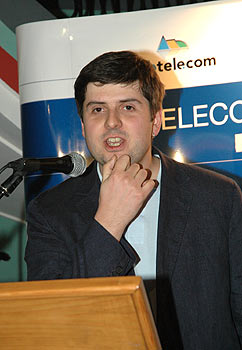
How to beat Nigel Short in a simultaneous

(In his excitement, Tim gets the date wrong: the game was played two days ago, on November 29, 2010.)
"Erik and Andrew Karklins: 143 years of chess, and counting...."

Photo: Betsy Dynako
Ken Marshall's wonderful article is in this month's Chess Life!
This article is currently available to USCF members only: it will be available on the ICA website next month.
Monday, November 29, 2010
It's not *billed* as a Hannukah tournament...
On Sunday, December 5th, Chess Scholars is holding a K-8 tournament at the Solomon Schechter Day School in Skokie.
Details on the JUF website!
Details on the JUF website!

a cool and free iPhone app
Any chess player (absolute beginner to master) with an iPhone, iPad, or iPod Touch should enjoy Chess Problems, a free application by PsyGames.
The interface is simple and intuitive. One can choose from directmates (e.g., "mate in two moves"), helpmates, and selfmates, sorted by level of difficulty (pawn to queen)

I knew the answer to the following one right away because my grandmother owned a mid-nineteenth century edition of Hoyle. The chess section gave this problem (or one like it!), accompanied by a version of the legend of Princess Dilaram.

Helpmates are fun! In a helpmate in two moves, Black moves first, and the two sides work together to allow White to checkmate Black on White's second move.

Selfmates are fun, too!

Some of the positions are easy enough for absolute beginners to solve. But the simple king and queen vs. king position below took me 1:18 to solve. I guarantee that anyone who knows the rules of chess and has a little patience should be able to solve it. Some of you will see the solution at sight, others might need five minute to explore all the possibilities.

And I sat staring for almost 17 minutes at this famous Mansfield two-mover even though I knew I'd seen it before. As soon as one sees the key move, one slaps one's head and says, "Of course!" But the trick is to find the key move...
I think that chess problems are of more than marginal benefit to practical players: they force us to understand the powers of the pieces, they push us to think outside the box, and they train us in brute-force calculation in bizarre positions.

I have one trivial complaint about this app. When you find the key move, only one defense is offered, no matter how many times you play through the solution. (Part of the beauty of these problems is that various defenses to the key move lead to various mates.) But that's a quibble.
Strongly recommended!
The interface is simple and intuitive. One can choose from directmates (e.g., "mate in two moves"), helpmates, and selfmates, sorted by level of difficulty (pawn to queen)

I knew the answer to the following one right away because my grandmother owned a mid-nineteenth century edition of Hoyle. The chess section gave this problem (or one like it!), accompanied by a version of the legend of Princess Dilaram.

Bonus Socius manuscript, circa 1266 (!)
White to play and mate in two moves
Helpmates are fun! In a helpmate in two moves, Black moves first, and the two sides work together to allow White to checkmate Black on White's second move.

Lind 1941
Helpmate in two moves
(remember that Black moves first in a helpmate!)
Selfmates are fun, too!

Widlet, 1982
Selfmate in two moves
(White to play and force Black to checkmate White on Black's second move: unlike the helpmate, the two sides are not cooperating)
Some of the positions are easy enough for absolute beginners to solve. But the simple king and queen vs. king position below took me 1:18 to solve. I guarantee that anyone who knows the rules of chess and has a little patience should be able to solve it. Some of you will see the solution at sight, others might need five minute to explore all the possibilities.

Courtenay, 1868
White to play and mate in two moves
I think that chess problems are of more than marginal benefit to practical players: they force us to understand the powers of the pieces, they push us to think outside the box, and they train us in brute-force calculation in bizarre positions.

Mansfield 1933
White to play and mate in two moves
I have one trivial complaint about this app. When you find the key move, only one defense is offered, no matter how many times you play through the solution. (Part of the beauty of these problems is that various defenses to the key move lead to various mates.) But that's a quibble.
Strongly recommended!
North Shore Chess Center - Amateur Closed events
Jon Burgess reports on the ICA website!
Congratulations to Matt Pullin (the runaway winner of Group A), and to Aakaash Meduri, Sam Schmakel, and James Wei, the joint winners of Group B.
Final results from St. Louis
Chicagoans Dmitry Gurevich and Yury Shulman tied for first with fellow American grandmasters Alexander Onischuk and Gregory Kaidanov. Young John Veech of Wisconsin tied with GMs Nigel Short and Ray Robson for fifth place.
Crosstable here!
Crosstable here!
Friday, November 26, 2010
Tuesday, November 23, 2010
"IESA Launching Major Middle School Chess Event in February"
Jerry Neugarten reports on the ICA web site. The inaugural IESA Championship will be in Bloomington on February 18-19, 2011. It's a two-day event for 5th through 8th graders.
The registration deadline is January 12, 2011. Registration must be made through the school, and the school must be an IESA member. Find out more here (pdf document).
The registration deadline is January 12, 2011. Registration must be made through the school, and the school must be an IESA member. Find out more here (pdf document).
Kasparov & Short in St. Louis this coming Monday
Another cut-and-paste from my email. One correction to my earlier post: the under-$100 entry fee for this weekend's tournament is only available to club members: it's $20 more for non-members. In the weekend tournament, GMs Gurevich, Shulman, and Amanov, and IM Young will be among those representing Chicagoland.
Kasparov and Short in St. Lou after Thanksgiving Tourney
SAINT LOUIS, November 23, 2010 – Grandmaster Garry Kasparov, widely recognized as the world’s greatest chess player, has announced he will be making an appearance at the Chess Club and Scholastic Center of Saint Louis on Monday, November 29, just one day after the conclusion of the Thanksgiving Open tourney featuring renowned GM Nigel Short and an $11,000 prize fund.
Kasparov, who is coming to Saint Louis to deliver a political lecture, will make an appearance at the CCSCSL from 4-5 p.m. The club has arranged a special setting in which club members and the general public can meet and greet the living legend.
Short, who was already scheduled to conduct a special lecture and simul beginning at 6 p.m., will also be in attendance. His lecture is free for club members but will cost the general public $10. The simul, scheduled to follow the lecture at 7:30 p.m., has been capped at 30 participants, but those interested can still submit their name for the wait list.
This is a once-in-a-lifetime opportunity to meet two of the best players in the world, who once battled one another for the World Chess Championship title in 1993.
The festivities follow the largest prize fund tournament ever offered by the CCSCSL excluding a U.S. Championship event. The Thanksgiving Open, which takes place November 26-29, features an $11,000 prize fund, and two-day and three-day options are available to make the tournament easily accessible for all.
In addition to Short, a host of other titled players have committed including:
* Resident GM Ben Finegold
* GM Yury Shulman
* GM Alex Onischuk
* GM Ray Robson
* GM Gregory Kaidanov
* GM Dmitry Gurevich
* GM Timur Gareev
* GM Mesgen Amanov
* IM Michael Brooks
* IM Istvan Sipos
* IM Angelo Young
* IM Raja Panjwani
* WGM Sabina Foisor
* WIM Alisa Melekhina
Registration costs $119 for the three-day option and $118 for the two-day option. There will be a re-entry option available for $60.
This event will be a FIDE-rated, six-round, G/120 event in three sections: Open, U1800 and U1400. The prize breakdown is as follows:
Open:
* Overall: $1,600-$1,000-$600-$400
* U2400: $550-$450
* U2200: $500-$300
* U2000: $450-$250
U1800:
* Overall: $1,000-$500-$300
* U1600: $450-$250
U1400:
* Overall: $1,000-$500-$300
* U1200: $250-$150
* U1000: $225-$125
Don’t miss your opportunity to meet two living legends and play in a fantastic tournament in Saint Louis. For more information, please call 314.361.CHESS (2437) or visit www.saintlouischessclub.org
Monday, November 22, 2010

Cool Thanksgiving tournament in St. Louis
Join legendary GM Nigel Short along with GM Yury Shulman, GM Ben Finegold, GM Dmitry Gurevich, GM Gregory Kaidanov and others in helping us start a NEW tradition, November 26-28. The CCSCSL presents the 2010 Thanksgiving Open featuring an $11,000 prize fund!Info here! The entry fee is
I won't be able to play because of family commitments, but I've extracted an oral commitment (my hopeful interpretation of "maybe") from Claire for 2011.
2010 Illinois Class Championships
Snipped and pasted from my email:
2010 Illinois Class Championship
Saturday December 4, 2010
Holiday Inn Chicago North Shore --- 5300 West Touhy Ave --- Skokie, IL 60077
847-679-8900 --- Google Map
ICA will pay the entry fee for FIDE titled players (FM IM GM WFM WIM WGM) who list Illinois as their residence on their USCF registration.
Free 90 days added to all players' ICA memberships. All they need to do is send their name, section, USCF number and contact details to freemembership@il-chess.org by Feb 28, 2011.
$2,000 Prize Fund Details at: http://il-chess.net/goto.php?a=class
Time control will be Game-60 with a 5-sec delay. All equipment provided. All you have to do is show up, register (or pre-register), and play! --- Register On-line
Round Times: 10:00am, 12:30pm, 3:30pm, 6:00pm (extra 30 minutes provided between Round 2 and 3 for lunch)
Dr. Nunn's guide for the perplexed
From chapter 8 of Nunn's Chess Endings, Volume 2 (I haven't gotten around to buying Volume 1
 ):
):
(I haven't gotten around to buying Volume 1):8.2 Rook vs PawnsHave another go at it!
There are a surprising number of subtleties in endings in which a lone rook faces enemy pawns, and here we shall focus on those which are of greatest importance in over-the-board play.
8.2.1 Hesitation checks
By hesitation check I mean that a piece traveling from square A to square B gives an intermediary check on square C before moving to B. The point is that if the enemy king is already on its best square, the hesitation check forces the king to an inferior square. It might seem unnecessary to give a special name to such an elementary concept, but it often helps to have a label to refer to a particular theme. Hesitation checks play an important role in rook endings and are often overlooked in practice.
Rook endings (or, the love that dare not speak its name)
If you enjoy rook endings as much as I do, you'll love Nunn's Chess Endings, Volume 2. John Nunn's books are always full of top-rate material, but unfortunately, much of it has often whizzed over my head. (For example: Secrets of Rook Endings .) But Nunn has put a lot of work into organizing his mind-bending examples thematically and giving the reader guidance. The examples are still difficult, but Nunn has never been this reader-friendly before!
For example, here are the first three diagrams in Nunn's book:


Hey! Didn't I learn in one of my beginners' books that two pawns on the sixth rank always win against an unassisted rook? And indeed, 1.Rxh3? does lose. Why? And where's the darn draw?

. John Nunn's books are always full of top-rate material, but unfortunately, much of it has often whizzed over my head. (For example: Secrets of Rook Endings.) But Nunn has put a lot of work into organizing his mind-bending examples thematically and giving the reader guidance. The examples are still difficult, but Nunn has never been this reader-friendly before!For example, here are the first three diagrams in Nunn's book:

Fries Nielsen-Plachetka, Rimavska Sobota 1991
White to play and win
Usually when I get such a position, I have three minutes left on the clock and am reduced to counting on my fingers: "I go here, he goes there, I go here..."

Analysis diagram
White to play and draw
White to play and draw
Hey! Didn't I learn in one of my beginners' books that two pawns on the sixth rank always win against an unassisted rook? And indeed, 1.Rxh3? does lose. Why? And where's the darn draw?

Penrose-Perkins, British Championship, 1972
White to play and draw
White to play and draw
I found the first position hard and the third position mind-numbingly difficult. Back with Nunn's guidance in a little bit.
Subscribe to:
Posts (Atom)