Tuesday, August 10, 2010

Another knight underpromotion


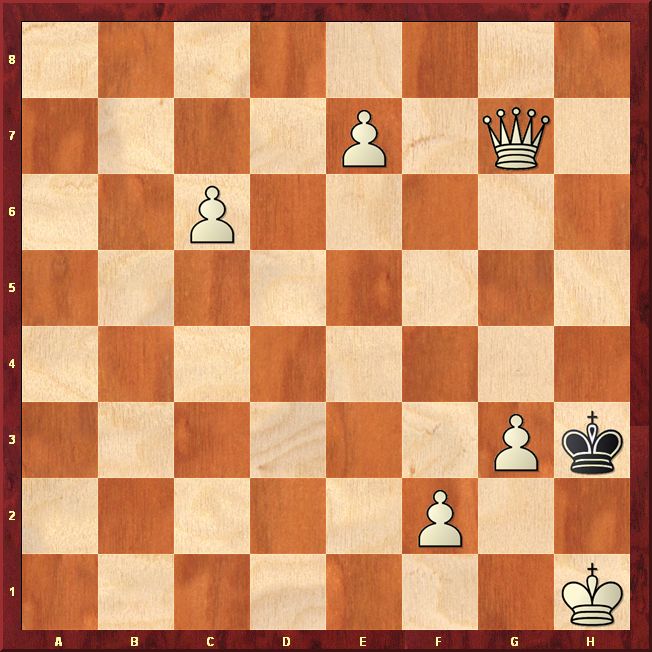
A few posts ago, I gave the game Fidlow-Maier, which featured an underpromotion to knight on move 7. Above is another such game, in which the underpromotion actually checkmates White! If White's play seems a bit, um, eccentric, a commenter at chessgames.com has the explanation:

Phony Benoni: I just happen to have an issue of the Lower Slobbovian Journal of Chess which gives a full account of this game, and can translate the story for you.

After <1.e4 e5 2.f4 exf4>, Wiede noticed that several of his pawns were off center. He adjusted, in order, his b-, h-, and g-pawns, then played 3.Nf3.

"Wait a minute!" said Goetz, who was an unpleasant fellow. "You touched your b-pawn--you have to move it."

"But I was just adjusting", replied Wiede.

"Then you should have said "j'adoube."

"But I don't speak French!"

"Makes no difference! Move the b-pawn."

Secretly, Goetz was hoping for 3.b4 so he could snatch another pawn, but when Wiede avoided the trap with <3.b3> he reluctantly played <3...Qh4+>. Wiede tried 4.Ke2, but Goetz was alert.

"Wait a minute! You also touched your g-pawn! You must interpose it!"

"What are you talking about? Touch-move isn't retroactive!"

"In this town it is. We're a law-and-order community."

"And anyway, I touched the h-pawn first."

"But that doesn't get you out of check. The rule is that you must move the first piece touched that can be legally moved. You can move the h-pawn next."

So the game continued <4.g3 fxg3 5.h3 g2+ 6.Ke2 Qxe4+ 7.Kf2 gxh1>

"And that's a knight", shouted Goetz gleefully, "With mate!"

"Whaddya mean, knight? You touched my rook; don't you have to promote to a rook?"

"Read the rules, dummy! I can get any piece I like."

"OK, you know the rules. But what's this knight you're talking about?"

"You know. Springer. Caballero. Horsie."

"I don't see one on the board."

"Well, I don't happen to have a third knight handy."

"Then it doesn't exist! Seeing is believing! You think I'm a Platonist or something?"

At this point, the kindly old arbiter arrived at the board, and placed a friendly hand on Wiede's shoulder. "Look, my friend, it is clearly in your best interests to allow the knight promotion with mate. I have watched your play, and the only way you'll ever reach immortality in chess is to go for negative immortality. You can be another Kieseritzky! Another Dufresne! Another Levitsky! You may even outrank Systemsson!

Wiede's response to this was one of those Lower Slobbovian words with which I am not familiar, but perhaps that's for the best. What I can tell is that he gave up chess forever and changed his name to Charles Berlitz.

Chicago Chess Meetup Group

Looking for a game in your neighborhood?  Try the Meetup Group!

chess tourists


Another blogger visits the Chess Pavilion.  (Our North Avenue Beach guest is from the Kenilworth, New Jersey, club, not Kenilworth, Illnois!)

A trap in the QGD Exchange Variation


In the first round of the 1949 Soviet Championship, the young Tigran Petrosian fell into an elementary trap against Alexander Kotov. Kotov's 7.Qc2! is an important finesse, since the natural 7.Bd3 allows Black to exchange pieces with 7...Ne4!, when White has little or no advantage. Petrosian, likely suffering from first-round jitters, played 7...Ne4?? anyway, but after 8.Bxe7 Qxe7 (the abject 8...Kxe7, immediately surrendering a pawn to 9.Nxe4 dxe4 10.Qxe4+, looks like a slight improvement) 9.Nxd5!, Black was losing at least two pawns, and could have resigned already. He did so on move 13, the shortest loss in the career of "Iron Tigran."

Petrosian later became known as one of the world's hardest players to beat. Of over 100 games in Chess Olympiads, he lost only one. He reigned as World Champion from 1963 to 1969. When he beat Spassky in 1966 to retain his title, he became the first sitting World Champion since Alekhine's victories over Bogolyubov in 1929 and 1934 to actually win a World Championship match.

August 14th: Evanston Chess Game/29 rapid

Let's decode the shorthand in the following tournament announcement for non-tournament players:

"5SS" - means each player will play five rounds in the Swiss System (roughly: winners play winners, losers play losers)

"G/29" - means each player has a whopping 29 minutes to make all the moves in his or her game.  If you take more time, you lose!  (If each player takes 28 minutes for the game, the game should be over in slightly less than one hour.)

"3 seconds delay" - What, 29 minutes isn't enough?  You're assured a whopping three whole bonus seconds for each move!  (If you're using a digital clock, that is.)

"bye" - you can choose not to play a particular round, but you have to schedule this with the TD before you begin play.

"Junior players (under fourteen) rated 900+" - A U.S. Chess Federation rating between 900 and 1199 makes one a strong beginner.  Adult beginners (folks who know how the pieces move) of any strength are welcome!

$5 - means $5!  It's a great deal, and the Evanston club is very hospitable.  But please arrive early, as space is limited!  (U.S. Chess Federation membership is required, you can have a trial one-day membership for $12.  If you decide to join, you'll receive a $10 credit towards membership.)
Levy Senior Center
300 Dodge Ave
Evanston, IL 60202
 
Evanston Chess Presents:
Aug 14, 2010
9:00am-4:30pm

Rapid
5SS G/29

One Section
USCF Quick Rated
From time to time Evanston Chess pays one or more titled players to play in our events. We usually do not pair them against each other. Even if they should lose (it does happen) we may pair them with the highest score groups.

Five rounds. Digital clocks are required and will be set to G/29 plus 3 seconds delay. Accelerated or decelerated pairings at TD discretion.

Registration from 9:00 to 9:30 AM. Players must check in by 9:30 am; players who arrive late will receive a half-point bye for the first round. First Round 9:45 am, last round over roughly 4:30 pm.

You may take one half-point bye in any round but the last.

Entry fee is $5, please pay cash (no checks) at the door. Masters and Experts play free.

Send name, USCF number, and telephone number to enter@evanstonchess.org

Junior players (under fourteen years) rated 900+ are welcome. Sorry, but we do not accept junior players rated under 900. Must be accompanied by a parent throughout the event.

Bring clocks -- Wheelchair accessible -- No Smoking.

Coming Events:
--Sep 25, 2010, 3SS G/70 Three x Three
--Nov 06, 2010, 4SS G/45 Tri-Level

See http://evanstonchess.org/ for details.

Monday, August 9, 2010

From chess champions to mind champions


Vishy Anand's promotional campaign in India is featured in today's New York Times.

P.S.  here's Anand's Twitter account!

GM Alejandro Ramirez wins US Open

Story at Chess Life Online!

It's not clear who the U.S. Championship qualifier from this event will be, as GM Ramirez still represents Costa Rica, and the formula calls for the top finisher not otherwise qualifying by rating.  Needlessly confusing....

If video gamers are smarter than existing computer software....

...what about chess players?  It's awfully hard to incorporate human pattern-recognition skills into software, just as it's virtually impossible for humans to compete with computers running brute force minimax programs.

Young chess players looking for a career should take a look at molecular biology: it's an information science.

Kamsky wins Mainz Rapids

...over a super-strong field. 


Coverage at Chess Life Online and ChessVibes.  Please play through a few of Gata's wins: they're incredibly entertaining examples of simple chess!

Sunday, August 8, 2010

Richard Verber remembered


It's hard for me to believe that Richard Verber has been gone for almost nine years.

Tim Redman's memorial originally appeared in the Illinois Chess Bulletin.  (PDF document.)  Hat tip to former ICB editor Colley Kitson.

Saturday, August 7, 2010

A trap in the Von Hennig-Schara Gambit


The Von Hennig-Schara Gambit is a tricky line in the Queen's Gambit Declined, Tarrasch Defense that begins 1.d4 d5 2.c4 e6 3.Nc3 c5 4.cxd5 cxd4!? Now the game usually continues 5.Qxd4 (5.Qa4+ often transposes, but White should be aware of the wild 5...b5!?) Nc6 6. Qd1 cxd5 7.Qxd5 Bd7, when Black gets considerable play for the sacrificed pawn.

Fidlow's 5.dxe6?! can't really be recommended for serious games, since Black has a fine game after 5...Bxe6! But it does set a trap, which Maier fell into hook, line, and sinker. After 5...dxc3? 6.exf7+!, Black had to play 6...Ke7 to save his queen. Since 7.fxg8(Q) would allow Black to escape the worst with 7...Qxd1+! 8.Kxd1 Rxg8, White played the clever 7.fxg8(N)+! Now Black had to play 7...Ke8!, when White can choose between a two-pawns-up ending with 8.Qxd8+ Kxd8 9.bxc3, or trying to hold onto his knight with 8.Qb3!? Instead, he played 7...Rxg8?? and resigned after 8.Bg5+, winning the queen.

The game presents an amusing riff on the more familiar "Lasker Trap" in the Albin Counter-Gambit (1.d4 d5 2.c4 e5!? 3.dxe5 d4 4.e3?! Bb4+ 5.Bd2 dxe3! 6.Bxb4? exf2+ 7.Ke2 fxg1(N)+! 8.Rxg1?? Bg4+).

Friday, August 6, 2010

A trap in the Slav

After 1.d4 d5 2.c4 c6 3.Nf3 Bg4?! (3...Nf6 is normal) 4.Ne5 Bh5 5.Qb3!, Black must play 5...Qc8! As the game below shows, the natural 5...Qb6? is a fatal blunder.

First Saturday tournament at Touch Move tomorrow!

4 rounds, ten bucks.  Such a deal!

Details here.

...Qa5+ claims another victim

Even GMs hang pieces to ...Qa5+.

Sometimes you've got to break the rules

 Kubbel
White to play and mate in two moves (using Basterot rules)

I'd never heard this story told quite this way.  The sick thing is that I solved all three problems in about a minute (I'd seen the first Kubbel problem before).

Are "fairy chess" problems of any use to the practical player?  Anything that encourages leaps of imagination can't be all bad!

Thursday, August 5, 2010

Jazzercise, then chess

From the local Harwood Heights / Norridge paper:
Mather's-More Than a Cafe, 7134 W. Higgins Ave., Chicago, invites adults 55 and older to experience professionally taught, free moderately-priced programs such as lifelong learning programs, fitness classes, free blood-pressure checks and health screenings, free consumer seminars, special-interest workshops and special events and day trips. Call (773) 774-4804.Chess Club for checkmate champs and new people who want to learn the rules and basic strategies. Sessions are Wednesdays, at 1 p.m. Jazzercise - A fitness program that combines aerobic exercises with elements of jazz dance. A series of dance routines is set to popular music while incorporating yoga, Pilates, cardio-kickboxing, and other fitness styles. The classes move incrementally through different intensity levels, so anyone is welcome to join. Classes are held at 11 a.m. Wednesdays, $5.35.....

Wednesday, August 4, 2010

Illinois Chess Association Newsletter!

Fresh from my email inbox!

Illinois Chess Association Newsletter 

August 4, 2010

New Prizes at the 2010 Illinois Open

Two prizes have been added to the prize list:
-- Plus Score certificates worth $20 in merchandise will be awarded.
-- Free three month memberships (or extentions) will be given to all main event registrants who send us an email with their contact details and USCF number.
GM Yuri Shulman, GM Dmitry Gurevich, GM Nikola Mitkov, IM Angelo Young and IM Florin Felecan will all compete for the title of Illinois Open Champion for 2010. A group of dedicated Illinois chess patrons has put together a modest support fund to pay the entry fees and offer a bit extra to these outstanding players. If you would like to join us in supporting the titled players of Illinois contact Carl Dolson or Tom Sprandel.
September 4, 2010 - September 6, 2010
Two Day and Three Day Schedules Available
DoubleTree Hotel: 1909 Spring Road , Oakbrook, Illinois 60523
(630) 472-6020, (630) 472-6000 (code C-CHE)

$11,000

Open Section
Reserve Section
Saturday Scholastic U1000 Trophy Tournament (side event)
Saturday Evening G/25 (side event)

Entry Fees for main events: $79 pre-entry, $90 at door.
For full details see http://chessforlife.com/

ICA Governance Takes a Step Forward

With the appointment of Mike Cardinale to Metro VP, we now have a full board, five executive officers and five additional directors. The board is ballanced by region and by focus on youth and adult chess.
Tom Sprandel, President
Michael Cardinale, Metro VP
David Long, Down State VP
Maret Thorpe, Secretary
Carl Dolson, Treasurer
Bill Barton, Director
Bill Brock, Director
Andi Rosen, Director and Chair, Warren Junior Scholars Program
Jerry Neugarten, Director and Chair, ICA Youth Committee
Garrett Scott, Director and Chair, ICA Bid Committee
The board usually meets twice a month by phone conference. Frequent meetings and sharing of views helps keep things moving forward.

Constitution and Bylaws being Updated

We're in the final stage of revising and updating our governance documents. Most of the changes are minor or involve re-organizing, simplifying and streamlining. We expect to have the changes finished and posted on our website by the end of this month.

Youth Committee makes proposal to Chicago Public Schools

Our Youth Committee, with approval from the Board, has proposed a major upgrade in the chess program in Chicago’s public schools and offered to take the lead in planning a new program targeted to students in the city’s Title 1 schools. The proposal is outlined in a four-page report entitled “Why Not Chicago?” sent to the office of CEO Ron Huberman on July 9. The proposal was requested by Mr. Huberman’s office a month earlier. It outlines the research on the benefits of chess for kids and details thriving programs in other U.S. cities. Based on experience elsewhere, the proposal says the Chicago program could be run on a budget of $300,000 to $400,000, but would not require direct financial assistance from CPS or the city. It lists other organizations which have offered to partner with ICA in planning and running the program.
The proposal is available at http://il-chess.org/non_joom/minutes/CPS%20Proposal%207-9-10.pdf.

USCF charges Affiliates with Selecting Delegates

The US Chess Federation has given the responsibilty for selecting delegates to its state affiliates. Starting in 2011 the ICA will appoint the delegates who will represent Illinois chess players at the USCF annual business meeting.
We will post a notice on http://il-chess.org/ as soon as we know where the 2011 meeting will be held. Those who want to serve must be willing to travel to the business meeting at their own expense. We anticipate that Illinois will continue to send six delegates.
The ICA Board will select the delegates. Selections will be based on demonstrated commitment to ICA and USCF as gauged by the length of the applicant’s membership in ICA and USCF and the degree of their active participation. Participation includes but is not limited to organizing, promoting, writing articles, directing and playing in tournaments, participation on committees, and attendance at meetings. An effort will be made to ensure geographic balance in the selection of delegates and alternates.

Annual Meeting and Banquet Scheduled for Nov 7th

The meeting is at 11:00 a.m. and the Banquet is from 1:00 to 4:00 p.m.
Buca di Beppo -- 90 Yorktown Road -- Lombard, IL USA 60148
The Banquet will honor Helen Warren, who has won the ICA's Broughton Award for outstanding service to chess in Illinois.
Mark your calendars. More details will follow.

Election of Officers Coming this fall

Executive board offices are up for election this fall. That includes the offices of President, Metro VP, Downstate VP, Secretary, and Treasurer. It does not include the remaining five board positions, which will be up for election next year.
Nomination procedures and deadlines will be published shortly. If you are thinking of running you should begin collecting your nominations now. It takes the recommendation of ten ICA members who are in good standing to get your name on the ballot (email nominations will be accepted, assuming the constitutional revisions are approved by the Board this month.)
If your membership has expired, renew now. You must be a member of the ICA to vote, and you must be nineteen years of age.

Chris Merli, New ICA Membership Secretary

I'm pleased to announce that Chris has volunteered to serve as Membership Secretary. It takes a lot of work to keep the ICA running. As one of our board members keeps telling me, it takes people, people, people, and money. She's so right. Thanks, Chris, for stepping up.
On January 1, 2009 we had 168 current members. We reached 321 in June of this year and hope to continue the upward trend. Our current membership list is on the website. The web page list is powered by the same database we use to record memberships, so it's always up to date.
Go to http://il-chess.org/ and then click on "Membership". You can join or renew from that page using Paypal or a credit card. You can check your renewal date by clicking on "Membership List".

Website Anniversary

It's been one year since we switched from static HTML pages to Joomla. For the uninitiated, Joomla is a content management system (like blog software on steroids). It's open-source (read free) and is very poplular. Switching to Joomla has allowed more people to contribute to the page.
Have an urge to write? Want your own byline? Contact Maret Thorpe, secretary@il-chess.org.
Sincerely,
Tom Sprandel
president@il-chess.org


Tuesday, August 3, 2010

A trap in the QGD, Baltic Defense


The Baltic Defense to the Queen's Gambit Declined (1.d4 d5 2.c4 Bf5) is very sharp. It is frequently seen on the Internet, in my experience mostly from people who don't know what they're doing. The theoretically critical move is 3.Qb3!?, aiming to exploit the bishop's absence from the queenside, and threatening both 4.Qxb7 and 4.cxd5. The only good response is the startling 3...e5!, leading to wild play. White often wins two or three pawns while Black gets a big lead in development. One line that White should emphatically avoid is 4.cxd5 exd4 5.Nf3 Bc5 6.Nxd4? Bxd4 7.Qa4+ Nc6! 8.dxc6 b5! 9.Qxb5 Ne7 with a huge lead in development for just one pawn, as Ward-Rausis, 1992 (0-1, 17!). Better is 6.Qc4 Nd7 7.Nxd4 Qh4 8.e3 Bxd4 9.Qxd4 Qxd4 10.exd4 Ngf6 11.Nc3 Nb6 112,d6 cxd6 1/2-1/2, Hracek-Bagirov, Brno 1991. I recommend instead 4.Qxb7 Nd7 5.dxe5!, which has scored well for White, for example 5...Nxe5 6.Qxd5 Bd6 7.Nc3 Nf6 8.Qd1 and White eventually exploited his material advantage in Koch-Haselhorst, Muenster open 1989.

Usually my Internet opponents haven't found 3...e5!, and instead have played something weak like (a) 3...Bxb1 4.Qxb7! Nd7 5.Rxb1 e5 6.Nf3! Rb8 7.Qxa7 e4 8.Nd2 e3 9.fxe3 Bb4 10.g3 Ngf6 11.Bh3! O-O (11...Ne4 12.Qa4!) 12.O-O Qe7 13.Nf3 and White successfully consolidated his material advantage in Skyva-Joukl, Czechoslovakia (ch) 1973; (b) 3...b6 4.cxd5 Bxb1 (4...Nf6 5.Nc3, followed by f3 and e4 if necessary, keeps the extra pawn) 5.Rxb1 Nf6 6.e4! Nxe4 7.Bb5+ Nd7 8.Nf3 f6 9.0-0 a6 10.Bc6 Ra7 11.Re1 Nd6 12.Bf4 g6 13.Qe3 Qc8 14.Nh4! Kd8 15.Bh6 1-0 Campos Vila-Miranda Llanes, Cuba 2009; (c) 3...dxc4? 4.Qxb7 Nd7 5.Nc3 e6 6.e4 Bg6 7.Bxc4 Nb6 8.Bb5+ Nd7 9.Bxd7+! Kxd7 10.Nf3 Be7 11.Ne5+ Ke8 12.Qc6+ Kf8 13.Nd7+ 1-0 Rhine-N.N., Internet blitz 2010; or (d) 3...Nc6? - see above game.

Monday, August 2, 2010

Round 3, continued

Rosen - Bowersock, round 3

Rosen - Bowersock
Denker Tournament of Champions, Round 3
White to play: what's the best move?

Eric lost a seesaw battle to the Michigan champion in Round 3.

The computer found a cute shot here for White.  (The idea is not that hard: what move is White dying to play?  How can White make this dream move possible?)  But the followup is rather messy.

Eric Rosen at Denker Tournament of Champions - Round 1

White gets a horrible pawn structure in this opening, which makes converting the ending nontrivial.

Sunday, August 1, 2010

How Not to Play Against the Falkbeer Counter-Gambit

If you're going to play an opening as sharp as the King's Gambit, you'd better know what you're doing. If not, you might just lose the shortest game of a Chess Olympiad (see below). After 3...Qh4+, White is losing at least a rook, after 4.g3 Qxe4+ 5.Qe2(!) Qxh1.

Incidentally, I once saw a tournament game where Black played 1.e4 e5 2.f4 Nc6!? (unusual, but playable; one idea is the countergambit 3.Nf3 f5!? invented by Miles). Now White innocently played 3.fxe5?? and Black just as innocently responded 3...Nxe5??, missing the crushing 3...Qh4+!

ADDENDUM: Incredibly, it seems that after 2...Nc6 3.fxe5??,
over 80% of players have played 3...Nxe5??

Saturday, July 31, 2010

Fo' shirazi my kamran

U.S. Women's Champion Irina Krush raps. I do not pretend to understand the meaning of everything to which I link.


Peace out, Chicago!

A weird queen trap

It's always amusing when you can trap your opponent's queen. A primitive example of this, which any 1.e4 player will eventually have the thrill of playing, is 1.e4 d5 2.exd5 Qxd5 3.Nc3 Qc6?? 4.Bb5!, Rhine-Melko, Chicago 1972 (and countless thousands of other games). And who can forget the immortal 1.Nc3 d5 2.e3 e5 3.Qf3? (3.Qh5!? is actually a good move) e4 4.Qf4?? Bd6! trapping White's queen in the middle of the board?

A somewhat more sophisticated queen trap can arise in the Fajarowicz Variation of the Budapest Gambit. In that strange variation, Black sacrifices a pawn (1.d4 Nf6 2.c4 e5 3.dxe5), then plays the eccentric 3...Ne4!? (rather than the normal 3...Ng4), making no effort to regain the pawn and placing the knight in a vulnerable position. After 4.Nf3 (4.a3, 4.Nd2, and 4.Qc2 are also playable), Black can continue the provocation with the remarkable 4...b6!?, practically begging White to fork Black's rook and knight with 5.Qd5!? As the game below shows, there is a method to Black's madness. After 5...Bb7 (5...Bb4+!? is also possible) 6.Qxb7 Nc6!, White's queen is in trouble and threatened with capture after ...Nc5 or ...a6 and ...Ra7, although White could still get rook, bishop and pawn for it by taking Black's rook. Grandmaster Viktor Moskalenko suggests 7.Nd4!? Bb4+ (7...Nxd4? 8.Qxe4; 7...Nc5? 8.Nxc6) 8.Nc3 0-0!? (8...Nxc3 9.Nxc6) 9.a3! Nxc3 10.e3! "and good luck with the rest." The Fabulous Budapest Gambit, p. 216. He cautions that 4...b6 is advisable "only when playing blitz or on the Internet."

The natural 7.Qa6?? was a blunder. After 7...Bb4+! 8.Bd2 Nc5! 9.Qb5, White may have expected 9...a6?? 10.Qxb4, winning three pieces for the queen. Black dashed this hope by interpolating 9...Bxd2+! With just two pieces for the queen, White resigned two moves later. Another White misadventure in this line continued 7.Be3 a6 8.Nd4 Bb4+ 9.Kd1? Ra7! 10.Nxc6?? dxc6 CHECK! (woops) 11.Kc2 Rxb7 and White could have resigned in Heroiu-Otto, Hamburg 1997.

White can even aim for this trap with an extra tempo, e.g. 1.Nf3 d5 2.b3 c5 3.e4?! dxe4 4.Ne5, the Norfolk Gambit, which occurs 11 times in ChessBase's Big Database. It was advocated by the late Claude Bloodgood, who became one of the highest-rated players in the country while serving a life sentence for murdering his mother. He wrote books about three of his pet openings: the Norfolk Gambit, the Hartlaub Gambit (1.d4 e5? 2.dxe5 d6?), and Grob's Attack (1.g4).

Tuesday, July 27, 2010

Even I wouldn't go THAT far


Heh. Charming video clip and blog entry.

For future reference: if you must play for dollars at the pavilion, it's touch-move, baby.

A busted line

The move 3...f5?! in Owen's Defense (1.e4 b6 2.d4 Bb7 3.Bd3 f5?!) has been played and analyzed for almost 400 years. Greco-NN, Rome 1619 quickly concluded 4.exf5! Bxg2 (the point, trapping White's rook - if Black can survive White's attack) 5.Qh5+ g6 6.fxg6 Nf6?? 7.gxh7+! Nxh5 8.Bg6#. Staunton pointed out the improvement 6...Bg7! in The Chess-Player's Handbook (1847), page 379. He analyzed 7.gxh7+ Kf8 8.hxg8(Q)+ Kxg8 9.Qg4 Bxh1 10.h4 e6 11.h5, with advantage to White. Over 120 years later, 10...Bd5!? (Schmid-Vitolinsh, Latvia 1969) and 10...Qf8! 11.h5 Qf6 12.h6 Rxh6 (Hendler-Radchenko, Kiev 1970) were shown to be playable for Black. Similarly, in Lombardy-Regan, U.S. Open 1974, the 15-year-old Regan got the advantage after 10.Nc3 Qf8! 11.Be3 Qf6 12.h3 Qh4 12.Qg6 Nc6. (Lombardy demonstrated why he's a grandmaster and we're not, holding a draw in an ending two(!) exchanges down.)

Alas for Black, later analysts convincingly refuted 3...f5? in two different and surprising ways. Accordingly, the French GM Christian Bauer now calls the move "simply suicidal" (Play 1...b6, p. 5). In both lines, White disdains the immediate capture on g8 and instead attacks Black's king. It is important to learn at least one of these busts so that you can refute 3...f5? if someone plays it against you.

In the mid-1970s, F.A. Spinhoven of the Netherlands found 8.Nf3!! Nf6 (8...Bxf3? 9.Qxf3+ and 10.Qxa8; 8...Bxh1 9.Ne5! Bxe5 10.dxe5 Bd5 11.hxg8(Q)+ Kxg8 12.Qg6+ Kf8 13.Bh6+) 9.Qg6! and now (a) 9...Bxh1 10.Bh6! Rxh7 11.Ng5! Bxh6 12.Nxh7+ Nxh7 13.Qxh6+ with a crushing attack or (b) 9...Bxf3 10.Rg1! Rxh7 11.Qg3!! ("the soul" of 8.Nf3!! - Soltis) Be4 12.Bxe4 Nxe4 13.Qf3+ and now White is a pawn up, with a winning attack, after 13...Kg8 14.Qxe4, or an exchange up with an easily winning position after 13...Nf6 14.Qxa8 Rxh2 15.Bf4 Rh4 16.Qg2 Rg4 17.Qh2 (Boris Avrukh, 1.d4, Volume Two, p. 551).

In 1982, Guido den Broeder found an alternative refutation, the stunning 7.Qf5!! Nf6 8.Bh6!! Bxh6 9.gxh7 Bxh1 10.Qg6+ Kf8 11.Qxh6+ Kf7 12.Nh3! and Black was quickly annihilated in den Broeder-Wegener, corr. 1982. See Wikipedia for more details. John Watson writes that den Broeder's 7.Qf5!! and Spinhoven's 8.Nf3!! both win, but that the analysis of 7.Qf5 "is complicated," while 8.Nf3 "is clearer" (Mastering the Chess Openings, Volume 4, p. 96).

Here is an online game I played yesterday. Unfortunately for my opponent, I was able to remember Spinhoven's analysis. Black played the latter part of the game weakly, but had an objectively lost position in any event.

Sunday, July 25, 2010

"For Bobby Fischer, the Drama Won't Die"


New York Times chess columnist Dylan Loeb McClain introduces us to the strange story of Fischer's estate.  (Estate attorneys may wish to order reproductions by the thousand: great marketing material!)

Saturday, July 24, 2010

The one that got away (umpteenth edition)

Brock-Vibbert, Oak Brook 2010
White to play


If only I could play chess, I would be a strong chess player.

Attackers are reminded to bring all their pieces to the party!

letter from Kayseri

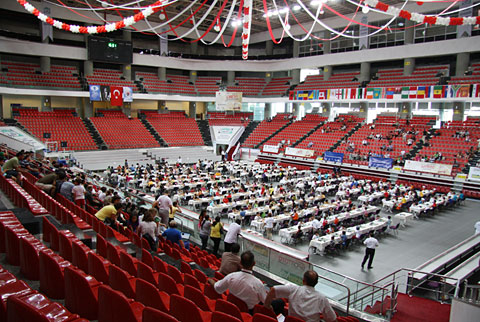
Sevan Muradian is an arbiter for the 2010 World School Individual Championships in Kayseri, Turkey.  He sent his impressions to Chessdom.

Edit: check out the cool venue!


Has anyone here used sports arenas for events with (say) 300 participants?  I'm thinking these might paradoxically be easier to get than hotels....  More pix at ChessBase.

Friday, July 23, 2010

Another From's Gambit trap

Here's another From's Gambit miniature. I first saw this game many years ago in Irving Chernev's classic 1000 Best Short Games of Chess. I actually managed to win the same game, move for move, in an offhand game in 1974 or so. Note that after 3...Bxd6, Black threatens immediate mate with 4...Qh4+ 5.g3 Qxg3+! 6.hxg3 Bxg3#. White's 4.Nf3! is the only good response. After 4...g5!? (the more solid 4...Nf6!? is another line), White's only decent responses are 5.g3 g4 6.Nh4 and 5.d4 g4 6.Ne5! (6.Ng5?! is interesting but unsound). As Bier demonstrates, 5.e4? is a lemon, losing material (or White's king) by force.

Thursday, July 22, 2010

Not all Bads are Equal

At chesscafe.com, Dan Heisman has a terrific article with the above title. He makes the profound point that inexperienced players often lose games because they have learned a lot of chess principles, but not their relative importance. He observes that, "Lower rated players have little trouble valuing most material issues, but many are absolutely clueless when assessing issues that are generally not quantified." For example, after 1.e4 e5 2.Nf3 Nc6 3.Bc4 Nf6 4.Ng5 d5 5.exd5 Nxd5 6.Nxf7!? (the Fried Liver Attack) Kxf7 7.Qf3+, the only move is 7...Ke6! with an unclear position that has been debated for centuries. Instead, most inexperienced players will retreat with 7...Ke8?, leaving them down material with a lost game, explaining that "I didn't want to expose my king." True, exposing one's king is bad, but being up a piece (as Black is after 7...Ke6!) is good, while being down material for nothing (after 7...Ke8?) is terrible. Another example he points out is that low-rated players will sometimes avoid exchanging pieces when they are ahead, yet will blithely trade off into dead-lost endings when they are behind. It's a very worthwhile article for anyone who is a low-rated player or teaches low-rated players.

From Denmark with Love

The From Gambit (1.f4 e5!?) is named for Martin Janus Severin From (1828-95) of Denmark, one of its early advocates. I have played it many times with great success, mostly in blitz games but also in my shortest-ever tournament win (1.f4 e5 2.fxe5 d6 3.exd6 Bxd6 4.Nf3 g5 5.h3?? Bg3# Napetschnig (1722)-Rhine, Gompers Park Fall Championship 1977). It often leads to sparkling play, as in this brilliancy, won by the great Carl Schlechter. Schlechter drew a match for the world championship against Lasker in 1910, and edited what David Hooper and Kenneth Whyld call "the eighth, last, and best edition of Bilguer's Handbuch (1912-16), a classic of more than 1,000 large pages." Tragically, he died of pneumonia and starvation at the end of World War I.

More fun with smothered mates

A smothered mate is a lot of fun, as long as you're not the hapless player who falls into it! In the game below, White was a strong player who won the Danish Championship the following year, and was awarded the IM title four years after that.

Wednesday, July 21, 2010

A Magnificent Trap in the Trompowsky

The Anglo-Swiss GM Joe Gallagher pulled off the elegant trap given below against the Trompowsky Attack (1.d4 Nf6 2.Bg5). All of White's moves are very plausible. Best may have been the retrograde 5.Bc1!?, arguing that the queen doesn't really do much on b6, and intending to drive back Black's knight with f3 and e4. White played 7.Bxb8 because he was worried about 7.cxd4 Nc6 8.Nf3 Nb4. After 7...dxc3!, 8.Be5?? seemed to hold everything, but Gallagher's glorious 8...Rxa2!! annihilated White. On 9.Rxa2, 9...c2! would threaten both 10...cxb1(Q)# and 10...c1(Q)#.

Chessgames.com says that the game ended after 8...Rxa2!!, but Gallagher says that White unsportingly played on, even though it is difficult to hold his losses to "only" a rook and knight. This game is reminiscent of the famous Schlechter-Perlis game, except that in that game Black avoided the worst with 8...Nxc6!, leaving him just a pawn down.

Addition to the blogroll

Check out thechessdad.com: interesting perspective from the parent of a local player.

Erik Karklins is my hero (continued)

For those of you new to the blog, please note that the player of the white pieces is 95 years old!

Betsy Dynako covers the Chicago Class

Timur Aliyev upset Dmitry Gurevich in the final round
(photo Betsy Dynako)
 
At Chess Life Online.

E. Karklins - Pullin


The null move I had to use created some major issues for ChessFlash. Basically, there was no 43rd White move but I wanted to enter in two options for White's 43rd move. If anyone knows a better way to do this please edit the post and delete this comment. Thanks.

Tuesday, July 20, 2010

A cheap but effective trap

The trap below was played in Keres-Arlamowski, 1950 and also, as I recall, in a game between Alekhine and four(!) amateurs. There are 12 games with the trap in ChessBase's Big database. In two of them, White missed the mate in one! Back in my 1.e4-playing days, I routinely played 5.Qe2!? in blitz games. More often than not, my opponent fell into the trap! The correct response is 5...Ndf6!

Yang-Rosen, round 9, U.S. Junior Invitational

Eric Rosen had a USCF performance rating above 2450 (and a FIDE performance rating above 2400): one local master told me this weekend that in his opinion, Eric has distinguished himself from the other top juniors in Illinois. (OK, other top juniors: time to rise to the challenge!) 

The quality of Eric's play was as impressive as his results. For example, this final round game reminded me of Rosen-Robson in the first round: both players played interesting, aggressive chess, both players played well enough to win, and a draw was a fair sporting result.

Like Rosen-Robson, the game was important to the tournament standings. Had Yang managed to win this last-round game, he would have tied for first with Robson, Sam Shankland, and Parker Zhao. 

Mount Prospect kids' event

From the Daily Herald:
Chess challenge
Calling all youthful chess players! The Mount Prospect Public Library hosts its Open Chess Tournament for players going into kindergarten through eighth grade. Trophies will be awarded to winners in two divisions: kindergarten to third grade and fourth grade through eighth grade. Ilya Korzhenevich, a 1993 Russian junior chess championship prize winner and candidate for U.S Chess Master, will serve as the tournament director. Participants must be familiar with the rules of the game. The library provides lunch.
Info: 9:30 a.m. to 2:30 p.m. Saturday, July 24, at the Mount Prospect Public Library, 10 S. Emerson St., Mount Prospect. Free admission. Advance registration is required. Indicate any dietary restrictions for lunch when registering. Call (847) 253-5675 or go to mppl.org/events.

Monday, July 19, 2010

"A new place on the chess continuum"

It's hard for people who don't play chess to "get" chess.  Andi Rosen gives her personal account of the problem and reports on what the Chess Club and Scholastic Center of St. Louis is doing about it.

Adarsh Jayakumar at U.S. Cadet Championship (final)

Story at Chess Life Online. Adarsh has to be somewhat disappointed with his -2 score (one win, three losses, three draws), but it's a very respectable result.

Eric Rosen at U.S. Junior Invitational - Round 8

Chicago Class - Master Section

Happy Monday!

GM Nikola Mitkov won the Master Section (link to crosstable) of the Chicago Class, held this weekend at the DoubleTree Oak Brook, with 4½ points.  Timur Aliyev took clear second with an impressive 4 points (Aliyev upset GM Dmitry Gurevich in the last round).  Gurevich, Erik Santarius, Owechukwu Iwu, and Gopal Menon tied for 3rd with 3½ points.

More on the other sections in the next day or so: please send an interesting game if you have one to share!

Yours truly did not play so well, but I had fun!

Friday, July 16, 2010

Genesis 35:18

Today's Bible verse:
Rachel was about to die, but with her last breath she named the baby Ben-oni (which means "son of my sorrow"). The baby's father, however, called him Benjamin (which means "son of my right hand").
Arguably, the Modern Benoni is the opening with the most ominous name.  Adarsh was the bringer of sorrow in an earlier round, but now....

Shipov annotates Dortmund live

GM Sergei Shipov

Wonderful stuff at Chess in Translation.

The live game (Friday, it's Ponomariov-Kramnik: not a permalink) is here.

Yesterday's Kramnik-Le Quang Liem is here.

Thursday, July 15, 2010

Wednesday, July 14, 2010

Tuesday, July 13, 2010

A trap in the Slav and QGA

In the post below, Bill remarked that Jayakumar-Shetty was an uneventful draw. Indeed, but there was one moment of potential drama that Adarsh wisely avoided. Had he played 10.Rd1?? instead of his 10.Re1! he would have fallen into a trap that has claimed many victims, including former Women's World Champion Maia Chiburdanidze. In addition to the Slav Defense (as in Adarsh's and Chiburdanidze's games), it also often arises from the Queen's Gambit Accepted, e.g. 1.d4 d5 2.c4 dxc4 3.Nf3 Nf6 4.Qa4+ c6 5.Qxc4 Bf5 etc. After 10.Rd1?? Bc2!, Black must give up the exchange, since 11.Rd2?? Nb6 wins the queen.

U.S. Cadet Championship

NM Adarsh Jayakumar (whose family is returning to Chicagoland in a couple weeks) is playing in the 2010 U.S. Cadet Championship in Crossville, Tennessee.  He's -1 after two rounds.

In Round 1, Adarsh got a nice position on the Black side of a Modern Benoni, but then got a little too creative.  The punishment was thematic.


Round 2 was an uneventful draw:

There are no easy opponents in these junior invitational events!

The Honorable George Neves Leighton

George Leighton (more on Wikipedia) graduated from Howard University in 1940, was a Captain in the U.S. Army during World War II, graduated from Harvard Law in 1946, and had a incredibly impressive legal career culminating in his appointment to the U.S. District Court, Northern District of Illinois, in 1976.   He served on the Federal bench until 1987. (Oh, and he beat me in the 1991 National Open.)

In this 1982 game, Judge Leighton was 69 years old and paired against a recent Soviet émigré who had become Chicago's top-ranked player, Leonid Kaushansky.  (Leo would later share the 1994 U.S. Open title with Albert Chow and Dmitry Gurevich, among others.)  One might expect a blowout.  Indeed, the game was rather one-sided:


At his peak, Judge Leighton was a strong expert.  Still more on his chess career at The Chess Drum.

October 22 will be Judge Leighton's 98th birthday!

The Kieninger Trap

The Kieninger Trap, seen below, is probably the most commonly played trap in the Budapest Gambit (1.d4 Nf6 2.c4 e5). It is named for Georg Kieninger, who first sprang it in 1925 in an offhand game against Godai in Vienna. (Shouldn't Kieninger have been playing the Vienna Game instead?) Some Budapest detractors say that this trap (which appears 14 times in ChessBase's Big database), is the only reason to play the Budapest. Not true! There's also 3.d5 Bc5 4.Bg5? Ne4! 5.Bxd8?? Bxf2# Arnold-Hanauer, U.S. Open 1936. In all seriousness, the Budapest is not that bad. IM Tim Taylor does a good job demonstrating its virtues in his 2009 book on the opening.